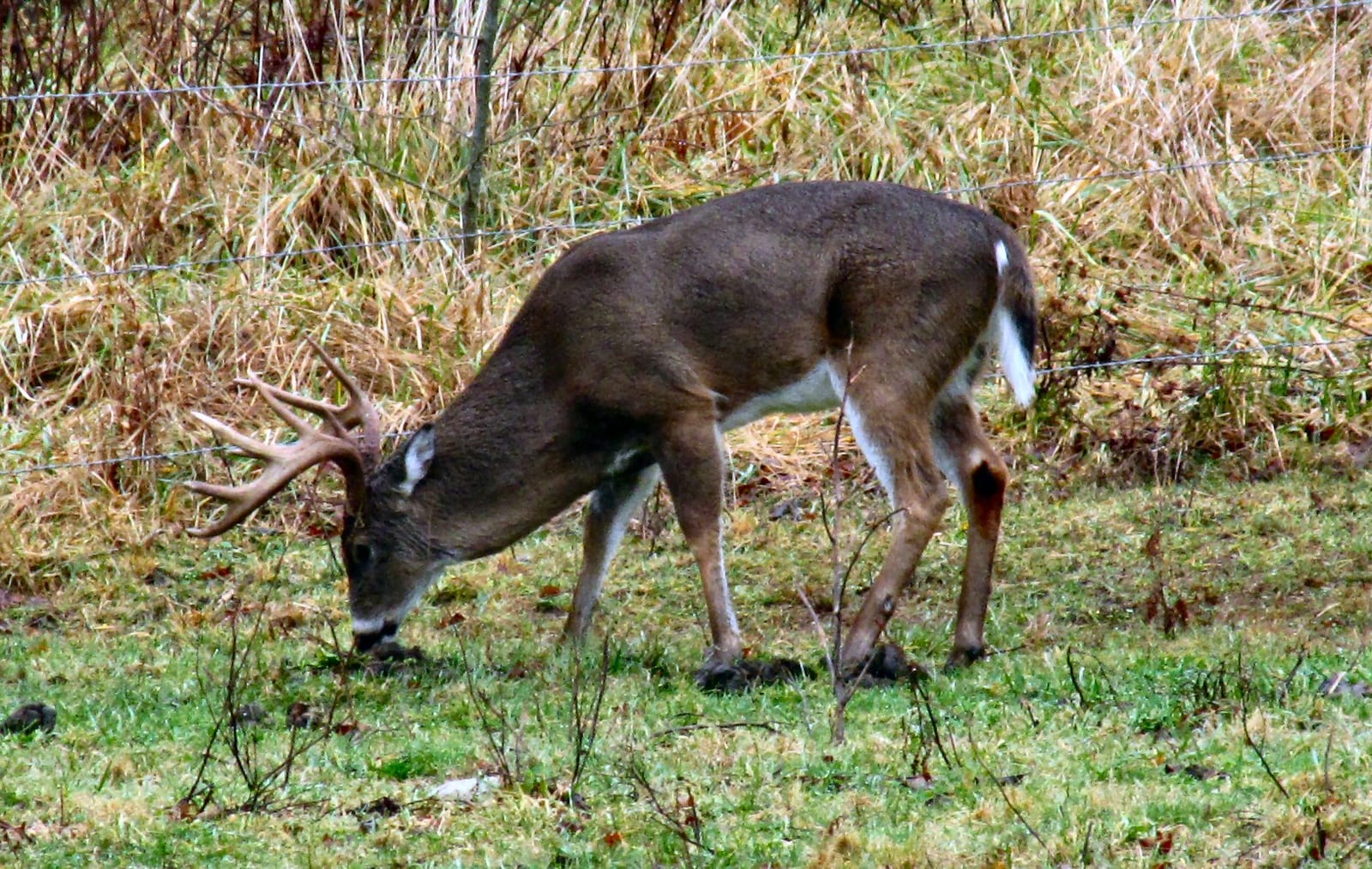
Buck antlers are bone, and a whitetail buck grows them from scratch every year: a brand-new set out of his skull each spring and summer, hardened in time for the rut, dropped in winter (USFWS). How big they grow depends first on his age, then on what he ate, and last on the genes he was dealt (MSU Deer Lab).
Key Takeaways
- Antlers are “branched bones that are shed every year.” Horns, on sheep, goats and bison, are bone covered in keratin and never come off (USFWS).
- Peak growth runs about 3/4 inch a week for yearlings and 1 1/2 inches a week for adult bucks (MSU Deer Lab).
- A buck takes about six years to reach maximum antler size. His first rack is only 10 to 25 percent of what he can eventually grow (MSU Deer Lab).
- In a penned study, bucks fed 16 percent protein scored 20 inches higher in Boone and Crockett score at age four than bucks fed 8 percent (MSU Extension).
- Does with antlers happen, but rarely. Estimates run from 1 in 65 to 1 in 4,437 depending on region (Missouri Dept. of Conservation) to about 1 in 10,000 (Iowa DNR).
Are buck antlers bone or horn?
Bone, every time. The U.S. Fish and Wildlife Service puts it plainly: deer, elk, moose and caribou grow antlers, which are branched bones shed and regrown each year. Cattle, sheep, goats and bison grow horns, which are a bony core wrapped in keratin, the same stuff as your fingernails, and they keep them for life (USFWS). Iowa DNR adds a detail worth remembering at camp: antlers grow from the tips, horns grow from the base (Iowa DNR).
Inside, a hardened antler is a shell of dense compact bone around a spongy core that “makes up about half the diameter of an average antler” (MSU Deer Lab). That’s why a big rack is lighter than it looks. USFWS puts a whitetail’s set at 3 to 9 pounds.
How does the antler growth cycle work through the year?
The cycle starts with a wound. When a buck casts last year’s antlers, the top of each pedicle, the bony stub on his skull, is literally an open sore. Skin closes over it within two to three weeks, and the new antler starts growing almost immediately after (MSU Deer Lab). Longer daylight and rising testosterone are the triggers (USFWS).
From there it’s what USFWS calls “the fastest bone growth in the world”: 3/4 inch per week for yearlings and 1 1/2 inches per week for adults at peak (MSU), or about a quarter inch a day (USFWS). Growth starts as cartilage, which mineralizes into bone from the inside out. By late summer the lengthening slows while the rack finishes hardening.
What is velvet and why do bucks rub it off?
Velvet is living skin, with blood vessels running through it to feed the growing bone underneath. The antler takes so much calcium that a buck on poor ground can lose bone density elsewhere in his skeleton while he builds it (USFWS).
Around the fall equinox the blood supply to the velvet shuts off and it dies (MSU Deer Lab). A buck can thrash the whole mess off on a sapling “in as little as 24 hours.” Most of that happens from late August into early September (NDA). If you’ve ever found a bloody, shredded bush in early September, now you know who did it.
When do the antlers fall off?
After the rut, shortening days drop a buck’s testosterone. Cells called osteoclasts de-mineralize the bone along a line at the base, and the weight of the antler does the rest (MSU Deer Lab). Timing, why one side drops first, and what the pedicle looks like afterward are on How do deer shed their antlers?.
What decides how big a buck’s antlers get?
Every deer camp argument about this ends up in the same place. Here’s how the research ranks age, groceries and genes.
Age comes first
A buck’s rack at 1 1/2 is 10 to 25 percent of what he can eventually grow. It roughly doubles by two, reaches about three-quarters of his potential by three, and tops out around six (MSU Deer Lab). USFWS puts a whitetail’s prime at ages 4 to 6, with older bucks past their prime growing smaller, less dense racks. MSU’s conclusion is blunt: “Protecting young bucks is the most effective single method to improve antler size in most deer management situations.”
Nutrition comes second, and it’s the one you can change
The classic penned study fed one group of bucks 16 percent protein and another 8 percent. Yearlings on the high-protein diet grew antlers twice as large, and by age four the 16 percent group scored 20 inches higher in Boone and Crockett score (MSU Extension, Publication 3013). MSU’s working target is an average of 16 percent protein from spring through summer, with weaned buck fawns needing up to 20 percent (MSU Deer Lab).
Then there’s the Mississippi soil study. Wild bucks from the fertile Delta averaged 41 pounds heavier and 25 inches more antler at age three than bucks from the poor-soil Lower Coastal Plain. Researchers raised fawns from both regions in pens on the same diet, and after two generations the Coastal Plain bucks matched Delta body weights and had gained 28 inches of antler, a 32 percent jump (MSU Extension; Virginia DWR). The “little deer” region wasn’t genetically doomed. It was underfed, and so were its mothers.
Genetics comes third
Genes set the ceiling, but in a wild herd you can’t manage them. MSU found only two studies that even measured heritability of antler traits, one of them its own, and concluded “we cannot impact genetic characteristics of free-ranging populations of deer” (MSU Deer Lab). The Extension publication’s first take-home message is literally “Stop worrying about genetics!” Which raises a fair question for your own lease: is the problem your deer, or your dirt?
What are the points on a buck’s antlers called?
Measurers use the Boone and Crockett letter system. G-1 is the brow tine, the first point up from the base. G-2, G-3 and so on are the normal points along the top of the main beam, usually three to seven of them. F is the main beam itself, measured to its tip. H marks the circumference measurements between points. A projection has to be at least one inch long, and longer than it is wide, to count as a point at all (Boone and Crockett).
Whitetails are described by total points, both sides added, which is why an 8-pointer isn’t a 4x4 like an elk. Eight points is the most common configuration, usually on 3- or 4-year-old bucks (USFWS). Drop tines and kickers are abnormal points, and enough of them make a rack non-typical. How the tape turns all of that into a number is on How are deer scored?.
Do does ever grow antlers?
Yes, and when it happens it’s usually a hormone story. The Missouri Department of Conservation says antlers on a doe come from “higher-than-normal testosterone levels,” and that the result is usually small, poorly formed and still in velvet when hunting season arrives. Its estimate of how often it happens is wide, 1 in 65 to 1 in 4,437 does depending on region (MDC). Iowa DNR uses about 1 in 10,000 (Iowa DNR).
Some “antlered does” with hard, polished racks aren’t does at all. The National Deer Association separates true antlered does, which can breed and raise fawns, from hermaphrodites and from cryptorchid bucks, males whose testicles never descended and who stay in velvet year-round (NDA). Telling them apart sometimes takes a biologist and a knife. The only deer where females grow antlers as a rule is caribou (USFWS).
Can you tell a buck’s age by his antlers?
Not reliably. USFWS says antlers reflect health and condition, not age, with one exception: yearlings usually grow spikes or small forks instead of a branched frame (USFWS). A 2 1/2-year-old on great ground can out-rack a 5 1/2-year-old on bad ground. Mississippi State Extension notes that many mature bucks never grow past 8 points or a 16-inch inside spread (MSU Extension aging guide). At the young end, MU Extension says buck fawns show visible buttons by about 4 to 5 months, and the first real rack comes the next summer as a yearling (MU Extension G9486). Body shape, neck, belly and face tell you more. We cover that on How to age a buck on the hoof.
Can you keep or sell shed buck antlers you find?
It depends where you’re standing. USFWS notes that shed hunting is illegal in many places (USFWS), and rules change by state and by who owns the ground. Before you pocket a shed on anything that isn’t yours, check the state wildlife agency. Our shed hunting page goes deeper.
Related reading on RAD:
The other side of it
All of this treats buck antlers like a report card, and there’s a decent argument that’s the wrong way to look at a deer. Antlers tell you about last summer’s groceries and the buck’s birthday, not whether he’s the one that keeps giving you the slip, and a herd managed strictly for inches can leave a lot of hunters passing deer they’d have been proud of twenty years ago. The age-first research also assumes bucks live long enough to get old, which on pressured ground is a bigger ask than any food plot. Still, it’s hard to take the “genetics” guy seriously when his fix for small racks is shooting every spike he sees and his fix for the soil is nothing.
Keep reading
Latest deer news
Sources
- Eight points about antlers | U.S. Fish & Wildlife Service
- Antler Growth Cycle | Deer Ecology & Management Lab | Mississippi State University
- Nutrition & Genetics | Deer Ecology & Management Lab | Mississippi State University
- The Role of Genetics and Nutrition in Deer Management
- Antlered female deer crop up in Missouri’s deer harverst | Missouri Department of Conservation
- 7 things you may not know about deer antlers | Department of Natural Resources
- NDA (deerassociation.com)
- Genetics vs Nutrition: What Research Shows | Virginia DWR
- Tips on Scoring a Whitetail Deer | Boone and Crockett Club
- NDA (deerassociation.com)
- Hunter’s Guide to Aging and Judging Live White-Tailed Deer in the Southeast | Mississippi State University Extension Service
- Antler Development in White-tailed Deer: Implications for Management | MU Extension
Comments