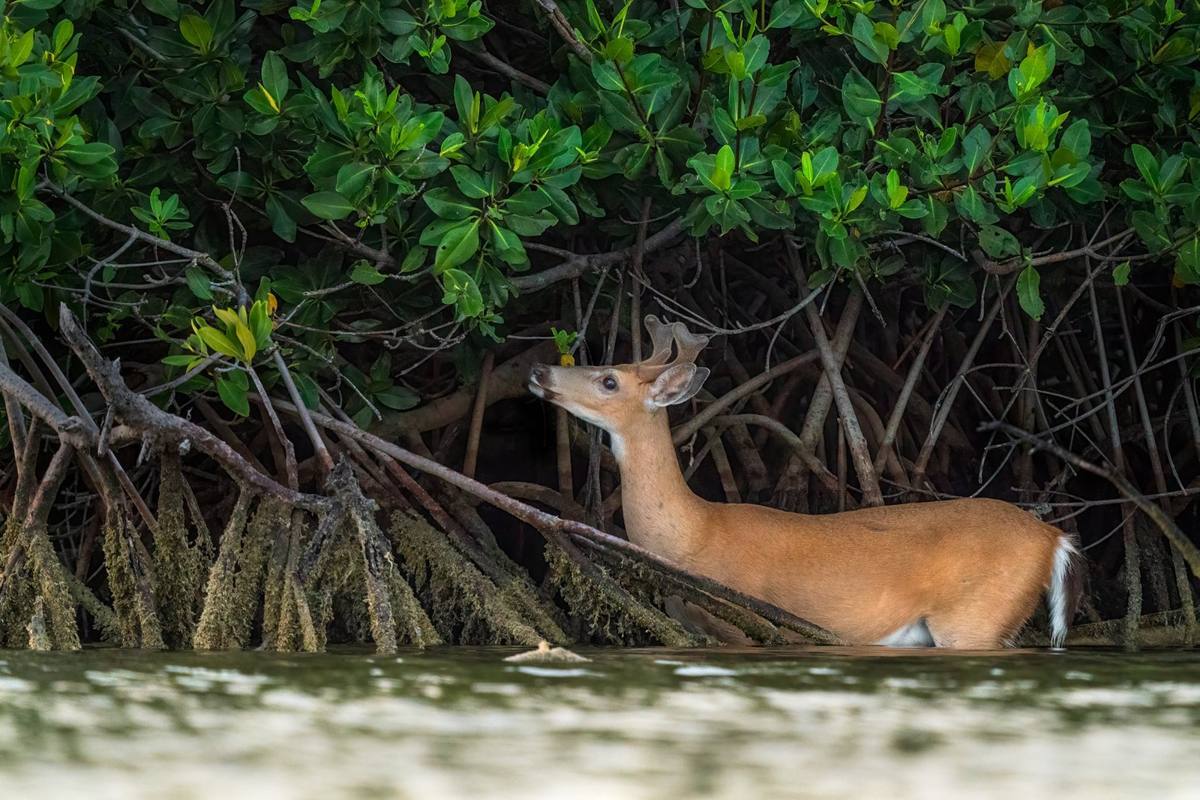
Are whitetail deer endangered? No. The white-tailed deer as a species is not endangered. Animal Diversity Web, the University of Michigan Museum of Zoology’s species database, says “Whitetail deer are extremely common throughout their ranges and are the most numerous of the large North American mammals,” and lists the species’ U.S. federal status as “No special status” (Animal Diversity Web). But two subspecies have a different story. The tiny Key deer of the Florida Keys is federally endangered. The Columbia River population of the Columbian white-tailed deer is listed as threatened, though federal biologists have recommended removing it from the list.
Key Takeaways
- White-tailed deer as a species: common across its range, with no special status on the U.S. federal list, per Animal Diversity Web.
- Key deer (Florida Keys): federally endangered since 1967.
- Columbian white-tailed deer, Columbia River population: federally threatened, with delisting recommended.
- Whitetails were once nearly wiped out in parts of their range and came back through conservation.
Are whitetail deer endangered anywhere?
The species as a whole is not. The U.S. Forest Service’s Fire Effects Information System review of white-tailed deer covers the species as a whole and names only two exceptions: “Key deer and the Columbian white-tailed deer, which due to their past or present status as federally listed endangered species in all or parts of their ranges” get treated separately (USDA Forest Service FEIS). Its federal status section lists those two and no others. The species is hunted legally across much of the United States under state rules. For an example, see our deer hunting license guide.
Endangered status in the US is set under the federal Endangered Species Act, and it can apply to a subspecies or a distinct population, not just a whole species. That is how two kinds of white-tailed deer ended up on the federal list.
The Key deer: endangered
The Key deer (Odocoileus virginianus clavium) lives only in the Florida Keys. The Florida Fish and Wildlife Conservation Commission lists its “Federal Status: Endangered” and says “Key deer numbers fell to less than 50 in the 1940s” (FWC).
The U.S. Fish and Wildlife Service explains what happened: “Over-hunting caused declines in the Key deer population until hunting of this species was banned in the 1950s.” It adds, “Establishment of the National Key Deer Refuge in 1957 and the subsequent listing of the deer as endangered in 1967 has allowed for protection and a dramatic improvement of the species overall population” (USFWS).
Today, FWC says “The current Key deer population is estimated to be 700 to 800 deer, with the greatest concentrations on Big Pine Key and No Name Key.” It adds, “While its population is considered stable for now, the Key deer remains listed as a federally endangered species.” FWC also warns that “Illegal feeding also causes a concentration of Key deer populations, facilitating the spread of parasites and disease.” For hunting the rest of Florida’s deer, see our deer hunting in Florida page.
The Columbian white-tailed deer: threatened
The Columbian white-tailed deer (Odocoileus virginianus leucurus) lives in Oregon and Washington. USFWS says “By the 1940s, their numbers were reduced to fewer than 1,000 individuals due to habitat loss and human development,” and “the deer were among the first species listed under the Endangered Species Act” (USFWS).
Two populations took different paths. Per USFWS, “one population in Douglas County, Oregon, met its recovery goals and was removed from the list in 2003, the Columbia River population remained listed as endangered until it was reclassified as threatened in 2016.”
In September 2025, USFWS said a five-year review found the Columbia River population “has met the criteria outlined in its recovery plan” and that “the Service is recommending the deer be removed from the federal Endangered Species List.” It stressed that “This recommendation is not a final decision, and the subspecies remains federally listed for now.” The agency’s July 2026 workplan lists the Columbia River population as threatened, with a proposed delisting (“PDEL”) slated for fiscal year 2026 (USFWS workplan). USFWS also notes that “the deer remain listed as threatened in Washington State.”
Were whitetails ever close to disappearing?
In many places, yes. Oklahoma’s wildlife department gives a short timeline for its state. Deer were abundant in the 1870s and heavily over-harvested by settlers in the 1890s. By the 1910s, “barely 500 remain and deer seasons close.” Restoration began in the 1930s, and by the 1980s the agency describes a “stable and abundant statewide herd restored” (ODWC). It calls the deer’s comeback “remarkable considering its near extinction at the turn of the century.” The Key deer and Columbian deer stories above follow the same arc on a smaller scale: heavy losses, protection, then recovery. See our Oklahoma page for the state today.
FAQ
Are white-tailed deer endangered or threatened? No. The species has no special federal status, per Animal Diversity Web. Only the Key deer (endangered) and the Columbia River population of Columbian white-tailed deer (threatened) are federally listed.
Is it legal to hunt Key deer? No. USFWS says hunting Key deer was banned in the 1950s, and the deer is federally endangered.
Why is the Key deer endangered? USFWS blames over-hunting. FWC says numbers fell to fewer than 50 by the 1940s and puts the population at 700 to 800 today.
Are Columbian white-tailed deer still threatened? The Columbia River population was still listed as of the July 2026 USFWS workplan. Check USFWS for any final delisting rule.
The other side of it
Listing status changes. The Columbia River population could be delisted, and status listings for the species as a whole can be reassessed. Federal and state listings are set by rule, so check USFWS and your state wildlife agency for current status before relying on this page. Some readers point to deer collisions and suburban herds as proof that whitetails are overabundant everywhere, but the Key deer shows a whitetail can still be one of the rarest animals in its range. Abundance in your backyard says little about a deer on Big Pine Key.
Keep reading
Latest deer news
Sources
- "Odocoileus virginianus (white-tailed deer)", Animal Diversity Web, University of Michigan Museum of Zoology (Tanya Dewey)
- "Species: Odocoileus virginianus (Fire Effects Information System)", USDA Forest Service, Fire Effects Information System
- "Key Deer (Odocoileus virginianus clavium)", U.S. Fish and Wildlife Service
- Key Deer, Florida Fish and Wildlife Conservation Commission
- "Columbian White-tailed Deer: A Conservation Comeback in the Pacific Northwest", U.S. Fish and Wildlife Service (Sep 9, 2025)
- "National Workplan to Address Downlisting and Delisting Recommendations: Fiscal Year 2026-2028 (July 2026)", U.S. Fish and Wildlife Service
- White-tailed Deer (field guide), Oklahoma Department of Wildlife Conservation
Comments