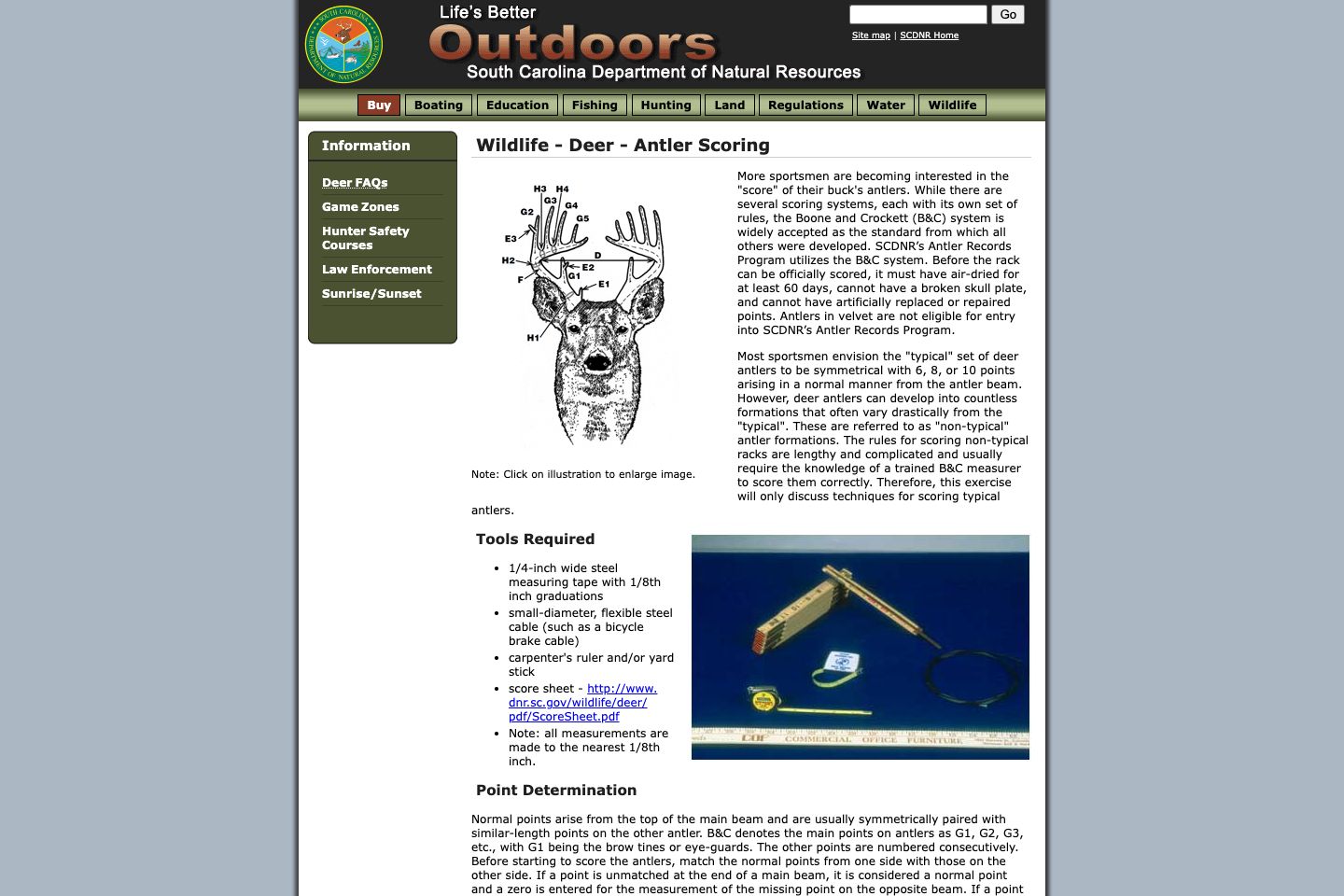
To score a deer, you measure each antler with a quarter-inch steel tape to the nearest eighth of an inch, in the order printed on the Boone and Crockett typical whitetail chart: inside spread, main beams, every normal point from the brow tine out, then four circumferences per side. Add it up for a gross score, then subtract the side-to-side differences and the abnormal points for a net. Pope and Young uses that same chart, and either way your number stays a green score until a certified measurer signs it.
Key Takeaways
- The B&C typical whitetail chart requires a “1/4-inch wide flexible steel tape to the nearest one-eighth of an inch.” A steel cable is allowed for points and main beams only.
- A projection counts as a point when it’s “at least one inch long, with the length exceeding width at one inch or more of length.” The beam tip counts as a point but isn’t measured as one (B&C chart).
- Chart order: A point count, B tip to tip, C greatest spread, D inside spread, E abnormal points, F main beam, G-1 to G-7 normal points, H-1 to H-4 circumferences. Only D through H figure into the score.
- Gross is inside spread plus both beams plus all G and H figures. Net subtracts the left-right differences and the abnormal points (SCDNR). B&C calls net the final score (B&C policies).
- B&C and P&Y require 60 days of air drying before an official measurement. Buckmasters requires none (Buckmasters).
What do you need to score your deer?
Most of it’s in your garage. South Carolina DNR’s scoring page lists the kit: a quarter-inch steel tape marked in eighths, a small flexible steel cable (a bicycle brake cable works), a carpenter’s ruler or yardstick, and a score sheet. Download the free typical chart from Boone and Crockett or Pope and Young. The instructions are printed on the back.
Add white masking tape for marking baselines (never mark the antler itself) and colored electrical tape to flag the tips of abnormal points, both from B&C’s own measuring tips. Write fractions in eighths without reducing them (6/8, not 3/4). And P&Y’s sheet is blunt that circumferences “must be taken with a steel tape (a cable cannot be used for these measurements).”
What counts as a point when you score a deer?
Settle this before you touch the tape. B&C’s definition: at least one inch long, and longer than it is wide at one inch or more of its length. A nub that’s an inch tall but wider than that at the base is not a point.
So what does “12-point buck” actually mean?
Twelve projections on both antlers combined that pass that test, beam tips included. That’s line A on the chart, and point totals “do not add into the final score.” A 12-pointer with short tines can tape under an 8-pointer with long ones. Point count is a description. Inches are the score.
Which points are normal and which are abnormal?
Normal points come off the top of the main beam, generally in pairs. Abnormal points, per the chart, are “non-typical in location (such as points originating from a point or from bottom or sides of main beam) or extra points beyond the normal pattern of points.” B&C’s tips page adds burr points and anything below the brow tine.
Two calls that trip people up. An unpaired point at the very end of the main beam stays normal, and SCDNR says the opposite side simply gets a zero in that row. But an extra point on top that breaks the left-right pattern is scored as abnormal, what B&C calls a “non-symmetry or unmatched normal point.” For a rack with real junk on it, SCDNR recommends a trained B&C measurer. Which chart you need, and the minimums for each book, is in our systems explainer.
What order do you measure a deer in?
Follow the chart letters.
| Chart line | What you measure | Counts toward score? |
|---|---|---|
| A | Number of points on each antler | No |
| B | Tip-to-tip spread of the main beams | No |
| C | Greatest spread, beams or points, at a right angle to the skull | No |
| D | Inside spread of the main beams at the widest point | Yes, capped at the longer main beam |
| E | Total length of abnormal points | Subtracted (typical chart) |
| F | Main beam length, each side | Yes |
| G-1 to G-7 | Normal point lengths, each side | Yes |
| H-1 to H-4 | Four circumferences, each side | Yes |
How do you measure the spreads?
If the beam tips cross, B&C says record center to center, not zero. Inside spread is taken at a right angle to the skull’s center line at the widest point between the beams. Then the cap: it goes in as spread credit only if it’s less than or equal to the longer main beam. Wider than that, and the credit is the beam length, not the spread.
How do you measure the main beam and points?
Main beam (F) runs “from the center of the lowest outside edge of burr over the outer side to the most distant point of the main beam.” Lay the cable along the outside curve and measure the cable.
Each normal point (G) is measured from the top edge of the main beam, over the outer curve, to the tip. The baseline is the whole game. Lay the tape or cable along the top edge of the beam on both sides of the point, as if the point weren’t there, and mark that line with masking tape. Measure from the tip down to it.
Where do the four circumferences go?
Always four per side, “regardless of the number of normal points” (B&C tips). H-1 is the smallest place between the burr and G-1, H-2 between G-1 and G-2, H-3 between G-2 and G-3, H-4 between G-3 and G-4. Two exceptions from the chart: no brow tine means H-1 and H-2 are both taken at the smallest place between the burr and G-2. No G-4 means H-4 is taken halfway between G-3 and the beam tip. B&C adds that an abnormal point can’t serve as a divider, and that halfway spot stands even if a kicker sits right on it.
How do you add it up for a gross and a net score?
The chart has three columns: right antler, left antler, difference. Every paired row (F, each G, each H) gets a difference entry. Then the math printed at the bottom:
- Add the spread credit, Column 1 and Column 2. That subtotal is your gross score.
- Add the abnormal-point total (E) to the Column 3 differences. That’s the deduction.
- Gross minus the deduction is the final score, which B&C treats as the net.
SCDNR’s walkthrough says the same thing. Every eighth of an inch one G-2 is longer than the other comes off at the end, and that’s why a lopsided buck “shrinks.”
How long does it take to score a deer?
The taping is quick. The waiting isn’t. The B&C chart says “official measurements cannot be taken until the antlers have air dried at a habitable room temperature for at least 60 days after the animal was killed.” Freeze the head or boil the skull and the clock restarts the day it comes out (B&C policies). P&Y’s sheet carries the same 60-day rule, and B&C flatly calls anything taped before that “not official.” Don’t get cute during the wait, either. B&C lists wedging a board or “Rack Jack” between the antlers to fight shrinkage as grounds for automatic disqualification.
After 60 days, find one through B&C’s Official Measurer locator. For a book entry, both clubs also want the original signed chart, photos of the rack from the front and each side, a $40 fee and an affidavit (B&C chart; P&Y sheet). What’s the biggest rack you’ve let sit two months without touching a tape to it? Be honest.
How is scoring a deer different under Buckmasters (BTR)?
Same antler, different arithmetic. Buckmasters says its Full-Credit system “simply measures every inch of antler and classifies it accordingly” (Buckmasters). In practice:
- No difference column. Buckmasters “does not deduct differences between lengths of opposing typical points or circumferences,” and an unmatched typical point is kept.
- One number. Since 2025 there is “one Buckmasters score which consists of the total inches of antler grown, plus the inside spread.” Founder Russell Thornberry had left spread out because he “believed measuring inside spread meant counting air, not antler,” per Buckmasters President Jackie Bushman (Buckmasters news).
- Classification by math. You “measure the rack, add the inside spread, and use the percentage of irregular inches to determine classification” as Perfect, Regular, Semi-Irregular or Irregular. We couldn’t fetch the exact percentage cutoffs from a Buckmasters page, so we’re not printing them.
- No drying period. “No drying time is required before antlers can be measured,” and velvet racks are scored as they are.
It only becomes an entry when a certified BTR scorer does it, and a BTR number is never a B&C number.
Related reading on RAD:
- How are deer scored? B&C, Pope and Young and BTR explained
- Buck antlers: what every part is called
- What fair chase means for a record-book entry
The other side of it
Fair question: if the only score that counts is the one a certified measurer takes after 60 days, why learn how to score a deer yourself? Your tailgate number will differ from the official one by a few eighths here and there, and a measurer who has handled a thousand racks will make baseline calls you won’t. The guys who refuse to tape their own deer have a point, and they’re usually the same guys who’ve been “about 165” since the day they dragged it out of the woods.
Keep reading
Latest deer news
Sources
- B&C typical whitetail chart (prod10-boone-crockett.s3.amazonaws.com)
- Wildlife - Deer - Antler Scoring | SCDNR - Wildlife Information
- Policies of the B&C Big Game Records Program | Boone and Crockett Club
- Scoring System
- Download B&C Score Chart PDFs | Boone and Crockett Club
- Score Sheets
- Tips on Scoring a Whitetail Deer | Boone and Crockett Club
- Interactive Whitetail Deer Typical Score Sheet
- Official Measurer Locator | Boone and Crockett Club
- Buckmasters Announces Major Changes to Our Scoring System
Comments