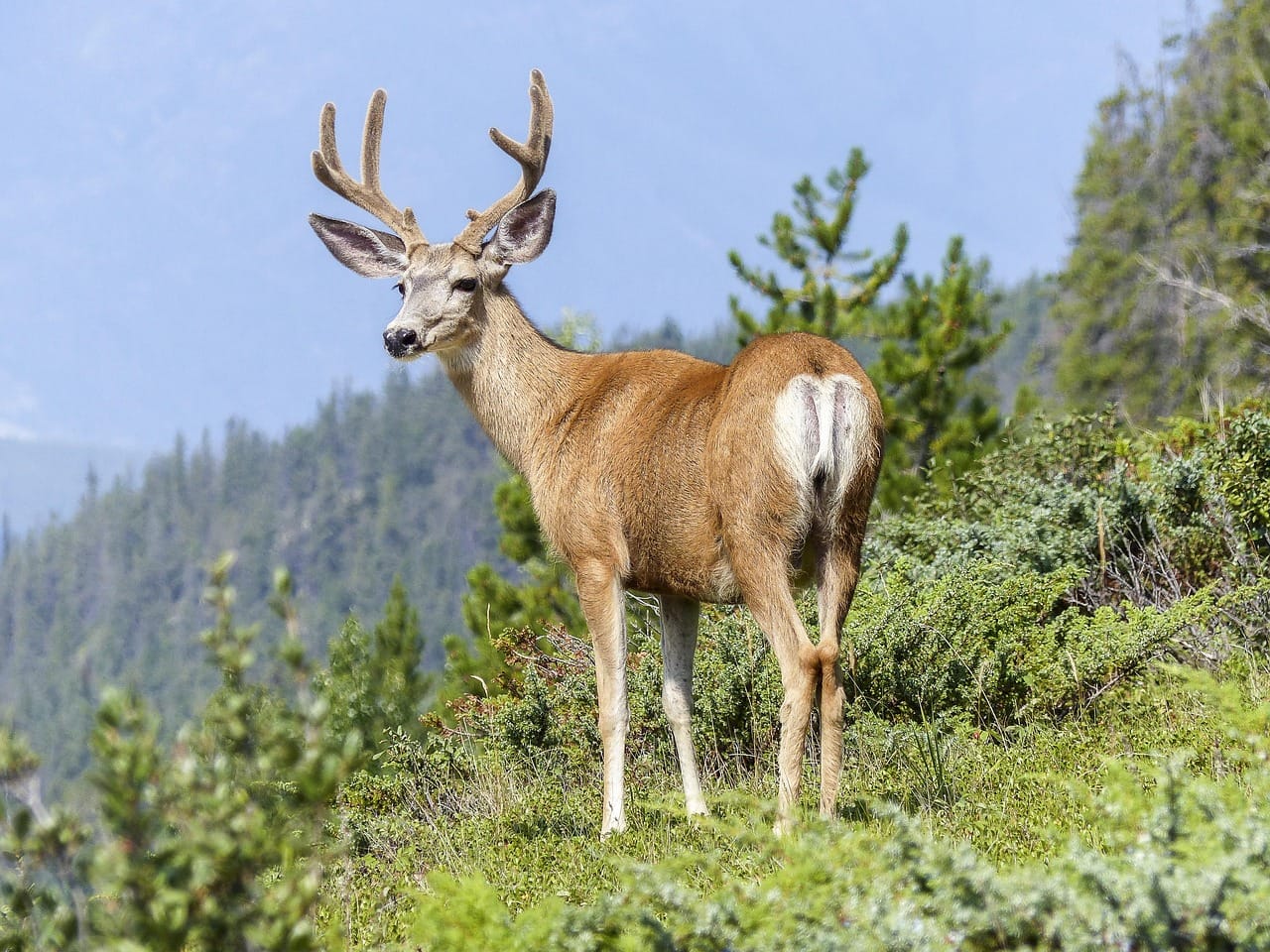
Are mule deer bigger than whitetail deer? As a rule, yes. Texas Parks and Wildlife, the National Park Service and the Alaska Department of Fish and Game all describe mule deer as the larger of the two species. The gap is modest, though, and whitetail size swings so much by region that a heavy northern whitetail buck can outweigh plenty of mule deer.
Key Takeaways
- Agencies agree mule deer are larger on average. Alaska’s wildlife agency calls whitetails “slightly smaller.”
- Alaska lists mule deer bucks at 150 to 250 pounds and does at 110 to 165 pounds.
- In North Dakota’s Theodore Roosevelt National Park, whitetail bucks average 170 pounds and does 130.
- Whitetail size varies hugely by region, from about 60-pound Key deer bucks to 300-pound Minnesota bucks.
- Size alone is a poor way to tell them apart. Use ears, tail and antlers.
Are mule deer bigger than whitetail deer? What the agencies say
Texas Parks and Wildlife says flatly that “Mule deer are larger in body size than white-tailed deer” (TPWD). The National Park Service at Rocky Mountain National Park agrees: “Compared to its cousin, the white-tailed deer, mule deer are larger in size” (NPS, Rocky Mountain). At Theodore Roosevelt National Park in North Dakota, the park lists “their larger body size” among the traits that separate mule deer from whitetails (NPS, Theodore Roosevelt).
Alaska’s Department of Fish and Game puts the difference in perspective: “White-tailed deer are slightly smaller than mule deer, but larger than Sitka black-tailed deer” (ADF&G). Slightly is the key word.
The numbers
Weight ranges vary by source and region, so treat these as rough guides, not a head-to-head measurement.
Mule deer. Alaska’s agency lists mule deer “Does: 110-165 lbs Bucks: 150-250 lbs.” The Park Service at Rocky Mountain says mule deer “can be three feet tall at the shoulder and weigh anywhere between 100 and 300 pounds.”
Whitetails. Theodore Roosevelt National Park, where both species live, says whitetails are “medium-sized mammals, with males, known as bucks, averaging 170 pounds, while females, known as does, are slightly smaller, averaging 130 pounds.”
Put together, a typical mule deer buck likely carries more weight than a typical whitetail buck in the same region, but the ranges overlap a lot. We could not find a single official source that weighed both species in the same place with the same methods, so we won’t claim a precise gap.
Why whitetail size makes the answer messy
Whitetails live in very different climates, from Minnesota to the Florida Keys, and their size changes with it. The National Deer Association explains this with Bergmann’s Rule: “within a species, or group of similar species, body size increases with latitude from south to north” (National Deer Association). It gives the extremes: “Florida Key Deer where a mature buck may weigh 60 pounds and a similar buck in Minnesota may weigh 300 pounds.”
The U.S. Fish and Wildlife Service calls the Key deer “The smallest race of North American deer,” with adults that “measure 25 to 30 inches at the shoulder and have an average weight of 55 to 75 pounds for males and 45 to 65 pounds for females” (USFWS).
So a 300-pound Minnesota whitetail would top the upper end of Alaska’s mule deer buck range. Latitude isn’t the whole story. Looking at antlers, the NDA found that “deer habitat (in this case soil quality and food) can have a bigger impact” than latitude alone. Either way, “whitetail” covers a very wide range of animals.
Same genus, different builds
Both deer belong to the genus Odocoileus. Mule deer are Odocoileus hemionus, and whitetails are Odocoileus virginianus. The Park Service says mule deer, “while closely related to white-tailed deer, are remarkably distinct in their biological, ecological, and behavioral attributes,” and that they “evolved in the dry, rugged badlands and mountains of the west.”
Their movement differs too. A startled mule deer moves “in a series of stiff-legged jumps with all four feet hitting the ground together,” a gait called stotting. The Park Service contrasts it with “the leisurely, graceful leaps of white-tail.”
How to tell them apart without a scale
Since weights overlap, field marks are more useful than size:
- Ears. Mule deer are named for their big, mule-like ears.
- Tail. TRNP says “A mule deer’s tail is thin and black-tipped, unlike the bushy white tail of its cousin.” Whitetails raise their tail “in a distinctive flag-like motion when they are alarmed.”
- Antlers. On whitetails, “tines all protrude in straight, vertical lines from the main beam, while the second tine on a mule-deer antler splits into a distinct” Y shape.
- Metatarsal gland. TPWD notes mule deer have an “8-12 cm metatarsal gland located above the midpoint of the shank.”
Where the two species overlap, hybrids happen. See identifying whitetail vs. mule deer hybrids in overlap zones. For more on how bucks gain and lose weight through the year, see bucks losing weight in the rut.
FAQ
Are mule deer bigger than whitetail deer? On average, yes. Texas Parks and Wildlife, the National Park Service and Alaska’s wildlife agency all describe mule deer as larger.
How much do mule deer weigh? Alaska lists bucks at 150 to 250 pounds and does at 110 to 165. The Park Service gives a range of 100 to 300 pounds.
How much do whitetails weigh? It depends on where they live. Bucks average 170 pounds in North Dakota’s Theodore Roosevelt National Park, Key deer bucks weigh 55 to 75 pounds, and NDA says a Minnesota buck may hit 300.
Can a whitetail be bigger than a mule deer? Yes. A large northern whitetail can outweigh a smaller mule deer.
The other side of it
Some hunters argue the question doesn’t have a real answer, because “bigger” depends on which whitetail and which mule deer you compare. A Minnesota farm-country buck and a desert mule deer in a drought year are hardly a fair test. That’s fair: the agencies are describing averages, not every animal. Still, every official source we checked put mule deer on the larger side. And the hunter who swears his 300-pound whitetail would beat any muley out West has usually done his weighing with a tape measure, a bathroom scale and a lot of optimism.
Keep reading
North Dakota's biggest bucks in the record book →
Latest deer news
Sources
- Cross Timbers Habitat: Big Game, Texas Parks and Wildlife Department
- Mule Deer - Rocky Mountain National Park, U.S. National Park Service
- Mule Deer - Theodore Roosevelt National Park, U.S. National Park Service
- Mule Deer Species Profile, Alaska Department of Fish and Game
- Mapping Antler Expectations, National Deer Association
- Key Deer (Odocoileus virginianus clavium), U.S. Fish and Wildlife Service
Comments