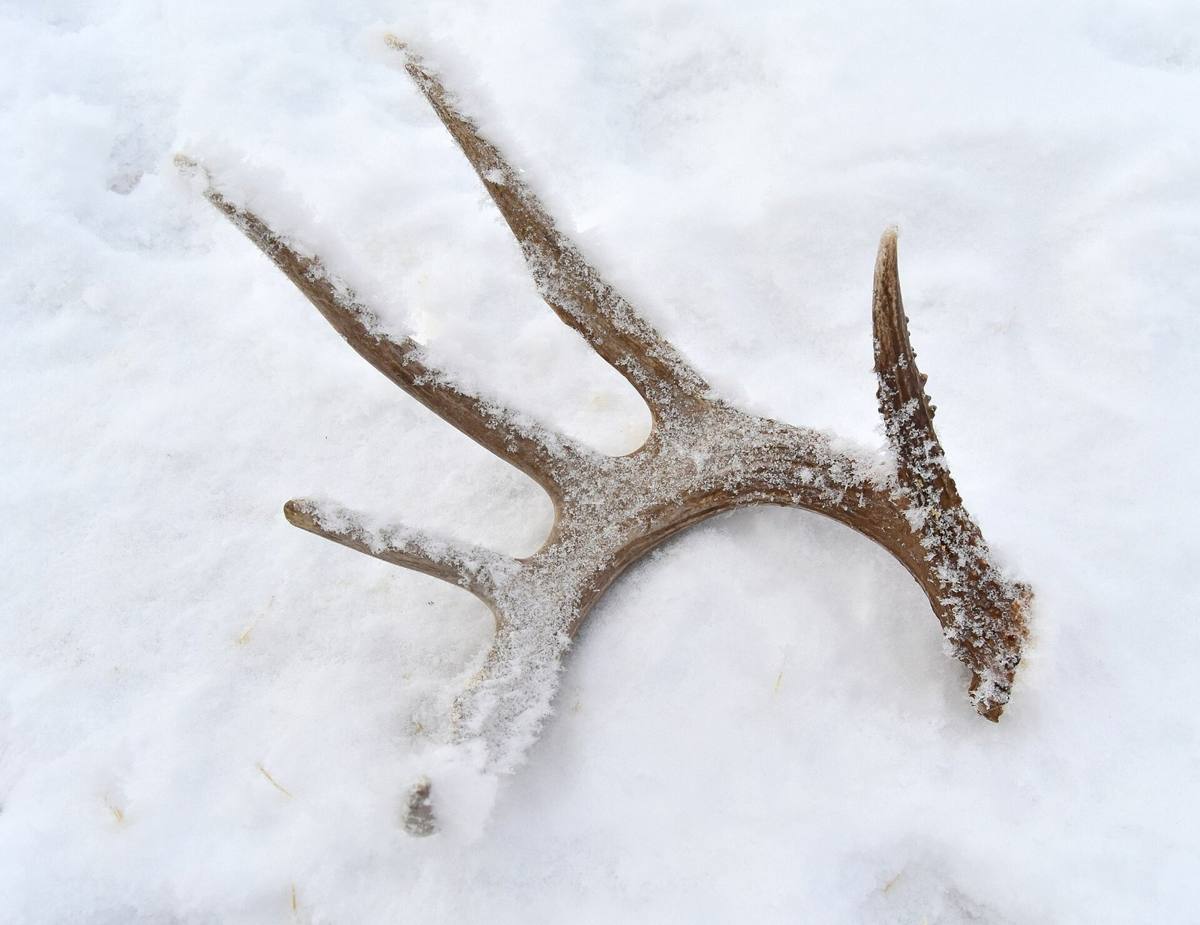
Deer shed their antlers when testosterone falls after the rut and bone-dissolving cells eat away the joint where the antler meets the skull. Once that joint is weak enough, the antler’s own weight does the rest and it drops off. Across most whitetail country that happens from January into March, earlier for bucks that are hurt or run down. Within days to a few weeks, the next set has already started growing.
Key Takeaways
- The trigger is hormonal. Shorter days lower a buck’s testosterone, and that drop “causes the connection between the antler and the skull to weaken” (USFWS).
- The mechanism is bone removal. Cells called osteoclasts “de-mineralize the bone along an abscission line where the pedicle meets the antler” (MSU Deer Lab).
- Timing runs by region. January to March in the Southeast (Alabama Extension), mid-January to mid-March in Iowa (Iowa DNR).
- Condition moves the date. “Bucks in good physical condition generally retain their antlers longer than those who are nutritionally stressed” (NDA).
- Regrowth starts fast. “New antler growth begins within days of shedding the old set,” per the National Deer Association (NDA).
Why do deer shed their antlers at all?
Because the hormone holding them on goes away. Per the National Deer Association, a buck’s testosterone starts climbing in July, peaks in late October to early November, and drops through late December. That cycle “is largely governed by photoperiod,” meaning day length (NDA, 2012). Antlers harden on the way up and come loose on the way down.
After the rut, the U.S. Fish and Wildlife Service says, the antlers “have served their purpose and can be discarded” (USFWS).
How do we know it’s daylight and testosterone?
Researchers tested it on captive whitetails. In a 1987 study, extending day length in autumn made adult bucks cast their antlers early and start growing new ones out of season. Giving hard-antlered bucks a drug that blocks testosterone also caused early casting (Bubenik et al., Comparative Biochemistry and Physiology, 1987). Change the light or cut the hormone, and the antlers come off on a new schedule.
The full growth cycle is on our buck antlers guide. This page sticks to the drop.
What actually happens at the base of the antler?
Every antler sits on a pedicle, the bony stub growing out of the skull. When testosterone falls, the NDA says “specialized cells line up at the base of the antler at what’s called the abscission layer” and “begin to dissolve a boundary between skull and antler.” Then, “within a couple of days, the antlers separate” (NDA, 2021).
Mississippi State’s Deer Lab describes the same thing at the bone level. Osteoclasts weaken the junction, and “this weakened attachment combined with the weight of the antler causes it to drop off or be cast.” That’s why the base of a fresh shed feels rough (MSU Deer Lab).
So a buck doesn’t knock his antlers off on a tree. Most of the time they just let go.
Does shedding antlers hurt the deer?
Nobody we read has measured it, so we won’t pretend to know. What MSU does describe is the aftermath: once the antler is cast, “the top of the pedicle can be considered an open wound.” It bleeds for a short time and scabs over (MSU Deer Lab). None of the agency or university sources we checked says whether the buck feels it.
The living, blood-fed part of an antler is the velvet, and MSU says it dies around the autumn equinox. A winter shed has gone months without it.
When do deer shed their antlers where you hunt?
It depends on your latitude, and on your rut.
| Where | When bucks drop | Source |
|---|---|---|
| Southeast | “between January and March” | Alabama Extension |
| Iowa | About two months, mid-January to mid-March. The DNR says around Feb. 20 is the time to start looking. | Iowa DNR |
| Central Platte River valley, Nebraska | Average casting “more than one month later than previously recorded in this region”; one buck still had antlers in April 2020 | Peterson et al., 2021 |
Age plays into it differently by region. The NDA says “in the North mature bucks cast their antlers earlier than young bucks,” and in the South they cast them later (NDA, 2018). Southern and Midwestern bucks often hold on longer. The NDA ties that to skewed sex ratios, late ruts and doe fawns breeding, and notes that unbred does can keep a buck’s testosterone up (NDA, 2012).
So the calendar isn’t fixed. Has your trail camera shown the first bald buck earlier or later than it did ten years ago?
Why do some bucks drop their antlers early?
The NDA’s 2018 shorthand is blunt: “a December or early January shed is nearly always a sign of trouble” (NDA, 2018). Its list of causes is short, and most of it comes back to testosterone (NDA, 2012).
Poor nutrition or too many deer
Run-down bucks drop sooner. If many bucks across several square miles cast early, the NDA points to “nutritional stress, physical exhaustion from the rut, or a combination of the two.” That can mean more deer than the habitat can carry.
Injury
The testes make most of a buck’s testosterone, so an injury there can drop it. Body injuries can too. “Depending on the severity of the injury, they may cast them earlier than they normally would have.” One early shed on its own more likely points to a hurt buck than a hungry herd.
A hard rut
In the North, dominant bucks often drop first, which the NDA ties to skipped meals and hard rutting.
What keeps antlers on longer?
Fighting, for one. “Frequent fighting can prolong elevated testosterone levels,” the NDA says. Unbred does do the same thing.
How soon does a new antler start growing?
Almost right away. The NDA says scab-like tissue “closes over the bloody pedicles within about 10 days,” new growth “begins within days,” and “within one month of shedding, a new antler base will begin to swell to noticeable size” (NDA, 2021).
MSU’s timeline runs a little slower. It says the wound covering forms within two to three weeks and antler growth “begins shortly after” (MSU Deer Lab). USFWS splits the difference at “just a few weeks” (USFWS). Either way, a whitetail buck barely gets a break. Moose, MSU notes, wait two to three months.
What happens to an antler once it hits the ground?
Something eats it. Antlers are “high in calcium and phosphorus,” which makes them a target for rodents, and sheds left in the sun bleach out (Alabama Extension). USFWS adds that mice, squirrels and porcupines gnaw on them, and “even bears, foxes, opossums and otters have been known to eat antlers” (USFWS).
That’s also part of why you can’t pick up sheds everywhere. National wildlife refuges and some western states restrict it. The rules, dates and where to look are on our shed hunting guide.
Related reading on RAD:
- What are buck antlers and how do they grow?
- Shed hunting: when, where and what’s legal
- How are deer scored?
- What is a non typical deer?
The other side of it
All of this makes the shed date sound like a health report you can read off the forest floor, and the NDA itself warns that’s a stretch. A shed you find in April or May tells you almost nothing about when it dropped, individual bucks vary a lot, and the Nebraska data shows a whole region’s calendar can slide by a month. So how deer shed their antlers is settled biology, but what one shed says about your herd usually isn’t. That won’t stop the guy who finds a single antler on New Year’s Day from declaring a nutrition crisis at the next co-op meeting.
Keep reading
Latest deer news
Sources
- Eight points about antlers | U.S. Fish & Wildlife Service
- Antler Growth Cycle | Deer Ecology & Management Lab | Mississippi State University
- Hunting Antler Sheds - Alabama Cooperative Extension System
- Go Shed Antler Hunting | Department of Natural Resources
- NDA, 2012 (deerassociation.com)
- NDA, 2021 (deerassociation.com)
- The effect of artificial photoperiodicity and antiandrogen treatment on the antler growth and plasma levels of LH, FSH, testosterone, prolactin and alkaline phosphatase in the male white-tailed dee...
- "Phenology of Antler Casting and Occurrence of Late-Breeding in Nebrask" by Brian C. Peterson, Patrick D. Farrell et al.
- NDA, 2018 (deerassociation.com)
Comments