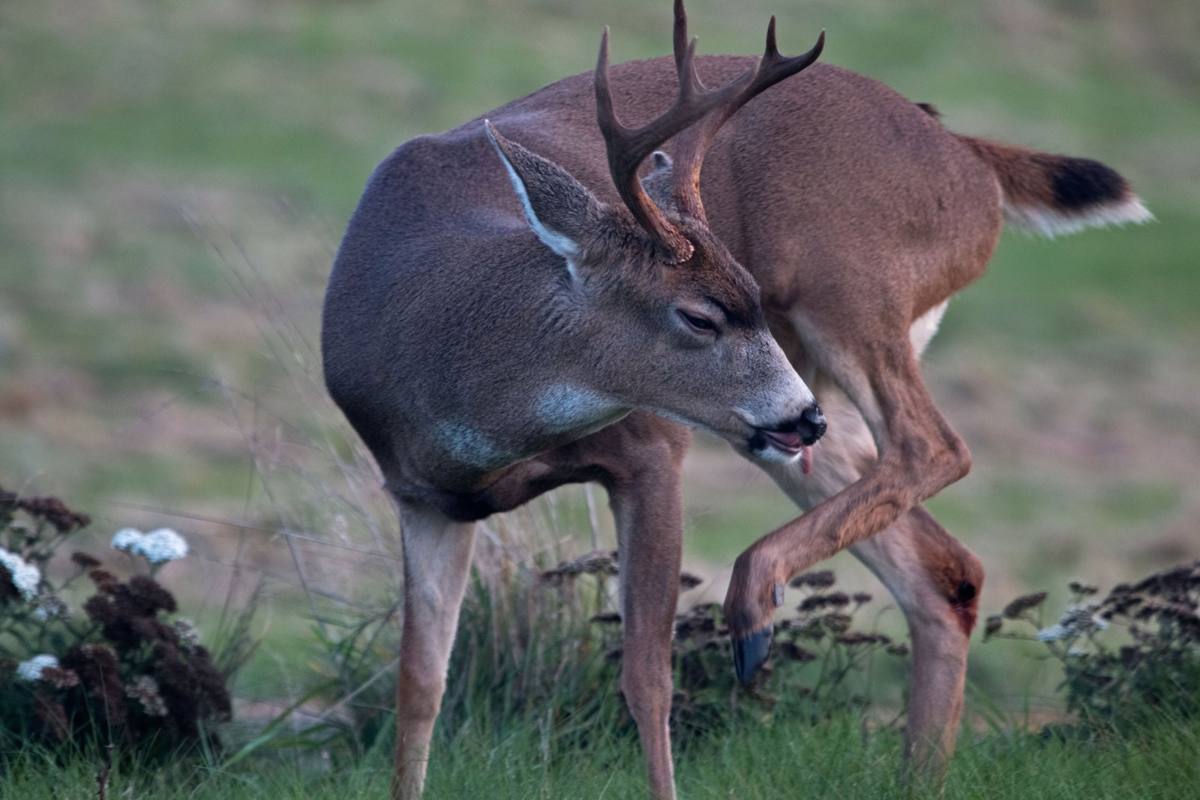
Are there whitetail deer in Alaska? Not in any confirmed way, at least not yet. The Alaska Department of Fish and Game (ADF&G) said in May 2026 that whitetails have “not yet been documented in Alaska,” even as their range pushes closer (ADF&G, May 2026). There have been sightings near the border, and the state already lets hunters take one in certain units. The deer Alaskans actually hunt is the Sitka black-tailed deer.
Key Takeaways
- ADF&G says white-tailed deer have “not yet been documented in Alaska” (May 2026).
- A state biologist said in 2019 that whitetails had been seen near Hyder and reported near Haines.
- Sitka black-tailed deer are the native deer, common in Southeast Alaska, Prince William Sound and Kodiak.
- Since 2019, hunters may take mule and white-tailed deer in Units 1, 5, 11-13, 20 and 25 with no closed season and no bag limit, but must salvage the carcass. ADF&G wants samples.
- The first reported mule deer harvest in Alaska came near Skagway in April 2026.
Are there whitetail deer in Alaska, according to the state?
ADF&G’s position has stayed the same since 2019. In July 2019, writer Riley Woodford reported that whitetails, like mule deer, are “historically non-native species that are now moving into Alaska,” and that the story for whitetails was similar to mule deer, “although they’ve not yet been documented in Alaska” (ADF&G, July 2019). The May 2026 article on the state’s first mule deer harvest repeats the line word for word.
The state’s mule deer species page puts it a little more loosely: “Sightings of mule and white-tailed deer are occasionally reported.” It also says whitetails “are uncommon in Alaska” (ADF&G mule deer profile). Read together, the answer is that people have reported whitetails, but the department hasn’t confirmed one in the state.
Where have whitetails been seen near Alaska?
Along the Southeast border. In the 2019 article, area biologist Roy Churchwell “said white-tailed deer have been seen near the southern-southeast community of Hyder, and in early July, a white-tailed deer was reported by a reputable source near Haines.” His summary: “They are basically within spitting distance of the border.”
The pressure is coming from Canada. ADF&G deer research biologist Dan Eacker said in 2019 that “White-tailed deer have been expanding west for a long time,” adding, “They’ve really spread into western states, and even up into Alberta.” The 2026 article says “In the past century mule deer and white-tailed deer have expanded their ranges north and west in Canada,” and credits “Agriculture, climate change, roadbuilding, and wildlife management practices.”
Mule deer got there first. ADF&G says a hunter took a mule deer near Skagway in mid-April 2026, “the first report of a mule deer harvested anywhere in Alaska.”
What deer are native to Alaska?
The Sitka black-tailed deer. ADF&G says “Sitka black-tailed deer are native to Southeast Alaska, and can also be found in Prince William Sound and on Kodiak Island.” The 2026 article says these deer “colonized coastal Alaska several thousand years ago as the glaciers receded,” and that people later introduced them to “Prince William Sound, Kodiak Island, Yakutat and a few other areas of Alaska with varying degrees of success.” For seasons on the native deer, see our Alaska deer season guide and the Alaska state hub.
How to tell a whitetail from a Sitka blacktail
ADF&G says whitetails “are perhaps best identified by their flag-like white tail that stands straight up when the deer is alarmed.” Their antlers differ, too, “with antler points growing off one main beam.” The Sitka blacktail’s “tail is completely black or dark brown when in lowered position,” and its bucks “have bifurcated antlers; each beam forks.” Size helps: whitetails are “slightly smaller than mule deer, but larger than Sitka black-tailed deer.”
Eacker also pointed to how they run. Mule deer stot, “they bounce straight up in the air on all four legs. You don’t see whitetail deer do that, white-tails gallop more like a horse.”
Can you hunt whitetails in Alaska?
Yes, where you find them. The 2026-2027 regulations page “Deer in Alaska” says the Board of Game “made it possible for hunters to harvest those deer in Units 1, 5, 11-13, 20, and 25. There is no closed season, no harvest ticket/permit required, and no bag limit. Hunters who harvest these deer are required to salvage the entire carcass” (ADF&G regulations, Deer in Alaska).
The point is surveillance. ADF&G said in 2019 that “The primary objective of the new harvest regulations is to provide Fish and Game with tissue samples.” The 2026 article explains the worry: “Deer can carry ticks, parasites and diseases that can have disastrous consequences when introduced to moose, caribou and other animals.” The regulations list the requested samples: “head with brain and skull plate intact, heart with lungs attached, liver, hide, one hoof, pellets (1/4 cup).” You still need a valid license; see Alaska deer hunting license cost.
FAQ
Are there whitetail deer in Alaska? Not confirmed. ADF&G says whitetails have been reported near the border but “not yet been documented in Alaska.”
What kind of deer live in Alaska? Sitka black-tailed deer are native. Mule deer are moving in, and one was harvested near Skagway in 2026.
Is it legal to shoot a whitetail in Alaska? In Units 1, 5, 11-13, 20 and 25, yes, with no closed season or bag limit. You must salvage the carcass, and ADF&G requests samples.
Where are whitetails closest to Alaska? ADF&G biologists pointed to Hyder and Haines in Southeast Alaska, with whitetails spreading west through Canada.
The other side of it
Some hunters argue that with whitetails seen at Hyder and Haines, one has surely crossed the line already and simply gone unreported. That may be true, and it is why ADF&G keeps asking for photos and samples. But a likely crossing is not a documented one, and the state is the one keeping the count. Rules and the deer’s range are both changing. Units, sample lists and the confirmed status of whitetails can change with each regulation year or a single harvested deer. Check the current Alaska hunting regulations and call your area ADF&G office before you hunt. And the hunter who swears his trail camera caught a Hyder whitetail but never sent ADF&G the photo has kept the state’s first record to himself.
Keep reading
Latest deer news
Sources
- Mule Deer Harvested in Alaska (Alaska Fish & Wildlife News, May 2026), Alaska Department of Fish and Game (Riley Woodford)
- New Deer in Alaska (Alaska Fish & Wildlife News, July 2019), Alaska Department of Fish and Game (Riley Woodford)
- Mule Deer Species Profile, Alaska Department of Fish and Game
- Deer in Alaska, 2026-2027 Alaska Hunting Regulations, Alaska Department of Fish and Game
Comments