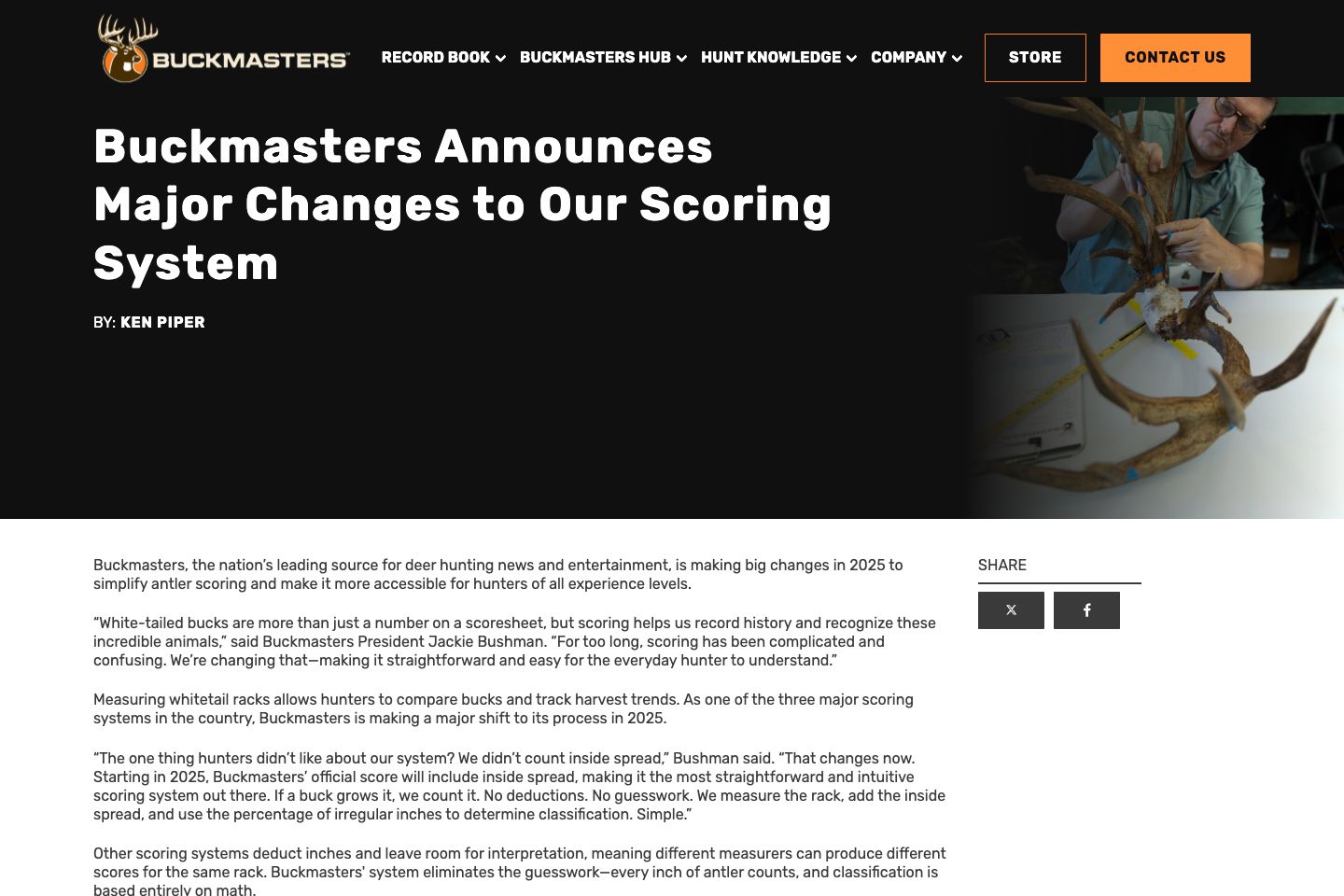
Deer are scored by measuring the antlers in inches: main beam length, every point, four circumference measurements per side and the inside spread, then adding it up. The big three systems handle that total differently. Boone and Crockett and Pope and Young subtract for side-to-side differences, while Buckmasters (BTR) counts every inch with no deductions. That’s why the same buck can carry two very different numbers, and why RAD always names the scoring system next to any score we publish.
Key Takeaways
- Boone and Crockett (B&C) and Pope and Young (P&Y) use the same measuring system. P&Y lists its minimums “using the Boone & Crockett / Pope & Young scoring system” (P&Y).
- In B&C/P&Y, the net score is the final score. Gross score is the frame before symmetry deductions, plus abnormal points, plus inside spread (B&C policies).
- B&C and P&Y require a 60-day drying period before official measurement (B&C). Buckmasters requires no drying period (Buckmasters).
- B&C whitetail minimums: typical 160 (Awards) / 170 (All-Time); non-typical 185 / 195 (B&C).
- P&Y whitetail minimums: typical 125; non-typical 145 with at least 10 inches of abnormal points (P&Y).
- Buckmasters (BTR) added inside spread to its official score in 2025. Minimums are 120 for bow kills and 155 for firearm kills and pick-ups (Buckmasters).
What gets measured on a whitetail rack?
Under the B&C system, an official measurer uses a 1/4-inch-wide flexible steel tape and records to the nearest eighth of an inch. A projection has to be at least one inch long, and longer than it is wide, to count as a point. That’s from the B&C typical whitetail score chart instructions.
On each antler, the measurer records:
- Main beam length (F), from the burr along the outside curve to the tip.
- Each normal point (G-1, G-2, G-3 and so on), measured from the top edge of the beam to the tip.
- Four circumferences (H-1 through H-4) at set spots between the points. B&C says there are “always four circumference measurements, regardless of the number of normal points” (B&C tips).
Then there’s the spread. Tip-to-tip spread and greatest spread get recorded, but they don’t add into the score. Inside spread of the main beams does count, as long as it’s no wider than the longer main beam. If it’s wider, the credit is capped at that beam length.
What does a 12-point buck mean?
It means the rack has 12 projections that qualify as points, counting both antlers. Under B&C rules, that’s anything at least one inch long and longer than it is wide (B&C tips). A point count isn’t a score. A 12-pointer with short tines can score lower than a long-tined 8-pointer, because score comes from inches.
What’s the difference between a typical and a non-typical buck?
It comes down to how the system treats abnormal points. B&C defines abnormal points as burr points, points off the sides, bottom or inside top edge of the beam, and anything below the brow tine. An extra point on top that breaks the side-to-side match also counts as abnormal (B&C tips).
In a typical score, abnormal point lengths are subtracted. In a non-typical score, they’re added.
How do Boone and Crockett and Pope and Young score a buck?
Same tape, same chart, different books. B&C takes any legal fair-chase method. P&Y requires the animal to be taken “entirely by the use of a bow and arrow (as defined by Pope & Young),” in compliance with state law and the club’s fair chase rules (P&Y entry requirements).
What is a gross score vs. a net score?
This is where most arguments at the taxidermist’s start.
- Gross score: the typical frame with no symmetry deductions, plus the total of the abnormal points, plus inside spread (B&C).
- Net score: what’s left after you subtract the left-right differences and, for a typical, the abnormal points. B&C and P&Y rank trophies by net, and B&C calls it the final score.
So when your buddy says his buck “grossed 150,” ask him the follow-up nobody wants: what did it net?
How long does it take to score a deer officially?
At least 60 days for B&C and P&Y. A green score is any score taken before the 60-day drying period. B&C is blunt about it: green scores “are not official scores” (B&C policies). If the antlers were frozen or boiled, the 60-day clock starts when they come out. And anything that messes with natural shrinkage, like wedging a board between the beams, is grounds for automatic disqualification.
Is a 150-inch buck good?
By record-book standards, it’s a Pope and Young buck but not a Boone and Crockett buck. A typical whitetail netting 150 clears P&Y’s 125-inch minimum and falls 10 inches short of B&C’s 160-inch Awards minimum. Here are the minimums:
| Record book | Typical whitetail | Non-typical whitetail | Source |
|---|---|---|---|
| Boone and Crockett, Awards | 160 | 185 | B&C |
| Boone and Crockett, All-Time | 170 | 195 | B&C |
| Pope and Young | 125 | 145 (10 in. abnormal min.) | P&Y |
| Buckmasters (BTR) | 120 bow / 155 firearm & pick-up (no typical/non-typical split) | Buckmasters |
Two notes. B&C publishes its Awards book every three years and its All-Time book every six (B&C FAQ). And P&Y dropped its non-typical whitetail minimum from 155 to 145, effective January 1, 2025, retroactively (P&Y announcement). If you’ve got an old non-typical that missed by a few inches, it may be worth a phone call.
How does the Buckmasters (BTR) scoring system work?
Buckmasters calls its system the Full-Credit Scoring System. Its pitch is simple: “This Full-Credit Scoring System takes nothing away from the rack” (Buckmasters). Here’s how it differs, straight from Buckmasters:
- No deductions. No penalties for mismatched points or circumferences, and an unmatched typical point isn’t thrown out.
- No gross vs. net. There’s one score: total inches of antler plus inside spread. Spread was added in 2025.
- Four categories instead of two: Perfect, Regular, Semi-Irregular and Irregular, assigned “by simple math.”
- Rankings by weapon: separate categories for centerfire rifle, shotgun, pistol, blackpowder, compound, recurve, longbow and crossbow, plus pick-ups and sheds.
- No drying period, a velvet category and a high-fence category. High-fence bucks must come from at least 500 contiguous acres and are ranked separately from free-range deer.
The system traces back to Russell Thornberry, whose method first appeared in Trophy Deer of Alberta in 1982. Buckmasters adopted it in the mid-1990s.
Why does the same buck score differently in each system?
Because each system is answering a different question. B&C and P&Y reward symmetry: how close is this rack to an ideal matched frame? Buckmasters asks how much antler the deer actually grew.
Picture a big 9-pointer with five typical points on one side and four on the other. Under B&C, an extra unmatched point on top is generally scored as abnormal and subtracted from a typical score (B&C notes unpaired points at the very end of the beam can still count as normal). Buckmasters uses this exact example to explain why it won’t “force this rack to become a hypothetical 8-pointer” (Buckmasters). Same deer, same tape, different number. Neither one is lying.
RAD’s rule: every score we print names its system and says whether it’s official, entry, green, gross, net or BTR. “He’s a 180-inch deer” isn’t a score. It’s a campfire story.
How do you quickly score your own buck?
You can tape your own deer all day with the free charts from B&C or P&Y. That’s how most of us learn. But for any record book, an official measurer has to do it. P&Y says a score chart “is not authenticated until signed and dated by a certified Pope and Young Club Official Measurer,” and entries also need a Fair Chase Affidavit, photos and a $40 recording fee (P&Y entry requirements). Buckmasters requires certified BTR scorers (Buckmasters).
Related reading on RAD:
The other side of it
All that said, there’s a real case that scoring has gotten too much of the spotlight. A tape measure can’t tell you how hard a hunt was, whether the buck came off public ground or a managed farm, or whether the meat got eaten. The B&C and P&Y side would add that deductions aren’t a punishment, just a consistent way to compare a century of deer. And the Buckmasters side would say that’s a fancy way of telling a guy his buck shrank because God didn’t make it even, which, as anyone with two different-length legs can tell you, is a weird standard to hold a deer to.
Sources
- Score Sheets
- Policies of the B&C Big Game Records Program | Boone and Crockett Club
- Scoring System
- Minimum Entry Scores for North American Big Game | Boone and Crockett Club
- Buckmasters Announces Major Changes to Our Scoring System
- Download B&C Score Chart PDFs | Boone and Crockett Club
- Tips on Scoring a Whitetail Deer | Boone and Crockett Club
- P&Y entry requirements (pope-young.org)
- Records Program FAQ | Boone and Crockett Club
- Pope and Young Club Announces Change to Non-Typical Whitetail Deer Category
Comments