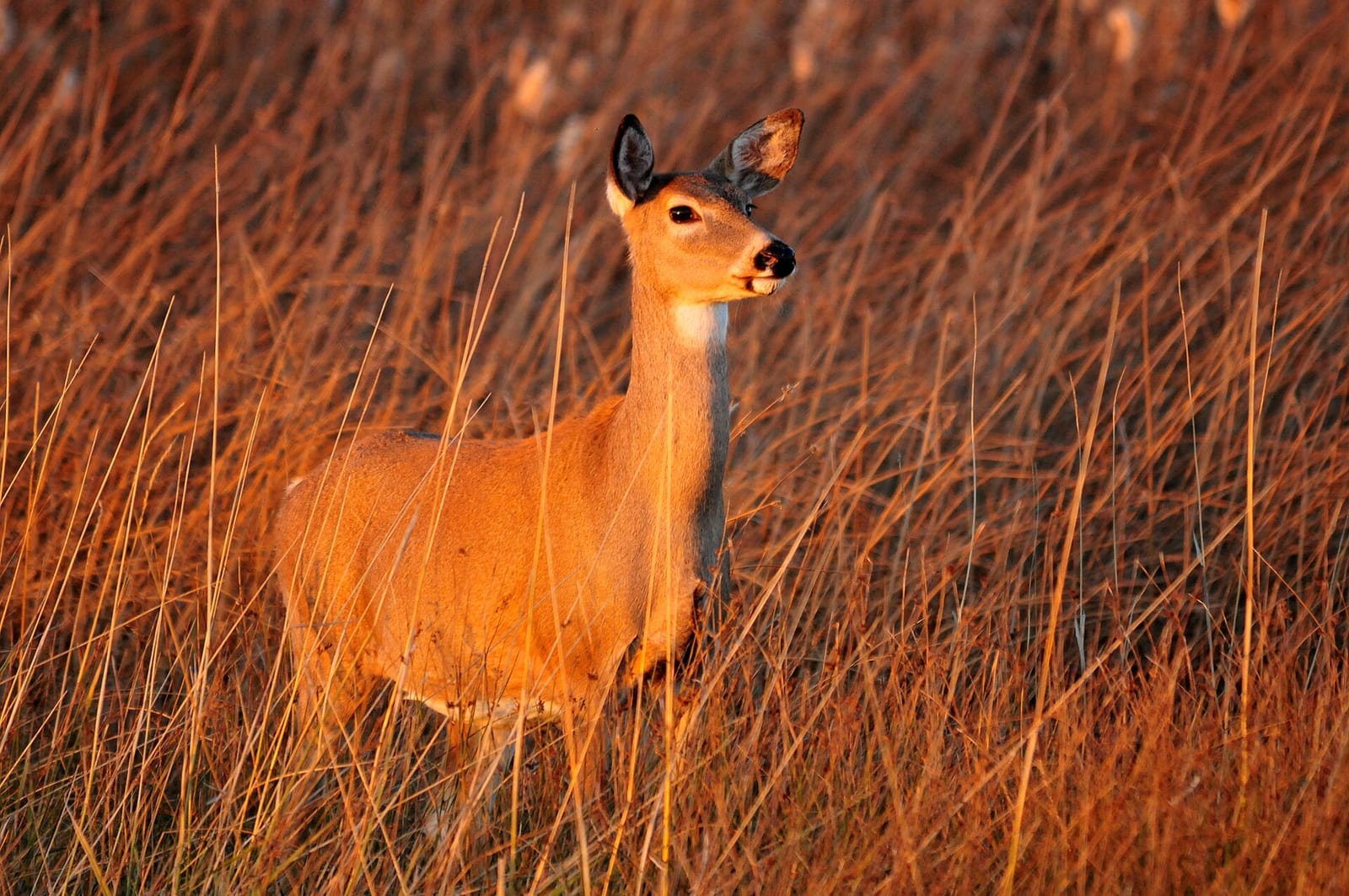
Are whitetail deer nocturnal? Not by nature. Biologists describe white-tailed deer as crepuscular, meaning their activity peaks around dawn and dusk. Maine’s wildlife agency says “White-tailed deer are crepuscular animals, meaning they are typically most active around dawn and dusk. This does not mean that deer are not at all active during the day” (Maine IFW). Deer do move at night, and some deer move mostly at night. Heat, people and hunting pressure are the usual reasons.
Key Takeaways
- Whitetails are crepuscular: most active around sunrise and sunset, with activity in daylight and darkness too.
- Mississippi State GPS data on 48 bucks found them moving more and bedding less in the hour around dawn and dusk.
- Hot weather and heavy daytime human activity can shift deer toward the night, per Maine IFW.
- The rut pulls bucks onto their feet in daylight. MSU found bucks traveled over 100 yards per hour more than usual.
- Moon phase didn’t change buck activity in the MSU study.
Are whitetail deer nocturnal or crepuscular?
Crepuscular. Mississippi State University Extension explains the difference in its moon study. It says some animals are “more active at night, called nocturnal activity,” and gives bats and owls as examples. Deer are different: “Research has shown repeatedly that deer are most active around sunrise and sunset, which biologists call crepuscular activity” (MSU Extension).
MSU put numbers on it. It tracked “48 white-tailed deer bucks equipped with GPS collars over 2 years in central Mississippi,” with collars that “recorded locations every 15 minutes from September through February.” Across the daytime, “bucks bed down around 34% of the time and travel around 269 yards per hour (yph).” Close to first and last light, they were busier: “Within 1 hour of dawn or dusk, bucks are bedded down around 21% of the time and travel around 317 yards per hour.”
Not every agency words it the same way. South Dakota Game, Fish and Parks writes that “Occasionally venturing out in the daylight hours, white-tailed deer are primarily nocturnal or crepuscular, browsing mainly at dawn and dusk” (South Dakota GFP). That’s a fair description of what many hunters see in their trail camera photos. The core pattern in both sources is still the same: dawn and dusk.
Why do some deer seem nocturnal?
Three things push deer into the dark, according to Maine IFW.
Heat. “During hot summer days, for example, deer are less active during the daytime and more active at night when it’s cooler.” The flip side: “deer may be more active than usual during cooler weather.”
People. Maine says “Areas with a lot of daytime human activity” can “see little daytime deer activity and increased nocturnality of resident deer.” Suburban deer are the classic example. We cover that in how city deer shift to nocturnal patterns.
Hunting pressure. Maine includes the woods during hunting season when “hunter densities are high” in that same group.
Does hunting pressure make deer nocturnal?
It can, but the research is more mixed than deer camp talk suggests.
A GPS study of nine adult bucks during Maryland’s firearms season at Chesapeake Farms, published in the proceedings of the Southeastern Association of Fish and Wildlife Agencies, found that movement and activity “decreased from pre-hunt to the hunt period.” The researchers said that drop “was at least partially attributable to hunting season coinciding with the post-breeding period.” Their overall conclusion: “hunting pressure levels at Chesapeake Farms did not influence deer behavior to a point of decreasing harvest vulnerability” (Karns et al., SEAFWA).
The same paper reviews earlier work showing that pressure can change daytime habits. It says “if deer are disturbed and dense security cover is readily available, deer may decrease diurnal movement and activity during hunting season.” In open, broken-up country, it says deer “have been observed to increase diurnal movement by frequent flight responses to hunting-related disturbances.” And it offers a practical takeaway: “Limiting hunting pressure on a property may be an effective way to mitigate loss of harvest opportunities due to avoidance by white-tailed deer of hunted areas.”
So pressure doesn’t flip a switch that makes every deer nocturnal. It can change where and when deer move. How much depends on cover, terrain and how hard an area gets hunted. If you manage land, our page on sanctuary core size covers how much unpressured ground deer need.
Do bucks move in daylight during the rut?
Yes, more than any other time. Maine IFW says “Deer activity may increase throughout the day during the breeding season while bucks are actively searching for does that are receptive to breeding.”
MSU’s collars showed it too: “In the rut, bucks are traveling over 100 yards per hour more than usual with about 10% less bedding time than usual in daylight hours (over 1.25 hours less).” If you only have a few days to hunt midday, the rut is when it pays off.
Does the moon make deer nocturnal?
Not in MSU’s data. The study tested moon phase and position against buck movement and concluded: “Moon phase has no effect on buck activity. The moon being full, new, or anything in between does not cause our bucks to become more or less active.” On moon position, it found “no effect from the moon, but our bucks were moving much more at dawn and dusk in general.”
For a deeper look at a large data set on the same question, see the moon’s effect on buck movement.
FAQ
Are whitetail deer nocturnal animals? No. They’re crepuscular, most active at dawn and dusk, though they move at night and during the day too.
Why do I only get deer on camera at night? Heat, nearby human activity and hunting pressure can all push deer activity into darkness, per Maine IFW.
What time of day are deer most active? Around sunrise and sunset. MSU’s GPS bucks moved more and bedded less within an hour of dawn and dusk.
Does a full moon make deer move at night? MSU found moon phase had no effect on buck activity.
The other side of it
Some hunters say it doesn’t matter what biologists call deer, because the mature bucks on their ground only show up on camera at 2 a.m. That experience is real, and Maine’s own description backs it: pressure and people can make local deer more nocturnal. But the Maryland study found no drop, once the season opened, in how often collared bucks came within range of stands during shooting hours. The hunter who blames the moon for a night-only buck, while walking past his bedding area twice a day, has found the wrong suspect.
Keep reading
Latest deer news
Sources
- White-tailed Deer, Maine Department of Inland Fisheries and Wildlife
- "Lunar Legends: Does the Moon Influence Buck Activity? (P4068)", Mississippi State University Extension (Bronson Strickland, Luke Resop, Steve Demarais and others)
- "The Way of White-tailed Deer (Deer Behavior and Scouting)", South Dakota Game, Fish and Parks
- Impact of Hunting Pressure on Adult Male White-tailed Deer Behavior, "Proceedings of the Southeastern Association of Fish and Wildlife Agencies 66:120-125 (Karns, Lancia, DePerno, Conner)"
Comments