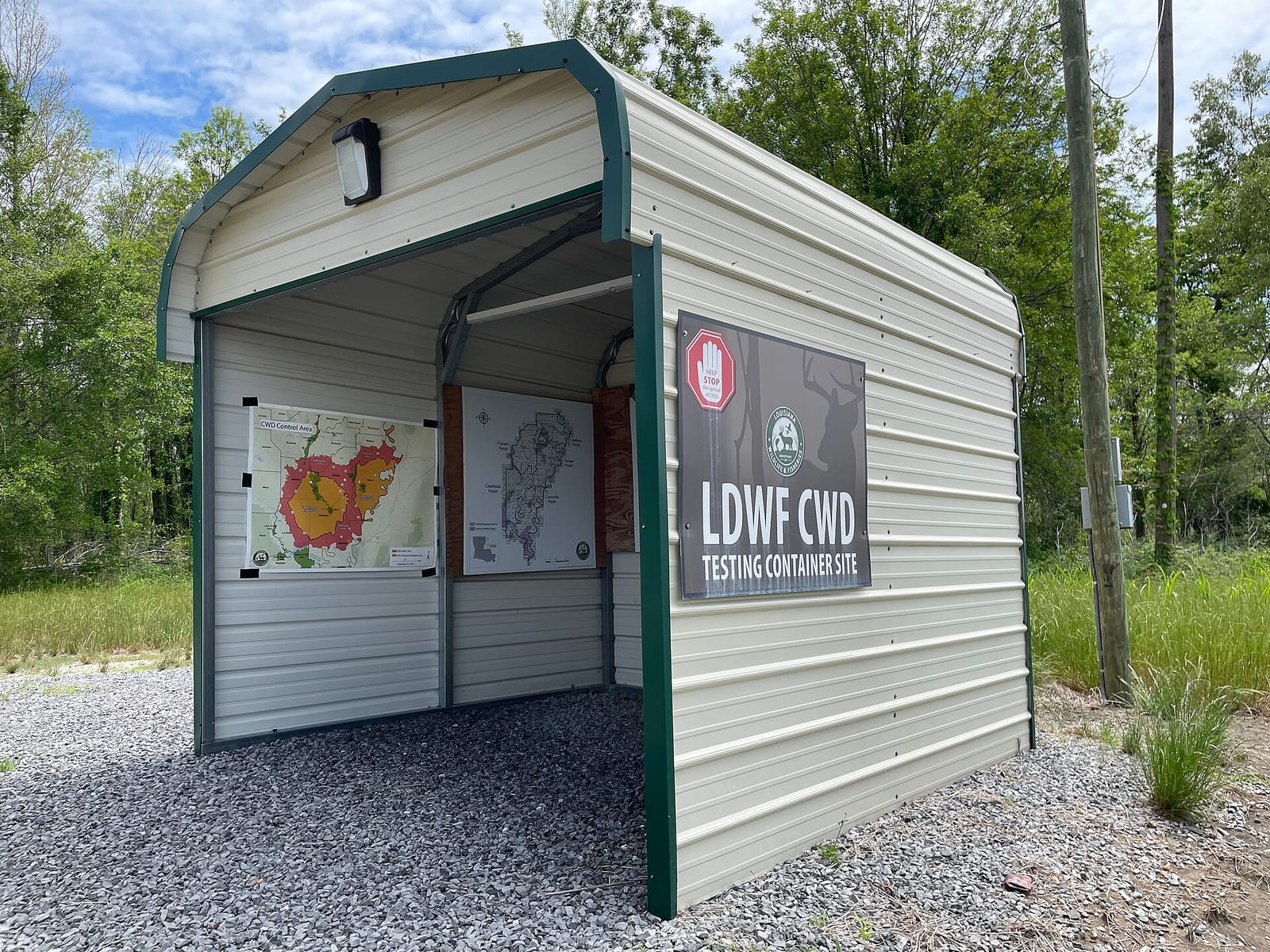
CWD restrictions exist because chronic wasting disease has no cure, spreads deer to deer and through contaminated ground, and can’t be confirmed without a lab test. That much is settled. What isn’t settled is which rules actually slow it. The best review of the research found only one kind of control that has been tested in the field, and it isn’t the one hunters complain about most. So “necessary” depends on which rule you’re pointing at, and some states are now pulling back on a few of them.
Key Takeaways (rules verified 2026-11-05)
- The usual toolbox: carcass movement limits, mandatory sampling, feeding and baiting bans, dropped antler restrictions and captive-deer certification. Arkansas uses most of them inside its 2026-27 CWD zone (AGFC).
- Prions outlast the deer. Mule deer caught CWD in pens where infected carcasses had rotted about 1.8 years earlier (Miller et al., Emerging Infectious Diseases, 2004).
- The evidence on control is thin. A 2016 systematic review found nine usable studies, none randomized, and “no studies” testing anything other than population reduction (Uehlinger et al., BMC Veterinary Research).
- Some states are changing course. Missouri removed its CWD Management Zone and CWD season portion for 2026 (MDC 2026 booklet). Louisiana’s legislature rewrote its bait ban in CWD zones (SCR 24, 2026).
- Hunters back some rules and reject others. In a Minnesota DNR survey, 64.5% supported a feeding ban, while 61.4% opposed professional culling (MN DNR).
What are we actually arguing about?
“CWD rules” covers five very different asks, and people at camp usually lump them together:
| Rule | What it costs you | 2026-27 example |
|---|---|---|
| Carcass movement | Boning out before you cross a line | Arkansas: only low-risk parts leave the CWD zone (AGFC) |
| Mandatory sampling | A drive to a check station | Missouri: designated counties, Nov. 14–15, head in the same day (MDC) |
| Feed and mineral bans | Your corn, salt and mineral sites | Missouri: banned year-round in counties within 10 miles of a detection (MDC) |
| Antler restrictions dropped | Nothing, unless you wanted young bucks to walk | Arkansas zone: “any buck may be legally harvested” (AGFC) |
| Captive-deer rules | Nothing for most hunters; a lot for deer farms | USDA: herds “must participate in the program and be certified to move animals interstate” (APHIS) |
Then split the question itself. Is the rule legal? That’s settled by your state. Does it work? That’s science. Is it worth what it costs? That’s a judgment about burden. Most of the yelling happens when somebody answers the third question and claims he answered the second.
The strongest case for CWD restrictions
Start with what the disease does. In a southeastern Wyoming whitetail herd tracked from 2003 to 2010, CWD-positive deer were 4.5 times more likely to die each year, and the population declined 10.4% a year (Edmunds et al., PLOS ONE, 2016). Nobody wants that in their county.
Then there’s the dirt. USGS says CWD spreads directly, deer to deer, and indirectly through environments contaminated by “saliva, urine, feces, and carcasses” (USGS). A pen experiment showed mule deer can get infected in paddocks where infected deer had last lived 2.2 years earlier (Miller et al.). That’s the logic behind carcass rules and feed bans. Once a spine gets dumped in a new creek bottom, nobody can take it back.
And there’s one real-world comparison. Illinois kept government culling going and held prevalence in tested deer near 1% from 2002 to 2012, while hunter harvest rose from 147,830 in 2001 to 181,451 in 2012 (University of Illinois). Wisconsin shifted from culling to letting hunters thin herds, and the review found its prevalence climbed 0.63% a year after that while Illinois held steady (Uehlinger et al.).
The strongest case against strict CWD restrictions
The science hasn’t caught up to the rulebook. The same 2016 review said evidence “was not sufficient to clearly support the recommendation of a primary control strategy.” Carcass rules and feeding bans come up only in its background section, because “no studies were identified that directly examined the efficacy of control options other than population management” (Uehlinger et al.). That doesn’t mean they fail. It means nobody has measured them.
Then there’s the burden, and a state legislature put it in writing. Louisiana’s SCR 24 says feeding and baiting bans “can discourage hunter participation” and hurt local businesses, and that “overly broad regulatory measures… may undermine the cooperation that is essential to effectively manage CWD.” It passed the Senate 36–0 and the House 81–0 (SCR 24; Louisiana Legislature).
Finally, the human-health fear is unproven. CDC says CWD infections in people “have never been reported” (CDC), and USGS says it is “not known to infect livestock or humans.”
What does the evidence say?
- Prions persist in the environment: strong evidence. The 2004 pen work is old but direct (Miller et al.).
- High prevalence hurts herds: strong evidence where it’s been measured. Wyoming is the clearest case (Edmunds et al.).
- Culling and heavy harvest: some support. Two of the review’s three field studies backed intensive non-selective culling, and the third found no difference (Uehlinger et al.).
- Carcass rules, feed bans, antler changes: plausible, not measured. The rules rest on how the disease spreads, not on trials of the rules themselves.
Limits worth stating: the review dates to 2016, the Illinois–Wisconsin comparison is two states, not a controlled experiment, and the Minnesota attitudes survey covers one region in one season (2,086 usable returns, 42% response rate).
Is a CWD-positive deer safe to eat, and does cooking help?
CDC’s answer is no: “If your animal tests positive for CWD, do not eat meat from that animal” (CDC). Virginia DWR adds that “CWD will not be destroyed through normal cooking,” and that a “no prions detected” result isn’t a guarantee (Virginia DWR). RAD’s CWD and humans guide covers the research.
What changes the answer?
- Whether CWD is already established. Louisiana’s rewrite allows bait in management zones Sept. 1 through March 31 when apparent prevalence stays under 2.5% and sampling goals are met. It also allows bait again once prevalence tops 20% (SCR 24). In other words, the rule treats a bait ban as an early-stage tool.
- Restructuring isn’t the same as quitting. Missouri dropped its CWD zone and CWD season portion for 2026. It also put every county on a four-year rotation for mandatory sampling, and its booklet still says CWD “threatens Missouri’s deer herd, hunting traditions, and many businesses supported by hunting” (MDC).
- Which rule. Southeast Minnesota hunters supported a feeding ban (64.5%) and a carcass-export ban (50.0% for, 21.4% against). They opposed culling (61.4%) and earn-a-buck (55.0%). A third (33.5%) were “extremely concerned” that deer and elk farms would spread CWD (MN DNR).
Your call
The disease side of this leans one way. Prions last, high prevalence shrinks herds, and nobody has a cure. Whether each rule earns its cost is still an open question, because most of them have never been tested on their own. So here’s ours: if your state could keep only one CWD restriction, which would you keep, and what evidence would it take to change your mind?
Related reading on RAD:
- What is chronic wasting disease in deer?
- Colosseum: Should deer feeding and mineral sites be banned?
- Is hunting deer over bait really hunting?
- Missouri deer season 2026-27
The other side of it
If you came in sure every CWD restriction is justified, sit with this. The best review we found couldn’t name one proven control strategy, and in 2026 alone a southern legislature and a Midwest agency both redrew their rules. Hunter cooperation is the whole program, and rules that feel arbitrary burn it. And nobody lectures harder about “doing your part” than the guy who has never once driven a head to a sampling station.
Sources
- CWD-Related Wildlife/Hunting Regulations • Arkansas Game & Fish Commission
- Environmental Sources of Prion Transmission in Mule Deer - Volume 10, Number 6—June 2004 - Emerging Infectious Diseases journal - CDC
- Uehlinger et al., BMC Veterinary Research (pmc.ncbi.nlm.nih.gov)
- 2026 Fall Deer & Turkey Hunting Regulations and Information
- Creator: PrintServer170
- Survey of Southeast Minnesota Deer Hunters
- APHIS (aphis.usda.gov)
- Chronic Wasting Disease Drives Population Decline of White-Tailed Deer | PLOS One
- USGS (usgs.gov)
- Targeted culling of deer controls disease with little effect on hunting – News Bureau
- SCR24
- CDC (cdc.gov)
- Human Health and CWD | Virginia DWR
Comments