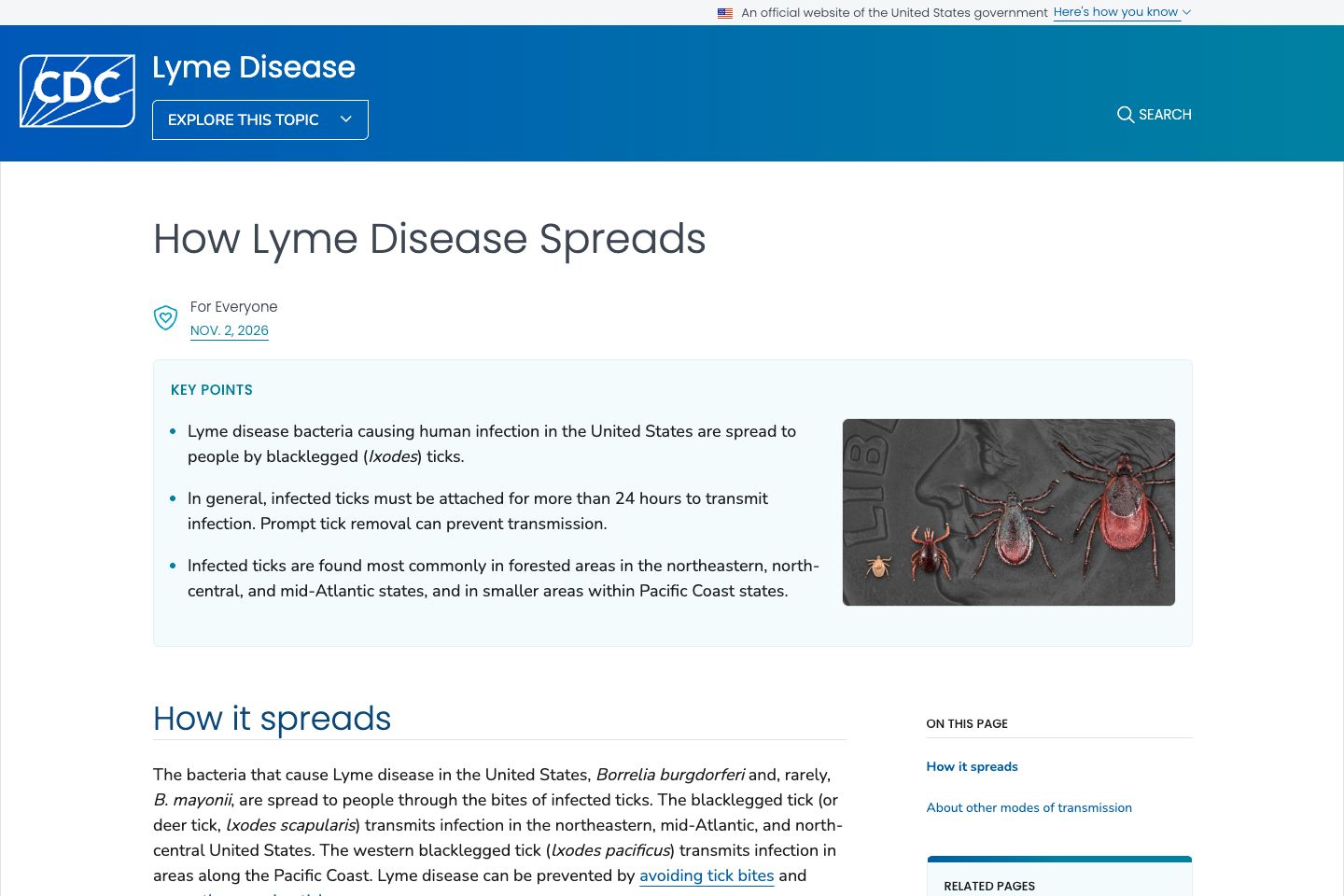
Deer ticks are blacklegged ticks (Ixodes scapularis), the tick that spreads Lyme disease in the northeastern, mid-Atlantic and north-central U.S., and adult deer ticks feed heavily on whitetails. But deer don’t spread Lyme disease. The CDC says deer “are not infected with Lyme disease bacteria and do not infect ticks” (CDC), and the ticks pick it up mostly from rodents, so the risk to you comes from the tick, not the deer.
Key Takeaways
- “Deer tick” and “blacklegged tick” are the same animal, Ixodes scapularis (CDC).
- Deer feed ticks and move them to new areas, but deer aren’t infected with Lyme bacteria and don’t infect ticks (CDC).
- Adult blacklegged ticks are active in fall, right through deer season, and can come out on any day above freezing (UW–Madison).
- In most cases a tick has to be attached for more than 24 hours to pass Lyme bacteria (CDC).
- The CDC recommends treating boots, clothing and gear with 0.5% permethrin (CDC).
Are deer ticks and blacklegged ticks the same thing?
Yes. The CDC uses both names for Ixodes scapularis, which transmits Lyme disease in the Northeast, mid-Atlantic and north-central states. On the Pacific Coast, it’s a cousin, the western blacklegged tick (Ixodes pacificus) (CDC).
How big is a deer tick?
Small. Adults are roughly the size of a sesame seed, and nymphs are about the size of a poppy seed (CDC).
How do you tell a deer tick from other ticks?
An unfed adult female is reddish brown with a black head, black legs and a black shield (scutum) behind the head. Males are smaller, and their shield covers more of the body. Larvae have six legs, while nymphs and adults have eight. Once a tick is engorged, it changes size and color and gets much harder to identify (UMN Extension).
Do deer give people Lyme disease?
No. This is the part most people get wrong. Larval and nymph ticks usually pick up Lyme bacteria from an infected wildlife host, “usually a rodent,” according to the CDC. The University of Wisconsin–Madison’s tick lab says white-tailed deer “are not considered competent reservoirs for Lyme disease” (UW–Madison).
So why are they called deer ticks?
Because deer are where the adults eat. UW–Madison calls whitetails “the principal host for the adult ticks,” and says tick abundance “is closely linked to the abundance of these animals” (UW–Madison). Deer are the ticks’ food truck and their ride across the county.
What is the deer tick life cycle?
Blacklegged ticks live two to three years and go through four stages: egg, larva, nymph and adult (CDC). The Minnesota Department of Health lays out the timeline (MDH):
- Larvae hatch and usually feed on small mammals like mice, and birds. That first meal is where many ticks pick up Lyme bacteria.
- Nymphs feed the next spring on small or large mammals, including deer and people.
- Adults appear in the fall and prefer large mammals like white-tailed deer. Females feed, mate, lay “hundreds to thousands of eggs,” and die.
MDH says they only have up to three blood meals in their whole lives (MDH).
When are deer ticks most active during hunting season?
Right when you’re in the woods. Adults look for hosts “during the fall and warm days of winter and the spring,” and “a frost does not kill blacklegged ticks,” according to UW–Madison. In Minnesota, adults usually become active again by the end of September and stay active through October until it freezes or snows (MDH). The University of Maine sees an adult peak in late October (UMaine).
Do deer ticks always carry Lyme?
No. MDH estimates about 1 in 3 adult blacklegged ticks and 1 in 5 nymphs carry the Lyme bacteria in Minnesota (MDH). Rates vary by place, and a bite only matters if the tick stays attached long enough (see below).
Are nymphs or adults more dangerous?
Nymphs cause most human infections, because they’re tiny and hard to spot, per the CDC. But adults transmit Lyme too, and the Minnesota infection rates above are an average, not a number for your county.
How long does a tick need to be attached to give you Lyme?
In most cases, more than 24 hours, according to the CDC. MDH says 24 to 48 hours, and notes that less common tickborne diseases such as anaplasmosis may take less time (MDH). The takeaway is simple: find it and pull it the same day.
What happens if you get bitten by a deer tick?
Usually nothing, if you remove it quickly. If the tick passes along Lyme bacteria, the CDC says early symptoms appear 3 to 30 days after the bite. They can include fever, chills, headache, fatigue and aches. The erythema migrans rash shows up in about 70 to 80 percent of infected people. It “does not always appear as a ‘classic bull’s-eye’ rash.” A small red bump that looks like a mosquito bite right after the bite is common and “is not a sign of Lyme disease” (CDC).
What smell do deer ticks hate, and how do hunters avoid them?
The CDC’s guidance doesn’t name a smell that ticks avoid. What it recommends is EPA-registered repellents and permethrin-treated clothing. Straight from the CDC’s prevention page (CDC):
- Treat clothing and boots with 0.5% permethrin. It stays protective “through several washings.” You can also buy pre-treated clothing.
- Use an EPA-registered repellent with DEET, picaridin, IR3535, oil of lemon eucalyptus, PMD or 2-undecanone on skin.
- Dry your clothes on high heat for 10 minutes when you get home. Cold and medium wash water won’t kill ticks.
- Shower within two hours and do a full body check: armpits, ears, belly button, backs of knees, hair, between the legs and waistline.
- Check your gear and your dog. Ticks can ride in on packs and pets and attach later.
What about handling a deer you just killed?
Adult ticks are on deer in fall, so dragging and field dressing puts you in close contact. We couldn’t find official guidance specific to carcass handling and ticks, so we’ll stick to what applies everywhere: treated clothes, a tick check after the work is done, and a hot dryer for your hunting clothes.
Are there deer ticks in Florida?
Yes. The blacklegged tick ranges along the East Coast with Florida westward into central Texas as its southern boundary (UF/IFAS). UF/IFAS says Florida blacklegged tick nymphs are found April through August and adults are common September through May, so adults overlap most of hunting season (UF/IFAS). The lone star tick, not the deer tick, is the most common human-biting tick in Florida (UF/IFAS).
Lyme disease is less common there. CDC’s state-by-state Lyme table counts 271 Florida cases in 2023, versus 16,671 in Pennsylvania and 22,173 in New York (CDC Lyme surveillance data). Part of the reason, UF/IFAS says, is that Florida blacklegged ticks feed heavily on reptiles and lizards, which are not Lyme reservoirs (UF/IFAS). Florida hunters should still check for ticks.
Which is worse, a deer tick or a wood tick?
For Lyme disease, the deer tick. The Minnesota Department of Health says the blacklegged (deer) tick “causes by far the most tickborne disease in Minnesota,” while American dog ticks, also called wood ticks, “rarely spread diseases.” Wood ticks can spread Rocky Mountain spotted fever and tularemia (MDH). UMaine Extension says American dog ticks can contain Lyme bacteria but “seem to be unable to transmit” it, and that they’re no longer active in October and November, when adult deer ticks are at their peak (UMaine). During deer season, the tick on your pant leg is more likely a deer tick.
Which tickborne diseases besides Lyme should hunters know?
The CDC says blacklegged ticks can also spread babesiosis and anaplasmosis in some regions (CDC). The University of Maine adds Powassan virus to the list there (UMaine). If you get a rash or fever after a tick bite, see a doctor and tell them you’re a hunter.
Related reading on RAD:
The other side of it
Some hunters say tick panic is overblown in fall. Ticks are most active April through September, per the CDC, and a cold November sit isn’t the same as a June hayfield. Fair point, but the same science says adults are out every fall day above freezing. And the guy who says he’s never had a tick in deer season usually just hasn’t looked.
Keep reading
Latest deer news
Sources
- CDC (cdc.gov)
- Ixodes scapularis Life cycle – Wisconsin Ticks and Tick-borne Diseases – UW–Madison
- CDC (cdc.gov)
- CDC (cdc.gov)
- Ticks - MN Dept. of Health
- Blacklegged Tick or Deer Tick - Cooperative Extension: Tick Lab - University of Maine Cooperative Extension
- CDC (stacks.cdc.gov)
- UF/IFAS (ask.ifas.ufl.edu)
- Ticks and Disease - Solutions for Your Life - University of Florida, Institute of Food and Agricultural Sciences - UF/IFAS
- American Dog Tick - Cooperative Extension: Tick Lab - University of Maine Cooperative Extension
- Lyme Disease Surveillance Data | CDC
- Ticks | UMN Extension
Comments