What Texas deer hunters need to know about screwworm this season is that it is here, it has turned up in elk during hunting season, and the state wants you to check every deer you kill. The Texas Animal Health Commission counts 25 Texas counties and 77 premises with at least one confirmed New World screwworm detection in the 2026 outbreak (TAHC). Texas Parks and Wildlife asks hunters to inspect harvested animals before field dressing or moving them, and to report anything suspicious to a TPWD biologist (TPWD release).
Key Takeaways
- TAHC confirmed the first Texas detection on June 3, 2026, in a calf in Zavala County (TAHC).
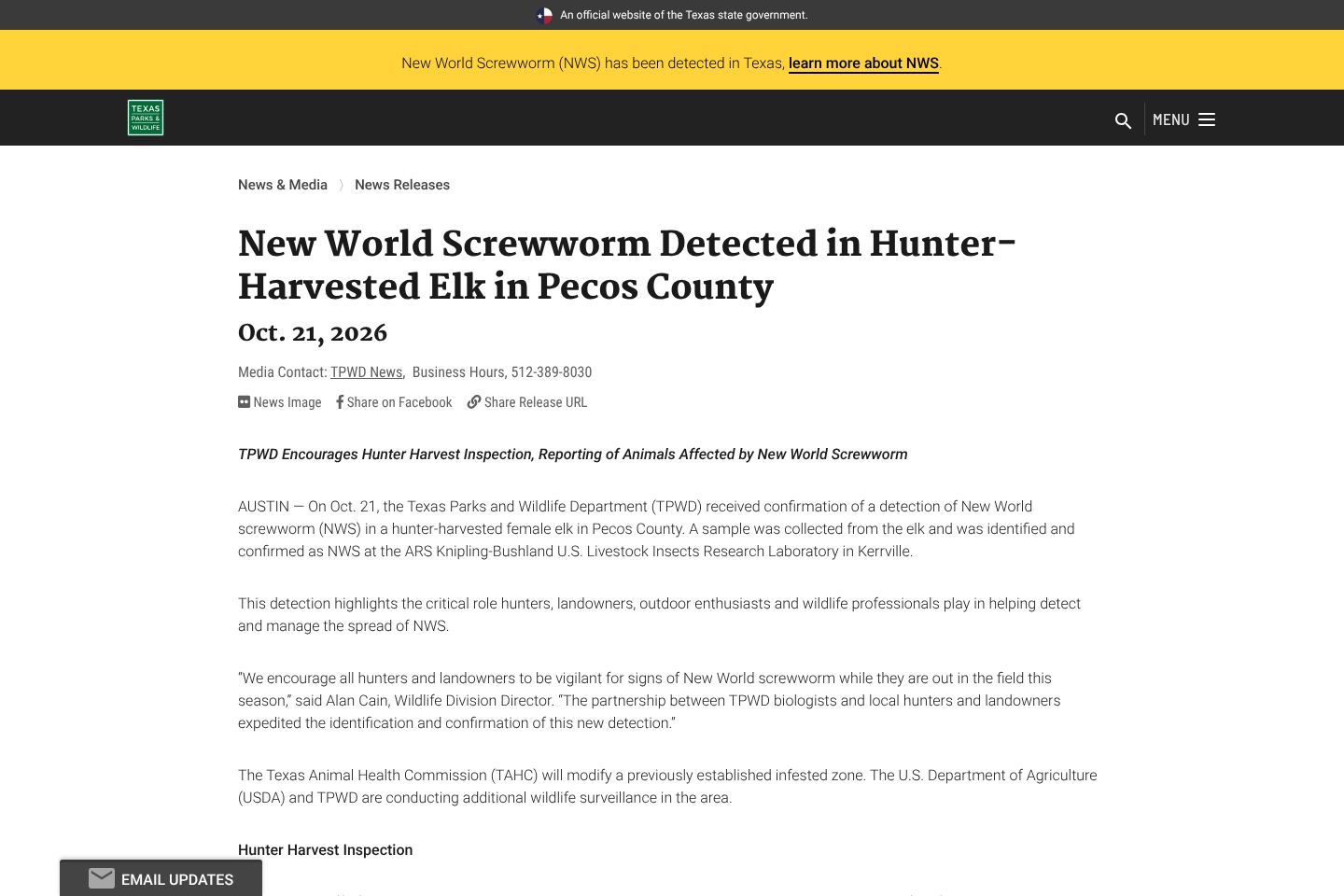
- A hunter-harvested female elk in Pecos County was confirmed on Oct. 21, and TAHC lists an elk detection in Jeff Davis County on Nov. 4 (TPWD release; TAHC order).
- TPWD names white-tailed deer among the wildlife more commonly affected (TPWD).
- Recent TAHC zone orders require hides, carcasses and parts of host animals to be inspected before they leave an infested zone (TAHC order).
- Suspected wildlife cases go to a local TPWD wildlife biologist or 512-389-4505 (TPWD release).
Where has screwworm been found in Texas?
TAHC’s notice lists movement restrictions in parts of 31 counties: Bandera, Brewster, Brooks, Crockett, Culberson, Dimmit, Edwards, El Paso, Fisher, Frio, Goliad, Hudspeth, Irion, Jeff Davis, Jim Hogg, La Salle, Medina, Mitchell, Nolan, Pecos, Presidio, Reagan, Reeves, Schleicher, Scurry, Starr, Sutton, Terrell, Val Verde, Zapata and Zavala (TAHC). The zone list is longer than the 25 counties with confirmed detections because zones are drawn around detections and cross county lines. One elk case in Jeff Davis County, for example, sits inside a zone spanning parts of four counties.
The list moves fast. TAHC posted new or modified executive director orders on Nov. 10, Nov. 13 and Nov. 14 alone, covering counties from Goliad to Brooks to Terrell (TAHC). If you hunt anywhere near one, check TAHC’s zone map before you drive home, not after.
What happened with the elk?
On Oct. 21, TPWD got confirmation of screwworm “in a hunter-harvested female elk in Pecos County.” The sample was confirmed at the USDA ARS Knipling-Bushland U.S. Livestock Insects Research Laboratory in Kerrville (TPWD release). TPWD credits the partnership between its biologists and local hunters and landowners for speeding the confirmation.
TAHC modified the Pecos and Terrell zone order the same day (TAHC order). Then on Nov. 4, TAHC recorded screwworm “in an elk in Jeff Davis County” and redrew the West Texas zone covering parts of Brewster, Jeff Davis, Pecos and Reeves counties (TAHC order). That same order notes a trapped fertile wild screwworm fly identified by USDA in Pecos County on Oct. 30.
Why are whitetails at risk?
Screwworm flies lay eggs in open wounds and mucous membranes of live warm-blooded animals, and TPWD says the larvae “burrow or ‘screw’ into living tissue.” Left untreated, infested wounds “will kill infested animals,” TPWD says. The agency lists white-tailed deer with jackrabbits, cottontails, small mammals and turkeys as more commonly affected, and names antler and velvet shedding and fawning among common infestation points (TPWD).
Texas A&M AgriLife’s wildlife guide ties the risk to the deer calendar. It says deer may be more prone to open wounds from fights than species like bighorn sheep, and that mature males had the highest death rates among Key deer in Florida’s 2016 outbreak, which hit during the rut. Bucks also see higher infection rates during velvet shedding, antler shedding and antler growth (Texas A&M AgriLife). USDA’s hunter sheet warns screwworm can cut the number of fawns that survive to adulthood (USDA APHIS).
How do I check a harvested deer for screwworm?
TPWD wants the check done before you field dress or move the carcass. Look at the eyes, ears, nose, mouth, genitalia and any mucous membranes. Then run your hands along the body and check the feet and between the toes for wounds with a foul smell or maggots (TPWD release).
Signs in a live animal before the shot include irritated or depressed behavior, loss of appetite, head shaking, the smell of decaying flesh, maggots in wounds and isolation from other animals (TPWD release). Trail cameras count too. USDA says even trail camera pictures or videos of suspected cases help (USDA APHIS).
What should I do if my deer has maggots in a wound?
Report it to your local TPWD wildlife biologist first. TPWD’s hunter guide then lays out the steps (TPWD guide):
| Step | What TPWD says |
|---|---|
| Contain | Put the carcass on a tarp, plastic sheeting or hard surface |
| Larvae | Remove them or cut out the affected area; seal them in a container fully submerged in 70% isopropyl alcohol |
| Infested parts | Double-bag and freeze solid before disposal |
| Carcass | Burn it, freeze it completely or bury it at least 4 feet deep on the property |
| Leaving | Infested carcasses should not be removed from the property of harvest |
TPWD also says it does not recommend eating apparently sick or infested wildlife, and it encourages hunters to debone meat from animals taken in infested areas (TPWD guide).
Can I haul a deer out of an infested zone?
This is where TAHC’s orders matter to hunters, not just ranchers. The Nov. 4 and Nov. 14 orders RAD read both say hides, carcasses and parts of any animal that can host screwworm “must be inspected and undergo any treatment deemed necessary by a Commission representative prior to removal” from the zone, and that unauthorized movement can bring penalties or criminal prosecution (TAHC Nov. 4 order; TAHC Nov. 14 order). TAHC’s deployed inspectors in screwworm zones can be scheduled at 512-714-1936 (TAHC).
Each order covers its own zone, so read the one for the county you hunt. TPWD’s guide adds that no infested animal parts shall leave an infested area, and that clean parts should be inspected before they go (TPWD guide).
Who do I call?
For native wildlife, call a local TPWD biologist or 512-389-4505. TPWD routes livestock and exotic species to TAHC, with the veterinarian on call at 800-550-8242 after hours and on weekends (TPWD). If you find maggots on yourself, USDA says to contact your healthcare provider right away (USDA APHIS).
For season dates and the rest of this year’s rules, see RAD’s Texas deer season page.
The other side of it
None of the TAHC, TPWD or USDA pages RAD read report a confirmed white-tailed deer case in Texas so far; the wildlife detections they list are elk (TPWD release; TAHC order). The caveat is that wildlife cases surface only when someone looks. TPWD says field observations from hunters and landowners will be important for early detection, so a short wildlife list may say as much about how few wild deer get checked as about the deer themselves (TPWD guide).
Sources
- New World Screwworm | Texas Animal Health Commission, Texas Animal Health Commission
- New World Screwworm Detected in Hunter-Harvested Elk in Pecos County, Texas Parks and Wildlife Department
- Second Modified Executive Director Order Declaring Animal Movement Restrictions Due to New World Screwworm in Brewster, Jeff Davis, Pecos, and Reeves Counties, Texas Animal Health Commission
- Modified Executive Director Order Declaring Animal Movement Restrictions Due to New World Screwworm in Brewster and Terrell Counties, Texas Animal Health Commission
- Second Modified Executive Director Order Declaring Animal Movement Restrictions Due to New World Screwworm in Pecos and Terrell Counties, Texas Animal Health Commission
- New World Screwworm - Diseases - Wildlife - TPWD, Texas Parks and Wildlife Department
- New World Screwworm Guide for Hunters and Landowners, Texas Parks and Wildlife Department
- Wildlife Monitoring and Management for New World Screwworm (RWFM-PU-432), Texas A&M AgriLife Extension
- New World Screwworm: A Threat to Wildlife, Information for Hunters, USDA APHIS
Comments