Deer disease in Ohio comes down to two problems in 2026, and ODNR’s deer program administrator, Clint McCoy, summed them up for Ideastream this week: “One poses a short-term threat while the other could affect deer populations for years to come” (Ideastream, Nov. 4, 2026). The short-term one is epizootic hemorrhagic disease (EHD), which hammered southern Ohio in 2025 and reached Lorain and Portage counties this year. The long-term one is chronic wasting disease (CWD), found so far in a block of west-central counties that make up Ohio’s Disease Surveillance Area (DSA).
Key Takeaways (verified 2026-11-04 against ODNR)
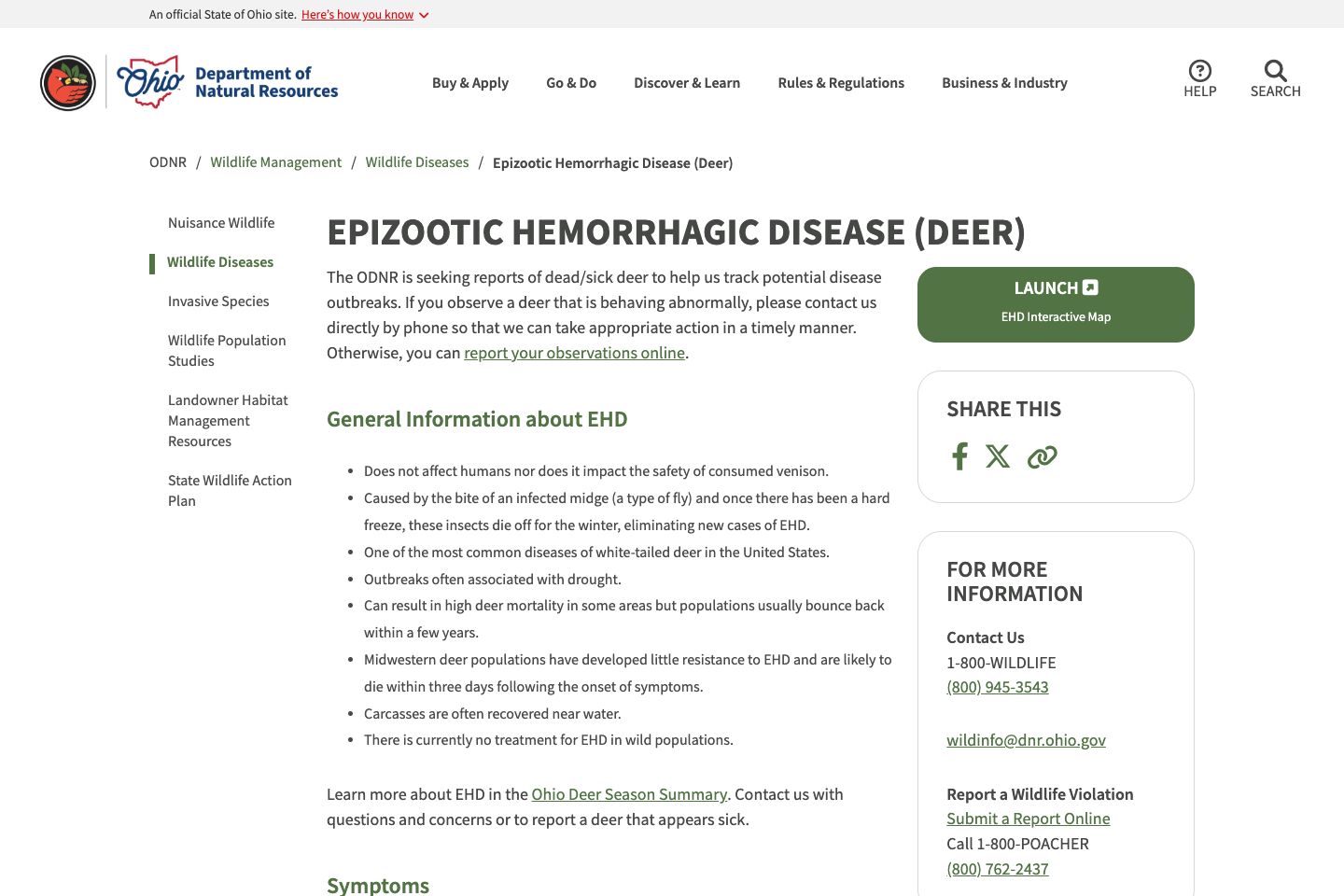
- EHD “does not affect humans nor does it impact the safety of consumed venison,” and a hard freeze ends new cases for the year (ODNR).
- CWD: as of June 2026, ODNR counts 115 deer that have tested positive in Ohio, in Wyandot, Marion, Hardin, Allen, Hancock and Morrow counties (ODNR).
- 2026-27 DSA rules: every deer killed in the DSA on Nov. 30 or Dec. 1, 2026 must be sampled (Oct. 10–11 were the other mandatory days), bait is banned, and high-risk carcass parts can’t leave unless they go to a certified processor or taxidermist within 24 hours (2026-27 Ohio regulations).
- Sick deer: call ODNR at 1-800-WILDLIFE (800-945-3543) if a deer is acting abnormally, or report it online.
What’s going on with EHD in Ohio this year?
Ideastream reports that EHD devastated deer in parts of southern Ohio last year, and this year it showed up in parts of northern Ohio, including Lorain and Portage counties. The same story says bag limits remain in place in southern Ohio because of the disease (Ideastream). The 2026-27 regulations confirm county bag limits changed in Athens, Defiance, Meigs, Paulding, Warren and Washington counties and in the DSA. Check the county map in the regulations (page 7) for your county’s number.
This isn’t new territory for Ohio. SCWDS at the University of Georgia, which tests hemorrhagic disease samples for state agencies, reported that in 2024, “confirmed HD activity in Ohio spanned diagonally across the state from the northwest to the southeast,” based on its communication with ODNR’s Dr. Mike Tonkovich (SCWDS BRIEFS, Winter 2025).
How does EHD spread, and when does it stop?
EHD comes from the bite of an infected midge. ODNR says that “once there has been a hard freeze, these insects die off for the winter, eliminating new cases.” Outbreaks tend to follow drought. Symptoms usually show about seven days after exposure: a disoriented deer with little fear of people, a swollen head, neck, tongue or eyelids, and trouble breathing. Carcasses often turn up near water (ODNR).
It’s rough on Ohio deer. ODNR says Midwestern herds “have developed little resistance to EHD” and sick deer are likely to die within three days of showing symptoms. The upside is that survivors build protection. “Once the deer is exposed to the virus and survives, it has built up antibodies to offer protection from future infection,” McCoy told Ideastream. ODNR adds that populations usually bounce back within a few years.
Can you eat a deer that had EHD?
ODNR says no risk has been shown from handling the virus or eating a deer infected with it. But the same page draws a hard line: “never kill or eat a sick deer.” If a deer looks sick, you don’t know it’s EHD. “Without testing, we cannot be certain what a sick deer is suffering from.” Wear rubber gloves when you field dress.
Which Ohio counties have CWD?
ODNR’s CWD page says that as of June 2026, a total of 115 deer have tested positive in Ohio, and lists them by county:
| County | CWD-positive deer (ODNR, as of June 2026) |
|---|---|
| Wyandot | 77 |
| Marion | 23 |
| Hardin | 8 |
| Allen | 4 |
| Hancock | 1 |
| Morrow | 1 |
Two notes for the careful reader. ODNR’s own county numbers add to 114, one short of its stated total. And ODNR’s April 2026 announcement of 40 positives from the 2025-26 season, as reported by Farm and Dairy, also named Crawford County. ODNR points hunters to its interactive CWD dashboard for the newest results, and that’s the place to check before you trust any county list, including ours.
Ohio’s first CWD-positive wild deer was confirmed in Wyandot County in December 2020, and cases have been confirmed every year since (2026-27 regulations).
What area does the Disease Surveillance Area cover in 2026-27?
Per the 2026-27 regulations, DSA 2021-01 covers:
- All of Allen, Hardin, Marion and Wyandot counties
- Crawford County: Bucyrus, Dallas, Holmes and Tod townships
- Delaware County: Marlboro, Troy and Oxford townships
- Hancock County: Delaware, Madison and Van Buren townships
- Morrow County: Westfield Township
- Union County: Claibourne and Jackson townships
New this year: all of Allen County, Holmes Township in Crawford and Van Buren Township in Hancock were added.
How common is CWD in Ohio deer?
Still uncommon, by the numbers ODNR publishes. The agency has tested more than 58,000 wild deer since 2002. For the 2025-26 season, ODNR reported 40 positives out of 6,617 deer tested (via Farm and Dairy). That works out to about 0.6 percent of tested deer, by RAD’s math, and since most testing happens inside the DSA, it’s not a statewide rate. Ohio hunters kill roughly 220,000 deer a year, per Ideastream.
McCoy’s warning is about the trend, not the total: “I don’t think there’s anywhere in the country where CWD has been detected and it hasn’t spread.”
Will CWD ever be cured?
Not for the deer that have it. ODNR says “once an animal is infected there is no recovery or cure for CWD,” and that prions shed into the environment “can remain infectious for years.” McCoy told Ideastream the disease can’t be eradicated once it’s established, which is why Ohio’s rules focus on slowing it down. No fetched agency page offers a timeline for any treatment or vaccine, and we’re not going to guess. For the human-health side, see can CWD spread to humans?
What are the DSA rules for the 2026-27 season?
All from the 2026-27 Ohio Hunting and Trapping Regulations (pages 7, 10 and 11):
- Mandatory sampling for all deer harvested in the DSA on Oct. 10–11 and Nov. 30–Dec. 1, 2026. Staffed stations run on those days, and self-serve kiosks take deer all season. Testing is voluntary on other days.
- Bait is banned. No placing or using salt, minerals or any food to attract deer in the DSA, and no hunting over bait. Food plots, crops and normal farming are allowed.
- Carcass rules. High-risk parts (brain, spinal cord, eyes, lymphoid tissue) can’t leave the DSA unless the deer reaches a certified processor or taxidermist within 24 hours. Deboned meat, wrapped cuts, quarters with no spine or head, cleaned skull caps and antlers, and finished mounts can move freely.
- Six-deer limit in the DSA, using any mix of either-sex and deer management permits. DSA archery opened Sept. 12, 2026, and runs through Feb. 7, 2027.
Getting it mounted? ODNR says DSA hunters “are not required to surrender their deer” for taxidermy. Take it to a certified taxidermist or call 419-429-8322.
Can you get a deer tested outside the DSA?
Yes, for a fee. ODNR sends hunters outside the DSA to the Ohio Department of Agriculture’s Animal Disease Diagnostic Laboratory at 614-728-6220 for cost, sampling and hours (ODNR).
How do you report a sick deer in Ohio?
ODNR asks for a phone call if a deer is behaving abnormally, “so that we can take appropriate action in a timely manner,” and online reports for everything else. The numbers:
- 1-800-WILDLIFE (800-945-3543) or wildinfo@dnr.ohio.gov
- CWD questions: 419-429-8322
- The 2026-27 regulations also ask hunters to contact a district office or state wildlife officer about any deer that appears sick, acts strangely or has a visible ear tag.
Why bother? ODNR’s Lindsey Krusling told Ideastream in 2025 that the reports show “the distribution and severity of the outbreaks” (Ideastream, Aug. 20, 2025).
Related reading on RAD:
- Ohio deer season dates and rules
- Deer hunting in Ohio
- Chronic wasting disease in deer
- Deer disease: what’s out there and what you can eat
The other side of it
Plenty of DSA hunters will point out that EHD killed far more Ohio deer in one summer than CWD has in six years, and that a bait ban and mandatory check days are a lot of rules for 115 deer. That’s a fair read of today’s count. The case for the rules is McCoy’s point that CWD has spread everywhere it’s been found, and that prions don’t quit after a hard freeze. Still, the guy fighting the bait ban hardest is usually the one whose trail camera has never photographed a deer more than 40 yards from the corn pile.
Keep reading
Ohio's biggest bucks in the record book →
Latest deer news
Sources
- Ohio wildlife officials monitor 2 deer diseases | Ideastream Public Media
- ODNR (ohiodnr.gov)
- ODNR (ohiodnr.gov)
- 2026-27 Ohio regulations (dam.assets.ohio.gov)
- SCWDS BRIEFS, Winter 2025 (vet.uga.edu)
- CWD detected in six Ohio counties during 2025-26 hunting season - Farm and Dairy
- Ohio Division of Wildlife asking people to report dead or sick deer as agency tracks disease | Ideastream Public Media
Comments