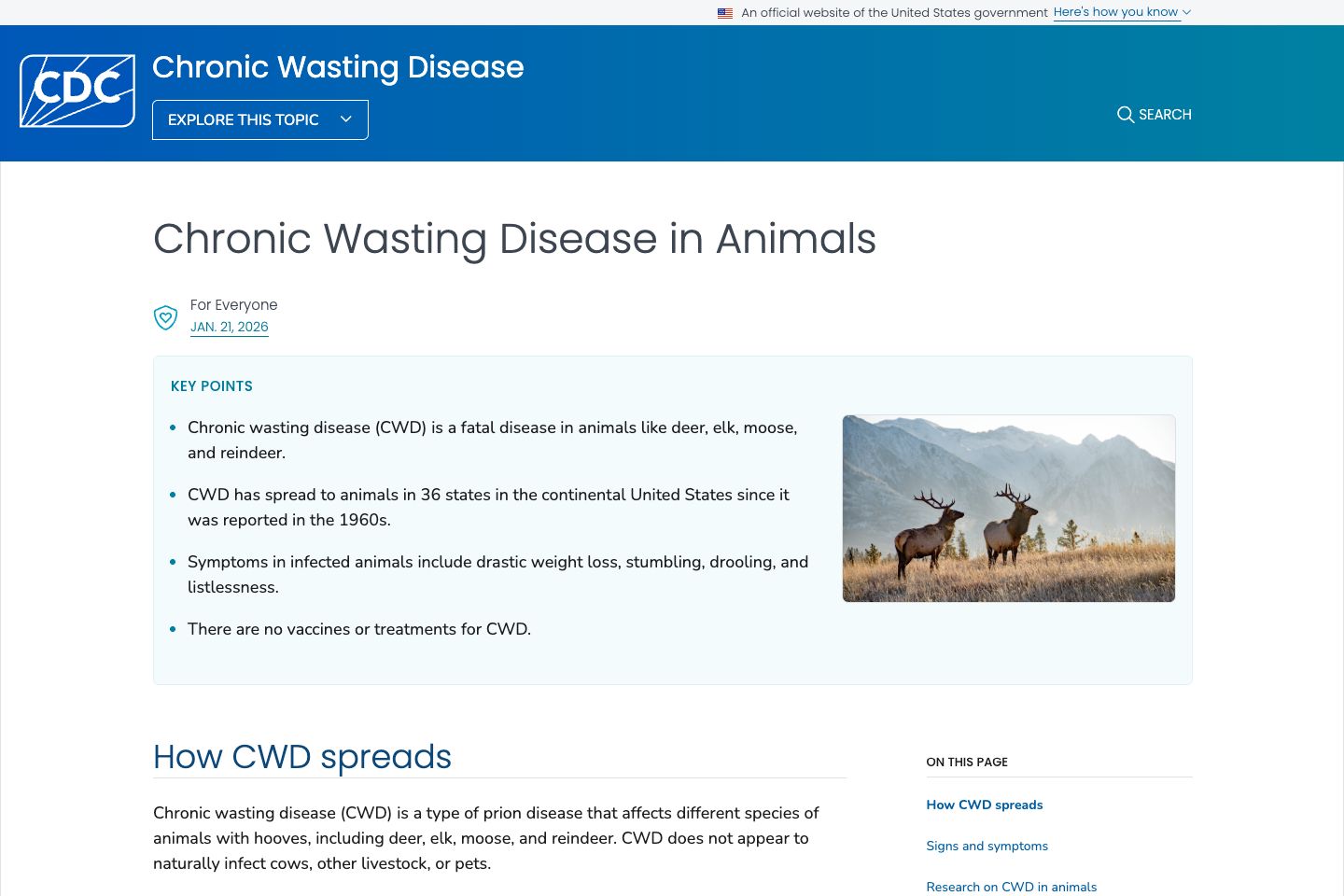
Chronic wasting disease in deer is a fatal brain disease caused by a prion, a misfolded protein, not a virus or bacteria. It spreads deer to deer through saliva, urine, feces and blood, and through dirt and water those fluids have touched. An infected deer can look healthy for months or years while it sheds prions, there is no cure or vaccine, and the only way to confirm it is a lab test on a dead deer. That last part is why your state keeps asking you to drop off a head.
Key Takeaways
- CWD is a prion disease of deer, elk, moose and reindeer. It “does not appear to naturally infect cows, other livestock, or pets” (CDC).
- It spreads animal to animal and through contaminated soil, food and water, where “the CWD prions stay in soil and water for years” (CDC).
- Deer shed prions before they look sick. Most live a year or more after signs appear; death is inevitable (Cornell).
- As of its June 2026 map update, USGS lists CWD in 37 U.S. states and five Canadian provinces in free-ranging and/or captive cervids (USGS).
- CDC: test your deer where the disease is present, and if it comes back positive, don’t eat it (CDC).
How does chronic wasting disease spread between deer?
Prions are the problem. A normal prion protein lives in every deer’s body. In CWD, a misfolded version converts the normal ones, mostly in the brain and spinal cord. Prions “are resistant to standard disinfection methods” that kill bacteria or viruses (Cornell), and cooking doesn’t touch them either.
The disease moves two ways. Direct contact, deer to deer, through saliva, urine, feces and blood. And indirect contact with the ground, plants, water and carcasses those fluids have been on (USGS FAQ). Prions bind to soil and plants and “remain infectious in the environment for years” (Cornell). That is why a mineral lick or a feed pile in an infected area worries biologists: the National Deer Association notes mineral licks can act as reservoirs and that saliva may be about ten times as infectious as urine (NDA).
It was first found in captive mule deer in Colorado in 1967 (Cornell). USDA APHIS says infected animals pass it on during a “silent” incubation period while still appearing healthy (APHIS).
Can you tell a deer has CWD just by looking at it?
Late in the disease, yes. Early on, no, and early is most of the disease.
Cornell lists the signs: poor coordination, a wide-based stance, head tremors, head and ears held low, repetitive walking, excessive sleeping, hanging around water, and a slow decline in body condition as the deer eats less. Late-stage deer drink, urinate and drool excessively (Cornell). CDC adds drooping ears and no fear of people (CDC).
Here is the catch: a skinny, stumbling deer in February might have CWD, hemorrhagic disease or a hard winter. NDA says a sick-looking deer doesn’t necessarily have CWD (NDA), and APHIS says post-mortem testing is required to confirm it (APHIS).
Why a healthy-looking buck can still test positive
Because the deer sheds prions long before it looks sick. CDC says infected animals may show no symptoms for “months to years” (CDC); NDA puts it at up to two years (NDA). The fat 4-year-old 10-pointer on your wall could have been positive. That is the whole argument for testing deer that look fine.
How long does a deer live with chronic wasting disease?
Not long, by deer standards. NDA says CWD takes one to two years to kill an infected deer (NDA), and Cornell says most animals live a year or more after signs appear (Cornell).
The best field data is a 2003-2010 collar study in a high-prevalence part of Wyoming, published in PLOS ONE in 2016. CWD-positive whitetails were 4.5 times more likely to die in a given year than negative deer, annual survival was about 40 percent for positives against 80 percent for negatives, and the herd was shrinking about 10 percent a year. Does lived about 137 weeks after first testing positive; bucks about 107 weeks (Edmunds et al., 2016). Many of those positive bucks died in hunting season.
Where has CWD been found?
The USGS National Wildlife Health Center keeps the national map. Its page, dated June 30, 2026 for the June 2026 update, says CWD “has been detected in 37 US states and five Canadian provinces in free-ranging cervids and/or captive cervid facilities,” and its global table adds Finland, Norway, South Korea and Sweden (USGS). CDC’s page, reviewed January 2026, cites at least 36 states as of August 2025 and expects the disease to keep spreading (CDC).
Two things to keep in mind. CDC says the nationwide rate in free-ranging deer is low, but it can be much higher where the disease has been present for years or decades (CDC). And a state that hasn’t found CWD may just not have looked hard enough yet; Wisconsin monitored for three years before its first positives in 2002 (Wisconsin DNR). The disease is still filling in county by county inside positive states: on Oct. 22, 2026, Wisconsin confirmed its first wild CWD-positive deer in Marinette County near Peshtigo, which under state law extends that county’s baiting and feeding ban three more years (Wisconsin DNR). How those bans work by state is on deer baiting laws by state.
What should hunters do about CWD?
Two things, mostly: get the deer tested, and don’t haul the wrong parts across a line.
Get the deer tested
The test uses lymph nodes in the neck, which is why agencies want the head. Alabama’s process is typical: remove the head with 4 to 6 inches of neck attached, bag it, fill out the sample tag, drop it in an agency freezer, and expect results in three to four weeks (ADCNR). Wisconsin offers sampling statewide to any hunter who wants to know (Wisconsin DNR). NDA’s advice: test every deer killed in a CWD zone and wait on the result before eating it (NDA).
Do you hold the venison until the result comes back, or process it and label every package to the deer? Either works. Eating it the first night doesn’t.
Know the carcass rules before you cross a line
Carcass transport rules exist in most states and they vary, so check your state’s page every season. They all target what Pennsylvania calls “high-risk parts”: the head “including brain, tonsils, eyes and any lymph nodes,” the spinal cord and backbone, the spleen, and anything with visible brain or spinal tissue on it (Pennsylvania Game Commission).
Alabama is a clear example (verified on the agency page 2026-11-04, 2026-27 season). Deer killed in the High-Risk Zone stay in the High-Risk Zone; Buffer Zone deer stay inside the Carcass Movement Zone. What can leave, and what can come into Alabama from any other state: fully deboned meat, cleaned skull plates with no visible brain or spinal cord tissue, loose antlers, raw capes cleaned the same way, upper canine teeth with no soft tissue, and finished taxidermy or tanned hides (ADCNR).
If you hunt out of state, assume you are coming home with boned meat and a clean skull plate, and you will rarely be wrong.
Should you shoot a deer that has CWD, and can you eat it?
If a deer looks sick, CDC says don’t shoot it, handle it or eat it, and don’t touch deer found dead (CDC). Call the state agency; a visibly sick deer is a sample they want.
For a healthy-looking deer you’ve already killed: wear gloves while field dressing, keep knives out of the brain and spine, don’t use kitchen utensils, consider testing before you eat it, and “if your animal tests positive for CWD, do not eat meat from that animal” (CDC, as relayed by the National Prion Disease Pathology Surveillance Center). CDC also says human infections “have never been reported” (CDC). The full human-risk question, the 2024 two-hunter report included, gets its own RAD page, linked below.
Is there a cure for CWD?
No. Cornell: always fatal, no treatments or vaccines (Cornell). Management means slowing the spread: testing, carcass rules, limits on moving live deer, and in some states, baiting and feeding bans. Whether those restrictions go too far is a fight RAD is having in the Colosseum.
Related reading on RAD:
- Can humans get chronic wasting disease?
- Are CWD restrictions necessary, or have some gone too far?
- Is hunting deer over bait really hunting?
- Deer ticks: what hunters should know
The other side of it
Plenty of hunters in CWD zones will tell you the sky has been falling for twenty years and the deer are still there, and they’re not entirely wrong: CDC itself says the nationwide rate is low, and no person has ever been diagnosed with chronic wasting disease from deer. The Wyoming numbers say what happens to a herd when prevalence gets high, not what happens in your county next year. Of course, the loudest “it’s a hoax” guy at the processor is usually the same one who won’t eat a bass out of a pond with a sign on it.
Keep reading
Latest deer news
Sources
- CDC (cdc.gov)
- Chronic Wasting Disease
- Expanding Distribution of Chronic Wasting Disease | U.S. Geological Survey
- CDC (cdc.gov)
- USGS FAQ (usgs.gov)
- NDA (deerassociation.com)
- APHIS (aphis.usda.gov)
- Chronic Wasting Disease Drives Population Decline of White-Tailed Deer | PLOS One
- Chronic wasting disease (CWD) | | Wisconsin DNR
- DNR Confirms CWD In Wild Deer In Marinette County | Wisconsin DNR
- CWD Sampling | Outdoor Alabama
- HUNTERS WHO HEAD OUT OF STATE REMINDED OF CWD RULES | Game Commission | Commonwealth of Pennsylvania
- CWD Harvest Movement and Transport | Outdoor Alabama
- Chronic Wasting Disease (CWD) | Pathology | School of Medicine | Case Western Reserve University
Comments