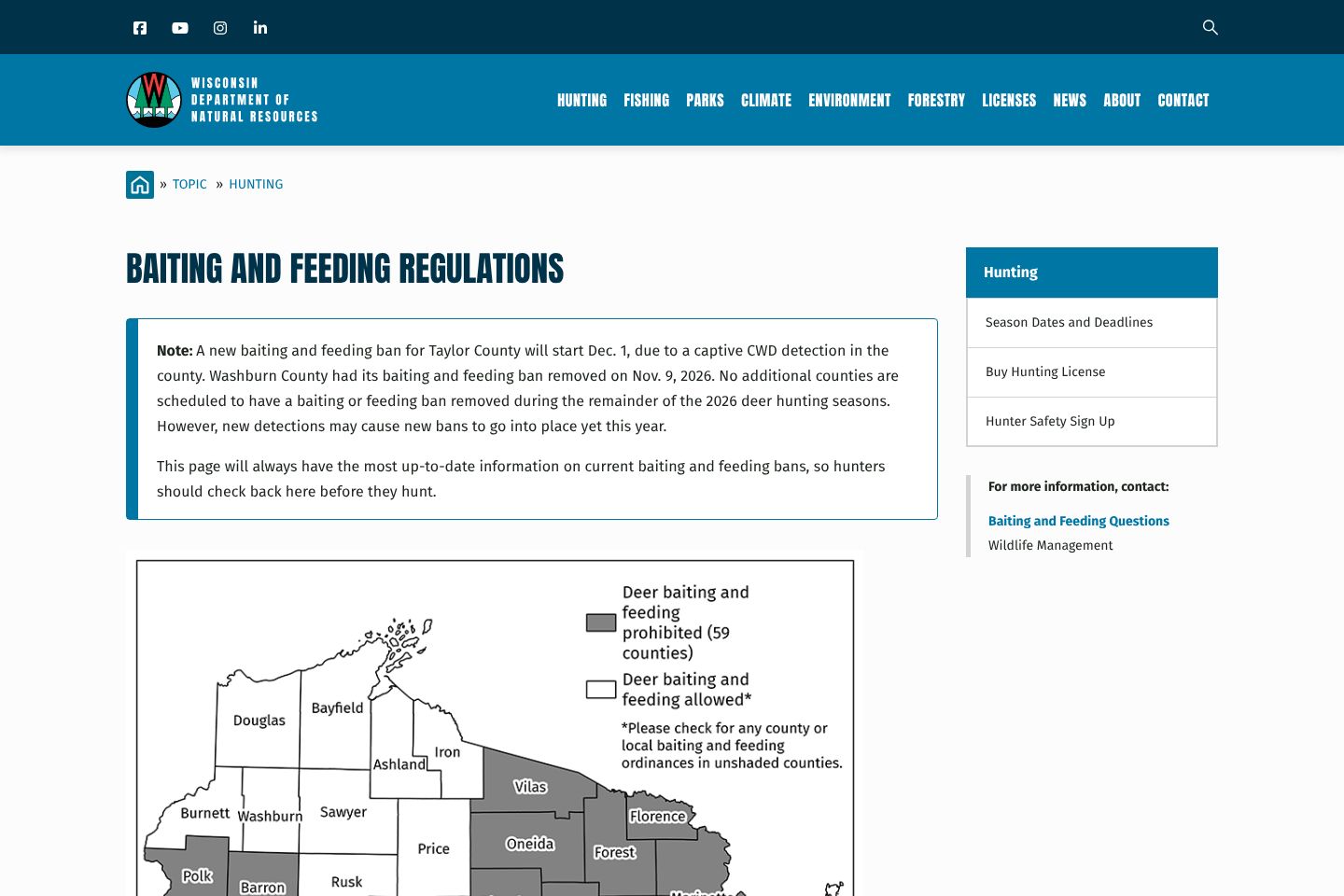
Yes, CWD was found in Price County, Wisconsin. The state Department of Agriculture, Trade and Consumer Protection (DATCP) said Nov. 23, 2026, that a Price County deer farm “has tested positive for two cases of chronic wasting disease,” both in 3-year-old whitetail bucks, and the farm is under quarantine (DATCP, Nov. 23, 2026). State law ties a baiting and feeding ban to a confirmed case like this, but as of Monday afternoon the DNR had not announced one for Price County or given a start date.
Key Takeaways
- The two positives came from two 3-year-old whitetail bucks, and the National Veterinary Services Laboratories in Ames, Iowa, confirmed the results (DATCP, Nov. 23, 2026).
- DATCP and USDA veterinarians are running the epidemiological investigation while the farm stays quarantined (DATCP, Nov. 23, 2026).
- Price is one of 13 Wisconsin counties where deer baiting and feeding are still allowed on the DNR’s map dated Nov. 9, 2026 (Wisconsin DNR baiting page).
- The DNR says state law requires a three-year ban in a county where CWD is detected and a two-year ban in adjoining counties within 10 miles (Wisconsin DNR, Nov. 11, 2026).
What was found on the Price County deer farm?
DATCP says “The positive results came from two 3-year-old whitetail bucks.” The premises “is quarantined, where it will remain while DATCP and the U.S. Department of Agriculture (USDA) veterinarians and staff conduct the epidemiological investigation” (DATCP, Nov. 23, 2026).
That’s about all the release gives. It doesn’t name the farm, say where in the county it sits, say how many deer it holds or say whether it’s a breeding farm or a hunting ranch. Those details aren’t public, so they aren’t here.
DATCP is the agency in charge of captive deer. Its release says it “regulates deer farms for registration, recordkeeping, disease testing, movement, and permit requirements” (DATCP, Nov. 23, 2026).
Is deer baiting banned in Price County now?
Not yet. The DNR’s baiting page still lists Price among the open counties: “Ashland, Bayfield, Burnett, Door, Douglas, Brown, Iron, Kewaunee, Price, Rusk, Sawyer, Taylor and Washburn Counties.” The page also warns that “new detections may cause new bans to go into place yet this year” and says bans renew with each new wild or captive positive, with the map updated “as soon as they are regulatory” (Wisconsin DNR baiting page).
Captive cases count. The same page says Taylor County’s new ban starts Dec. 1 “due to a captive CWD detection in the county” (Wisconsin DNR baiting page). A farm buck triggers a ban the same as a wild one.
The DNR’s own summary is plainer: “State law requires that the DNR enact a three-year baiting and feeding ban in counties where CWD has been detected and a two-year ban in adjoining counties within 10 miles of a CWD detection” (Wisconsin DNR, Nov. 11, 2026).
What nobody has said yet is when a Price County ban would start. We checked the DNR newsroom Monday afternoon and found no Price County release. RAD won’t guess at a date.
How did the Taylor County case play out?
Taylor County is the closest example. DATCP’s list of farm-raised deer positives, revised Oct. 22, 2026, shows a second Taylor County premises with one positive sampled Sept. 21, 2026 (DATCP farm-raised deer CWD positives list). The DNR then announced on Nov. 11 that “Taylor County will begin a three-year baiting and feeding ban on Dec. 1, 2026,” and that “Chippewa County will renew the baiting and feeding ban for another two years from Dec. 1, 2026” (Wisconsin DNR, Nov. 11, 2026).
That’s one case, not a rule about timing. Our Taylor County baiting ban story has the details.
Price County doesn’t appear on that Oct. 22 list, which came out before this case (DATCP farm-raised deer CWD positives list).
Can you still bait in Price County this season?
Under DNR rules, for now, yes, within limits. Outside the banned counties, the DNR’s hunting regulations say “up to two gallons of bait may be placed in total if the parcel is less than 40 acres,” and “If the parcel is 40 acres or more, two gallons may be placed per every 40 acres.” It’s illegal to “Place a baiting site within 100 yards of another baiting site” or to use bait that “Contains any animal part or animal byproduct,” which the DNR says includes honey. Bait could go out “starting at midnight the day prior to the archery deer season opener,” and “Baiting must stop at the close of all deer seasons” (Wisconsin DNR online hunting regulations).
The nine-day gun season “opens on Saturday, Nov. 21, and runs through Sunday, Nov. 29” (Wisconsin DNR, Nov. 10, 2026). Our Wisconsin deer season page has the rest of the 2026 dates.
Check local rules too. The DNR says “Hunters should follow local ordinances that may prohibit baiting and feeding deer until they are notified of a change locally” (Wisconsin DNR baiting page). And check the DNR baiting page before every hunt, because a ban can land midseason.
Which nearby counties could be affected?
That depends on where the farm is, and neither agency has said. The DNR’s rule is a two-year ban in “adjoining counties within 10 miles of a CWD detection.” In Taylor’s case, the DNR said “This positive result is within 10 miles of the border of both Chippewa and Clark counties” (Wisconsin DNR, Nov. 11, 2026).
Counties that already have a longer ban may not change. When the Taylor case hit, the DNR said Clark County “will not be impacted by the detection, as the existing ban is longer than the two-year ban that would otherwise result from this detection” (Wisconsin DNR, Nov. 11, 2026). Expect the DNR’s Price County release, when it comes, to spell out each neighbor the same way.
How common is CWD on Wisconsin deer farms?
It’s not new. DATCP’s farm-raised deer page, with data last updated August 2026, counts 50 farms with a CWD positive test since 2001 and 26 herds depopulated as a result. The state has 216 registered deer premises, 58 of them hunting ranches, and 73 enrolled in the CWD Herd Status program (DATCP Farm-Raised Deer Program).
In the wild, the DNR started watching whitetails for CWD in 1999 and found the first positives in 2002 (Wisconsin DNR, Nov. 18, 2026).
Should Price County hunters test their deer?
It costs nothing. The DNR says “Testing through the DNR is free for deer harvested within the state,” and hunters can drop a head “with 5 inches of neck attached” at a self-service kiosk, use a cooperating processor or taxidermist, pull the lymph nodes themselves, or book DNR staff through the Wildlife Switchboard. Every deer still has to be registered “by 5 p.m. the day after the deer is recovered” (Wisconsin DNR, Nov. 10, 2026).
The DNR’s reason for the bait rules is the pile itself: deer “congregate unnaturally around a shared food source where infected deer can spread CWD through direct contact with healthy deer” (Wisconsin DNR, Nov. 11, 2026).
The other side of it
These two bucks lived behind a fence, and the DATCP release says nothing about whether CWD is in Price County’s wild deer. The DNR’s ban rules don’t make that distinction, so a captive case can close baiting for every hunter in the county. Until the DNR posts a Price County release with dates, the current open-county map is the rule.
Sources
- Price County Deer Farm Confirmed with CWD, Wisconsin Department of Agriculture, Trade and Consumer Protection
- Baiting and feeding regulations | Wisconsin DNR, Wisconsin Department of Natural Resources
- Online Hunting Regulations (deer baiting section) | Wisconsin DNR, Wisconsin Department of Natural Resources
- New Baiting And Feeding Ban For Taylor County Effective Dec. 1, Wisconsin Department of Natural Resources
- Chronic Wasting Disease Positives in Farm-raised Deer, Wisconsin Department of Agriculture, Trade and Consumer Protection
- Farm-Raised Deer Program, Wisconsin Department of Agriculture, Trade and Consumer Protection
- Wisconsin's 2026 Nine-Day Gun Deer Season Opens Nov. 21, Wisconsin Department of Natural Resources
- DNR Confirms CWD In Wild Deer In Pepin County, Wisconsin Department of Natural Resources
Comments