The deer disease you should worry about is usually one of two. Hemorrhagic disease (EHD or bluetongue) kills deer in late-summer outbreaks but doesn’t infect people, and chronic wasting disease (CWD) is the slow, always-fatal prion disease state agencies are chasing county by county. Behind those sits a short list you’ll actually see on a carcass: warts, nasal bots, brain abscesses and, in one corner of Michigan, bovine tuberculosis. Most of them don’t make the meat unsafe, but a couple do.
Key Takeaways
- Hemorrhagic disease is spread by biting midges and “cannot be transferred from one deer to another.” North Carolina says hunters “do not need to be concerned about consuming venison from infected deer” (NCWRC).
- CWD “hasn’t been shown to infect people,” but CDC says to test deer from affected areas and not eat one that tests positive (CDC).
- Bovine TB in Michigan deer can pass to humans, and “less than 38%” of infected deer show chest lesions a hunter would notice (Michigan DNR).
- Deer don’t carry Lyme. CDC says deer “are not infected with Lyme disease bacteria and do not infect ticks.” The ticks riding on them are the problem (CDC).
- The universal rule: don’t shoot, handle or eat a deer that looks sick or acts strange (CDC, NCWRC, ODNR).
What are the most common deer diseases?
Here’s the short version, with what each agency says about eating the deer.
| Disease | What causes it | What you might see | Eat the meat? | Source |
|---|---|---|---|---|
| Hemorrhagic disease (EHD, bluetongue) | Viruses carried by Culicoides midges | Swollen head, neck or tongue; dead deer near water; peeling hooves | Yes, per NCWRC and ODNR, unless the deer looked sick | VA DWR, NCWRC |
| Chronic wasting disease | Misfolded prion protein | Often nothing; late cases are thin, uncoordinated, drinking a lot | Test first; never eat a positive | CDC |
| Bovine tuberculosis | Mycobacterium bovis bacteria | Tan or yellow lumps on ribs or lungs (most infected deer look healthy) | No, if infected | Michigan DNR |
| Brain abscess | Trueperella pyogenes bacteria in a head wound | Pus at the antler base or eye sockets, mostly bucks | Never the head; skip anything abnormal | Wisconsin DNR |
| Cutaneous fibromas (“warts”) | A virus | Hairless, wart-like skin growths | Yes, unless a growth is infected | NCWRC |
| Nasal bots | Fly larvae (Cephenemyia) in the nose and throat | Grubs in the nasal passages | Yes | NCWRC |
How can you tell an EHD deer from a CWD deer?
People mix these up every fall, and the agencies wish they wouldn’t. They’re nothing alike underneath.
Hemorrhagic disease (EHD and bluetongue)
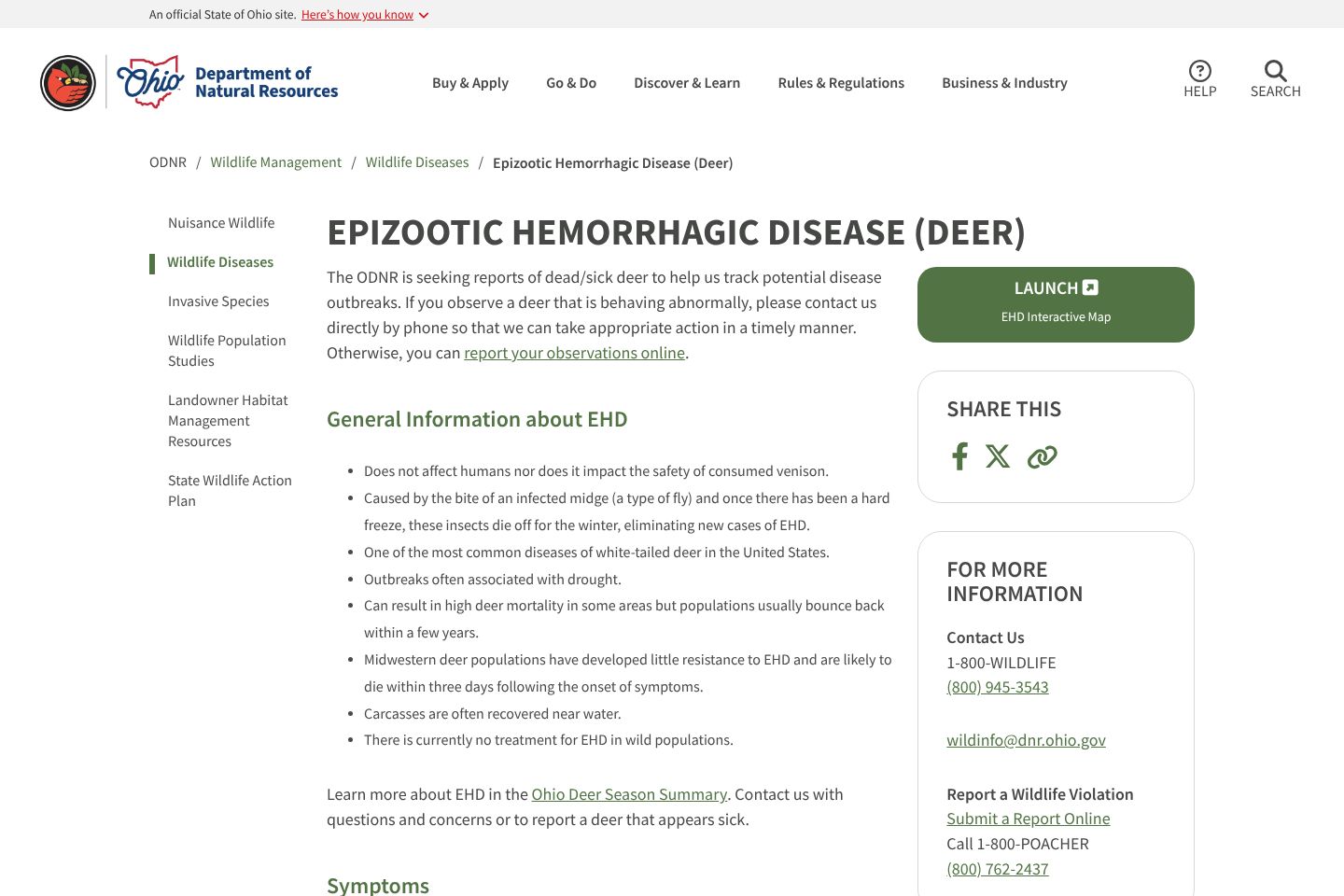
Virginia DWR explains that HD “can be caused by epizootic hemorrhagic disease (EHD) viruses or bluetongue (BT) viruses,” spread by biting midges that breed on exposed mud flats, which is why big outbreaks tend to follow drought (VA DWR; Cornell CWHL EHD). Infected deer can run a high fever and bleed internally. Feverish deer go looking for water, so that’s where the carcasses turn up.
Ohio DNR adds the part every hunter wants to hear: once there’s a hard freeze, the midges “die off for the winter, eliminating new cases” (ODNR). Herds also bounce back. Virginia says local deer have rebounded within a couple of years even after bad outbreaks. Deer that survive can show it later as cracked, peeling hooves (NCWRC; Maryland DNR).
If your state posts an HD outbreak map, know what it’s counting. Wisconsin’s outbreak pages separate laboratory-confirmed counties from suspected citizen reports and publish running carcass-count estimates by county (WI DNR EHD).
Chronic wasting disease
CWD isn’t a virus or a bacterium. It’s a prion, a misfolded protein that eats holes in brain tissue, and Virginia DWR says it “is always fatal to deer, with no known cure or vaccine” (VA DWR). Many infected deer look completely healthy until late in the disease. North Carolina lists the late signs: isolation, poor coordination, walking in set patterns, heavy drinking and urination, and low weight (NCWRC).
That’s as far as this page goes on CWD. Our full guide to chronic wasting disease in deer covers spread, testing and carcass rules, and can CWD spread to humans? covers the human-health research.
So here’s one to chew on at camp: which is worse for a herd, a disease that can wipe out a county’s deer in one August and then fade, or one that kills a few deer a year and never leaves?
Is there a new deer disease?
No agency page we read lists a brand-new deer disease. What’s new is where the old ones are showing up:
- CWD keeps reaching new states. Delaware confirmed its first case in a wild white-tailed deer from Sussex County on April 21, 2026 (Delaware DNREC).
- Hemorrhagic disease is moving north. The Southeastern Cooperative Wildlife Disease Study (SCWDS) at the University of Georgia, which has run hemorrhagic disease testing for state agencies since the early 1990s, reported that “the continued detection of EHDV and BTV in northern states demonstrates the continued expansion into the upper Midwest and Northeast” (SCWDS BRIEFS, Winter 2025).
- COVID in deer. North Carolina’s deer disease page notes that SARS-CoV-2 “has been detected in wild white-tailed deer” in Iowa and Ohio (NCWRC).
If a story calls something “the new deer disease,” check whether it’s one of these three with a fresh headline.
Which deer diseases make the meat unsafe?
Most of the scary-looking stuff is cosmetic. The invisible stuff is what to respect.
Warts and nasal bots: ugly, not dangerous
NCWRC says fibroma-covered deer “are safe to eat unless a fibroma has developed a secondary bacterial infection,” and nasal bots “do not make the carcass unfit for human consumption.” Cut off the growth, don’t eat anything infected, and keep going (NCWRC).
Brain abscess: leave the head alone
Wisconsin DNR says brain abscesses usually start when bacteria get into wounds from sparring, a broken antler or a freshly shed pedicle, which is why it’s mostly a buck problem. The infection usually stays in the head, and “no part of the head should be eaten.” Normal cooking destroys the bacteria, but if anything else on the deer looked abnormal, skip it (Wisconsin DNR). Indiana DNR calls it “one of the most common forms of mortality for bucks after the harvest season” (Indiana DNR).
Bovine TB: a Michigan problem with real stakes
Michigan’s bovine TB core sits where Montmorency, Alpena, Oscoda and Alcona counties meet, and the DNR asks for deer heads from an 11-county area in the northeast Lower Peninsula (Michigan DNR). The DNR recommends hunters “do not consume animals infected with bovine TB,” and to wear rubber gloves while field dressing. Its disease page also says the threat of people catching it from animals is “extremely remote” (Michigan DNR). If you find tan or yellow lumps on the inside of the rib cage anywhere in Michigan, the DNR wants that carcass.
What diseases can deer give to people?
Fewer than the internet suggests, but not zero.
- Lyme disease (through ticks, not deer). You “will not get Lyme disease from eating game meat,” CDC says, but “hunting and dressing game animals may bring you into close contact with infected ticks” (CDC). See deer ticks and Lyme disease.
- Brucellosis. CDC lists deer alongside wild hogs, elk, bison, caribou and moose as animals hunters can get it from. It advises eye protection and latex or rubber gloves when handling carcasses, and warns that “freezing, smoking, drying, and pickling meat does not kill the bacteria” (CDC).
- Bovine TB, in the Michigan area above.
- E. coli. In November 2010, a Minnesota high school class processed seven deer on school grounds and grilled venison kabobs. Twenty-nine students got sick. Undercooked venison and not washing hands after handling raw venison were associated with illness (CDC Emerging Infectious Diseases). The authors’ advice: handle and cook venison “with the same caution recommended for other meats.”
- The brain-abscess bacterium can infect people, but Indiana DNR says “human infections are extremely rare” (Indiana DNR).
What deer don’t give you: hemorrhagic disease, which Ohio DNR says “does not affect humans” (ODNR), and, so far, CWD. CDC says “CWD infections in people have never been reported,” though it still recommends testing (CDC).
What should you do with a deer that looks sick?
Don’t shoot it for the freezer, and call your state agency. Ohio DNR puts it plainly: “never kill or eat a sick deer,” because “without testing, we cannot be certain what a sick deer is suffering from” (ODNR). Reports matter because “delays in reporting hinder the ability to determine the cause of death or illness,” per North Carolina. In North Carolina, that’s the Wildlife Helpline at 1-866-318-2401 (NCWRC). Ohio hunters can find the specifics in our Ohio deer disease guide.
And when you field dress any deer, do what CDC tells CWD-area hunters: wear latex or rubber gloves, stay out of the brain and spine, and keep your kitchen knives out of it (CDC).
Related reading on RAD:
- Chronic wasting disease in deer: what hunters need to know
- Can chronic wasting disease spread to humans?
- Deer ticks: where they live and how they find you
The other side of it
All this “most of it’s fine to eat” talk comes with fine print. Virginia DWR reminds hunters that “a CWD test is not a food safety test,” most TB-infected deer in Michigan look perfectly healthy, and every “safe to eat” line above assumes the deer didn’t look sick to begin with. So the careful hunter’s version of deer disease is less “don’t worry about it” and more “know what you’re looking at, and test when the agency says to.” As for the guy who’s eaten sick-looking deer for forty years and turned out fine, that’s a sample size of one, which is also the number of tests he’s run.
Keep reading
Latest deer news
Sources
- Deer Diseases | NC Wildlife
- CDC (cdc.gov)
- Hunting in the bovine tuberculosis area? Get your deer tested
- CDC (cdc.gov)
- CWD and HD: What’s the Difference? | Virginia DWR
- Bovine Tuberculosis
- Brain abscesses or cranial abscessation syndrome (CAS) | | Wisconsin DNR
- ODNR (ohiodnr.gov)
- Diseases and Parasites of Maryland Deer
- Delaware Confirms State’s First Case of Chronic Wasting Disease in Wild White-tailed Deer - State of Delaware News
- SCWDS BRIEFS, Winter 2025 (vet.uga.edu)
- Fish and Wildlife: Brain Abscess Syndrome
- CDC (cdc.gov)
- Non-O157 Shiga Toxin–producing Escherichia coli Associated with Venison - Volume 18, Number 2—February 2012 - Emerging Infectious Diseases journal - CDC
- Epizootic hemorrhagic disease (EHD) in Wisconsin deer | | Wisconsin DNR
- Hemorrhagic Disease of Deer
Comments