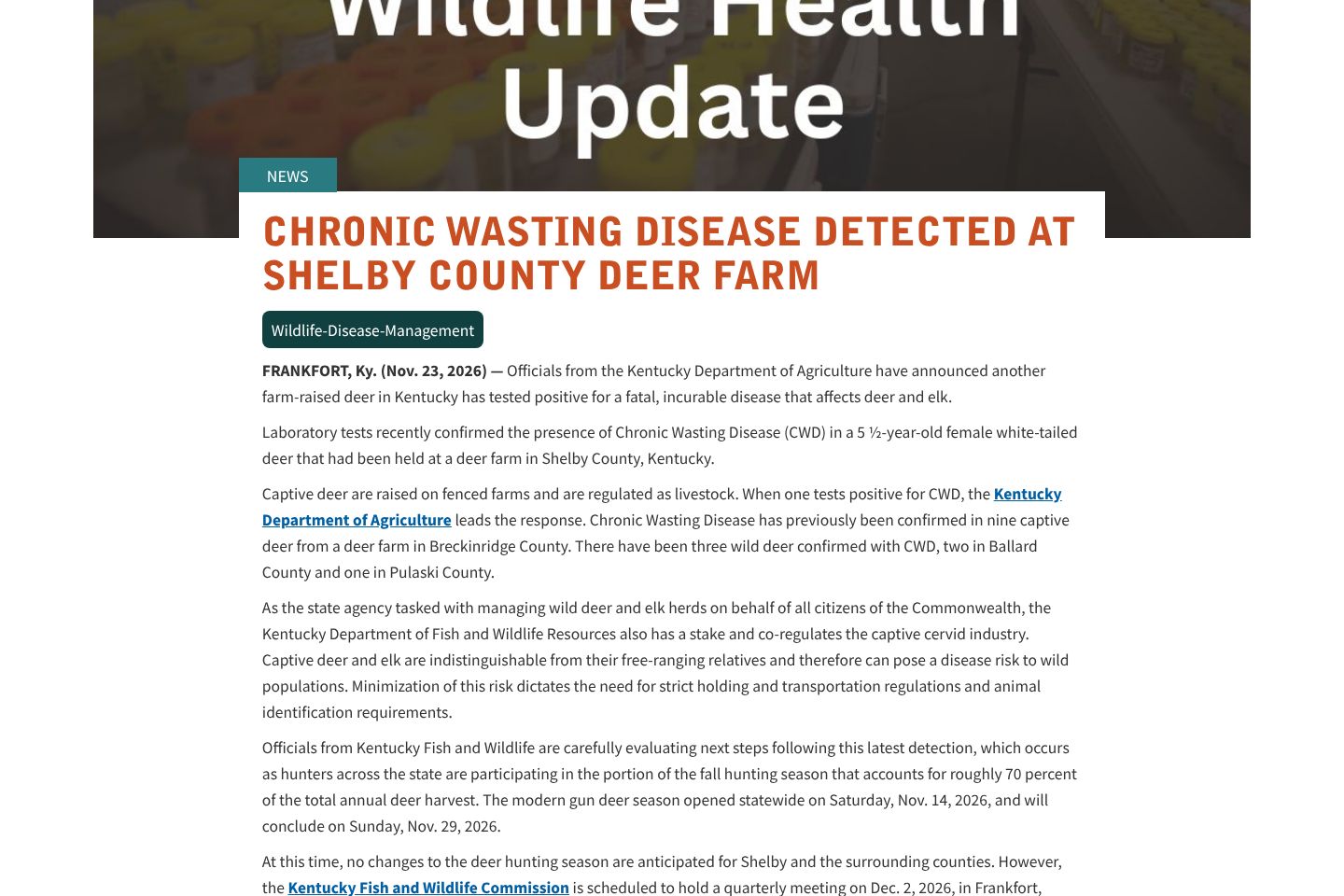
Yes, CWD was found in Shelby County, Kentucky, in a 5½-year-old female white-tailed deer that had been held at a deer farm there, Kentucky Fish and Wildlife announced Nov. 23, 2026. No changes to the deer season are expected for Shelby or the counties around it right now, and the agency plans to bring an update to the Fish and Wildlife Commission on Dec. 2 (KDFWR, Nov. 23, 2026).
Key Takeaways
- The positive came from a deceased deer on a Shelby County farm. The National Veterinary Services Laboratory notified the state on Nov. 19, 2026, and the farm is under quarantine (Kentucky Department of Agriculture, Nov. 23, 2026).
- The Department of Agriculture leads the response because captive deer are regulated as livestock (KDFWR, Nov. 23, 2026).
- Kentucky’s count now stands at nine captive deer from a Breckinridge County farm, this Shelby County deer, and three wild deer: two in Ballard County and one in Pulaski County (KDFWR, Nov. 23, 2026).
- Shelby County is not on KDFWR’s current CWD Surveillance Zone list (KDFWR CWD page).
- Testing your deer is free through drop-off sites or mail-in kits (KDFWR, Nov. 23, 2026).
What was found on the Shelby County deer farm?
Lab tests confirmed chronic wasting disease in one doe, about 5½ years old, that had been kept on a deer farm in Shelby County (KDFWR, Nov. 23, 2026).
The Department of Agriculture’s release fills in the timeline. On Nov. 19, 2026, the National Veterinary Services Laboratory told the Office of the State Veterinarian about “a positive Chronic Wasting Disease (CWD) test from a deceased deer at a deer farm in Shelby County.” The farm takes part in the state deer program and “has been issued a quarantine restricting movement into or out of the facility, including live deer or deer products” (Kentucky Department of Agriculture, Nov. 23, 2026).
Neither agency has said where the doe came from or how many other deer are on the farm. That’s not in either release, so it isn’t here.
Who is in charge of the response?
Farmed deer in Kentucky are livestock on paper, so the Department of Agriculture runs the show when one tests positive. Kentucky Fish and Wildlife co-regulates the captive deer industry and says captive deer “are indistinguishable from their free-ranging relatives and therefore can pose a disease risk to wild populations” (KDFWR, Nov. 23, 2026).
The State Veterinarian set up a 5-mile management zone and a 15-mile surveillance zone for herds near the farm. Every deer farm inside those circles is under restricted movement until the State Veterinarian says otherwise, and the office is going back through recent movement records. It’s working from a CWD Response Plan that Agriculture and Fish and Wildlife approved together in 2022 (Kentucky Department of Agriculture, Nov. 23, 2026).
Those zones apply to deer farms. They are not the hunting rules KDFWR uses for wild deer.
Will Shelby County deer season rules change this year?
Not for now. “At this time, no changes to the deer hunting season are anticipated for Shelby and the surrounding counties,” KDFWR said. The Commission meets Dec. 2, 2026, in Frankfort, and the agency plans to give an update and any management recommendations there (KDFWR, Nov. 23, 2026).
The timing lands in the middle of the busiest stretch of the year. Modern gun season opened statewide Nov. 14 and runs through Sunday, Nov. 29, 2026, the part of the fall that KDFWR says accounts for roughly 70 percent of the annual deer harvest (KDFWR, Nov. 23, 2026). Our Kentucky deer season page has the rest of the 2026-27 dates.
Shelby County isn’t one of the counties under KDFWR’s CWD Surveillance Zone rules. The agency lists that zone as Ballard, Breckinridge, Calloway, Carlisle, Casey, Fulton, Graves, Hardin, Henderson, Hickman, Laurel, Lincoln, Marshall, McCracken, McCreary, Meade, Pulaski, Rockcastle, Union, Wayne, Webster and Whitley counties (KDFWR CWD page). If you hunt any of those, the Kentucky CWD carcass transport rules still apply.
What happened the last time CWD turned up on a Kentucky deer farm?
Kentucky’s first captive case was a dead deer on a Breckinridge County farm in October 2024. The state quarantined that farm too (KDFWR, Oct. 2024).
KDFWR’s 2025 disease report to the legislature lays out what came next. The facility “was indemnified and depopulated in July of 2025,” and testing of the herd turned up eight more positives, nine in all. Seven were natural additions to the herd and two had come from a decommissioned facility in Monroe County. Breckinridge, Hardin and Meade counties went into the Surveillance Zone (KDFWR CWD status report, Nov. 2025).
That detection also came after the season had started, and the department “opted to not adjust deer seasons or regulations” that year. It ran voluntary check stations at three meat processors instead. Those samples met the county goals, but the report says the department “did not meet the statistically significant sampling goals for the 5-mile radius Management Zone surrounding the known positive to confidently assess whether the disease had spilled over into wild deer surrounding the facility” (KDFWR CWD status report, Nov. 2025). Whether Shelby County gets the same treatment is up to the Dec. 2 meeting.
Where else has Kentucky found CWD?
The first wild case was in Ballard County in December 2023, a 2.5-year-old buck taken by a hunter that “displayed normal behavior” (KDFWR CWD status report, Nov. 2025).
A hunter-killed 2.5-year-old buck from Pulaski County followed in October 2025. Two separate tests confirmed it (KDFWR, Oct. 29, 2025). KDFWR’s Nov. 23 release now counts two wild cases in Ballard County and one in Pulaski (KDFWR, Nov. 23, 2026).
KDFWR’s current wild deer and elk testing table shows 4,990 samples statewide: none detected, 2,314 not detected and 2,676 still pending (KDFWR CWD page).
How do I get my deer tested for CWD in Kentucky?
Drop the head at a self-serve CWD Sample Drop-off site or send it in with a mail-in kit. Both are free, and KDFWR says hunters “will be promptly notified if a deer they harvested tests positive for CWD.” A deer that looks sick without an obvious injury can be reported through the agency’s online sick deer form, and the Information Center is at 800-858-1549 (KDFWR, Nov. 23, 2026).
Is venison from Kentucky deer still safe to eat?
CWD “is not known to be transmissible to people,” but the Centers for Disease Control and Prevention recommends not eating meat from deer that test positive. KDFWR also says not to eat meat from animals that look sick or in poor condition (KDFWR, Oct. 2024). If you plan to eat a Shelby County deer and want peace of mind, test it and wait on the result.
The other side of it
One sick doe behind a fence is not proof the disease is in the woods outside it, and KDFWR has not reported a wild positive in Shelby County. The catch is that nobody can say it isn’t there either until enough hunter-killed deer around the farm get tested, and the Breckinridge report shows that sample can come up short. Until the Commission meets, the free test is the only answer any hunter has.
Sources
- Chronic Wasting Disease detected at Shelby County deer farm, Kentucky Department of Fish and Wildlife Resources
- CWD positive deer confirmed in Kentucky farmed cervid facility, Kentucky Department of Agriculture
- Chronic Wasting Disease, Kentucky Department of Fish and Wildlife Resources
- Chronic Wasting Disease detected in captive cervid from Breckinridge County, Kentucky Department of Fish and Wildlife Resources
- Status of Chronic Wasting Disease (CWD) and Wildlife Diseases, Report Required by KRS 150.740(6), November 1, 2025, Kentucky Department of Fish and Wildlife Resources (filed with the Kentucky General Assembly)
- Chronic Wasting Disease detected in Pulaski County wild deer, Kentucky Department of Fish and Wildlife Resources
Comments