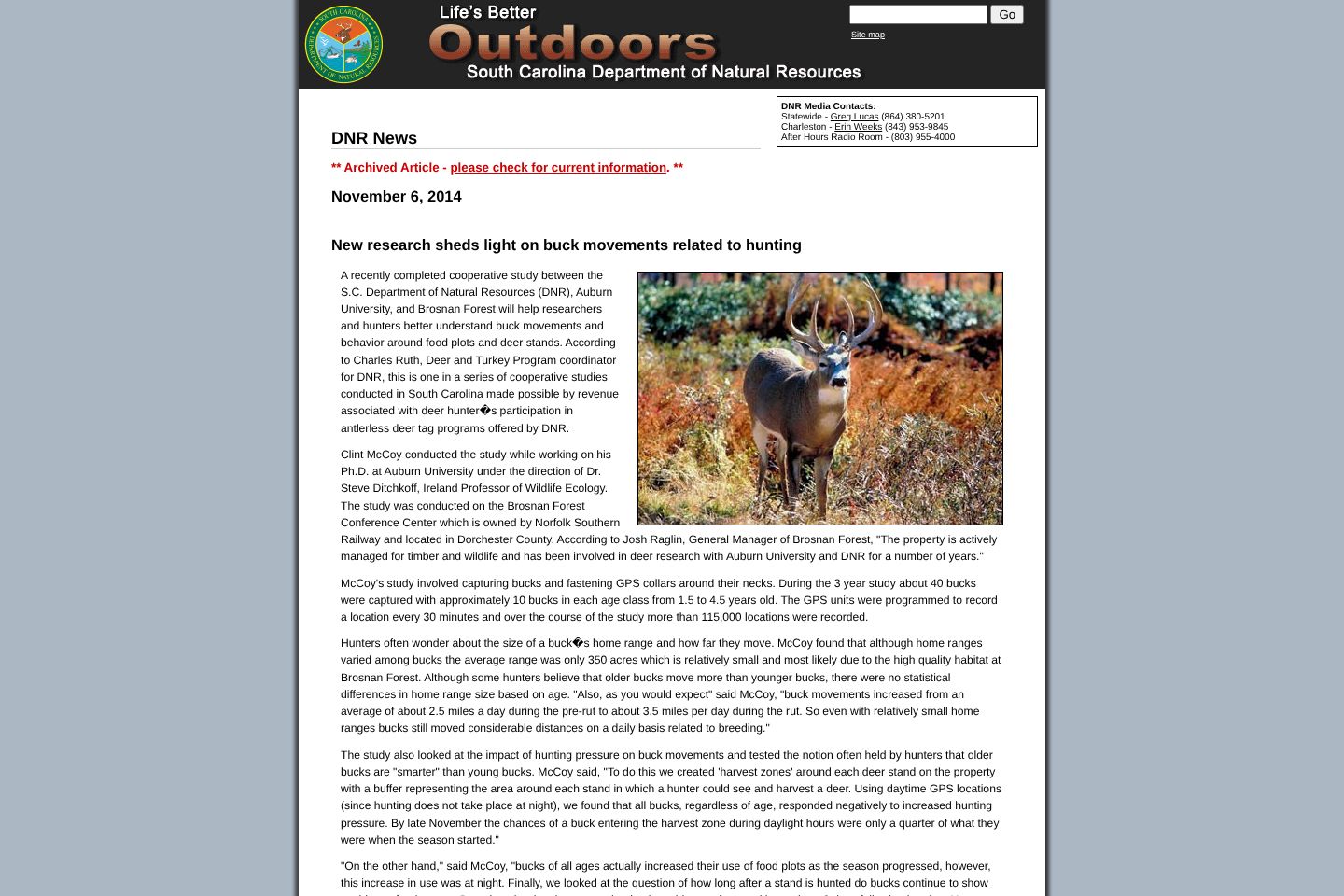
The deer hunting tips that hold up are the ones GPS collars keep confirming: bucks move most in the first and last two hours of light even under heavy pressure, one sit burns a stand for about three days, most hunters never get half a mile from a road, and deer barely register blaze orange but see blue well. Every tip below links to the study or agency page that measured it.
Key Takeaways
- Penn State’s collared bucks in rifle season moved least from 9 a.m. to 4 p.m. and peaked from 6 to 8 a.m. and 5 to 7 p.m. (Penn State).
- Mississippi State found about one-third of October and November buck movement in daylight, rising past 40 percent in the rut (MSU Extension).
- One sit kept bucks away from a stand for about three days. By late November a buck’s odds of entering a hunted zone in daylight were about a quarter of opening-day levels (SC DNR / Auburn).
- GPS units on Pennsylvania public-land hunters put the average farthest point from a road at about half a mile (Stedman et al., 2004).
What’s the most effective way to hunt deer, according to the data?
Go where the other hunters don’t, and the GPS units on actual hunters show how little ground that takes.
In 2001 and 2002, Penn State researchers handed GPS units to rifle hunters on Sproul State Forest. The average hunter’s farthest point from an open road was 0.84 km. Hunter density fell with distance from roads and with slope, and 73 percent stayed within 0.5 km of a road (Penn State report, 2004). Surveyed afterward, those hunters said they’d gone 2.23 km. The units said otherwise (Stedman et al., 2004).
Penn State’s Duane Diefenbach wrote that bucks and does shrink their daytime range to about 100 acres in rifle season, down from roughly 3 square miles for a rutting buck, and that “deer that survive the rifle season have a special hiding place” (Penn State). The hunter data is twenty years old and from one forest, so treat the half mile as a lead, not a law. But an Oklahoma study found hunter sightings of collared bucks fell every weekend after the opener, and under heavy pressure the bucks that got seen were the ones that had been moving (Little et al., 2014). Deer that hold still in cover survive. Hunters who sit over that cover see them.
What time of day are most bucks on their feet?
First light and last light, even after the shooting starts.
Penn State logged buck locations every 20 minutes through rifle season. Movement bottomed out between 9 a.m. and 4 p.m. and peaked from 6 to 8 a.m. and 5 to 7 p.m. Later in the season the bucks slowed at every hour, and Diefenbach wrote, “Clearly deer are responding to hunting pressure and reducing their movements.” Proof they go nocturnal? His answer: “I’m not so sure” (Penn State).
Mississippi State collared more than 40 bucks aged 2 and up and checked them every 15 minutes for two seasons. About a third of October and November movement was in daylight, and in the rut it passed 40 percent. Their advice on when to hunt: “Whenever you can” (MSU Extension).
Should the moon change your plan?
No. The same Mississippi data, 48 bucks, showed no bump on full moons and no slump on new ones, even though 83 percent of Mississippi hunters surveyed believed the moon strongly affects deer (MDWFP). As the NDA’s Cole Gander puts it, “Deer are crepuscular, not nocturnal.” A buck on your camera at midnight was probably also on his feet at 7 a.m., somewhere your camera wasn’t (NDA).
How badly does one sit burn a stand?
About three days’ worth, and it compounds all season.
Auburn’s Clint McCoy collared around 40 bucks on Brosnan Forest in South Carolina. After a stand was hunted once, bucks avoided it for about three days, and five days later they were still less likely to visit than before. By late November, a buck’s chance of entering a harvest zone in daylight was about one-quarter of what it had been at the opener, and age didn’t buy immunity (SC DNR).
McCoy’s takeaway: “For hunters it is best to be unpredictable when choosing your hunting locations.” So, honestly: how many mornings in a row did you climb the same tree last November?
Do deer remember getting shot at?
Nobody has collared that exact question. The South Carolina study measured stand occupancy, not shots fired, and your presence alone moved the bucks. Diefenbach, on opening day in Pennsylvania: “you can see they respond incredibly quickly to the hunters” (Penn State).
Does wind matter more than the forecast?
For deer movement, less than you’d think. For your scent, it’s the whole game.
Penn State saw the least movement on calm days and more as wind picked up. Auburn’s South Carolina data showed little wind effect before and during the rut, and Mississippi State’s Bronson Strickland said of his earlier work, “we generally found little to no effect of weather on deer movements.” The closer to the rut, the less any weather variable mattered (NDA).
It is a reason to pick a different tree. No study we found measured how far a deer smells a hunter, so no number here. Every stand you hang should have a wind it works in and a wind it doesn’t; the how-to is in our scent-control guide below.
What colors do deer actually notice?
Blue, not orange. A 2023 paper from University of Georgia deer researchers summarizes it: whitetails are “most sensitive to short- and mid-wavelength light (e.g. blue and green)” and “less sensitive to long wavelengths with a sharp decline in sensitivity at wavelengths >600 nm” (Newman et al., 2023). Red and orange sit at that long end. Your blaze vest reads close to dull gray. Your blue jeans are a flag.
Where should you aim to kill a deer cleanly?
Broadside, just behind the shoulder, a third of the way up. Texas hunter-ed says it plainly.
Texas Parks and Wildlife calls broadside the best shot for new hunters because it “presents the largest target area to strike the heart and lungs”: aim low on the near front leg, come up one-third into the body, hold just behind the shoulder. Quartering-away still gets the vitals if you hold behind the shoulder; drift back and you gut-shoot him. Rear-end: “Never take this shot with firearm or bow” (TPWD).
Nothing “kills a deer instantly” on a reliable basis. There’s a heart-lung shot and a short wait.
| Where you hit him | How long the NDA says to wait |
|---|---|
| Heart or lungs, firearm | A few minutes |
| Heart or lungs, archery | 15 to 30 minutes |
| Liver | 8 to 10 hours |
| Guts | 10 to 12 hours |
Source: National Deer Association. Read the arrow and the hair before you pick a row.
What mistakes cost first-season hunters the most?
Falling out of a tree, and it isn’t close.
Arkansas Game and Fish logged 16 hunting injuries in the 2022 season. Ten were treestand falls, one of the two deaths was a fall, and “in every treestand injury reported last year, the victim was not wearing a safety harness.” About two-thirds of falls happen climbing in or out, and people have died from 8 feet (AGFC). New York had nine elevated-stand incidents in 2025 and one death; the hunter who died and seven of the eight injured wore no harness (NY DEC).
After that, the rookie mistakes are the ones the collars already explained: the same stand five mornings running, and a wind you never checked.
Is a deer from an EHD area safe to eat?
Yes, if it looked healthy on the hoof. Michigan’s DNR, confirming 2026 cases, wrote: “Venison harvested in areas affected by EHD is safe for consumption,” while warning against eating any visibly sick animal. EHD spreads by midge bite, there’s no evidence people can catch it, and the first frost ends it (Michigan DNR).
Related reading on RAD:
The other side of it
Every study above comes from one property with its own hunter density, cover and food, and a Pennsylvania big-woods buck may not act like the deer on your 80 acres. Read honestly, the best deer hunting tips the research supports are boring: sit the edges of daylight, don’t wear out a stand, hunt where the trucks aren’t, and go as many days as you can, which is roughly what the crew-tips articles said without a single footnote. Still, when a man at camp tells you the solunar table had the majors at 11:40, ask him which of the 48 collared bucks in Mississippi got the memo.
Keep reading
Latest deer news
Sources
- When do they sleep? | Penn State Deer-Forest Study
- Research sheds light on best times to hunt bucks | Mississippi State University Extension Service
- State Heritage Trust Advisory Board to meet at Lake Wateree State Park on Nov. 6
- Integrating wildlife and human-dimensions research methods to study hunters - Penn State
- Penn State report, 2004 (ecosystems.psu.edu)
- The Life and Times of Buck 8917 | Penn State Deer-Forest Study
- "Does Human Predation Risk Affect Harvest Susceptibility of White-Taile" by Andrew R. Little, Stephen Demarais et al.
- Moon Myths vs Deer Reality? What the Science Says | Mississippi Department of Wildlife, Fisheries, and Parks
- NDA (deerassociation.com)
- Oh, deer: Study uses GPS to explore animals' relationship with forest | Penn State University
- NDA (deerassociation.com)
- Newman et al., 2023 (pmc.ncbi.nlm.nih.gov)
- Shots to the Vital Areas — Texas Parks & Wildlife Department
- National Deer Association (deerassociation.com)
- Arkansas hunting injuries hit 13-year low • Arkansas Game & Fish Commission
- NY DEC (dec.ny.gov)
- DNR confirms epizootic hemorrhagic disease in deer from four counties
Comments