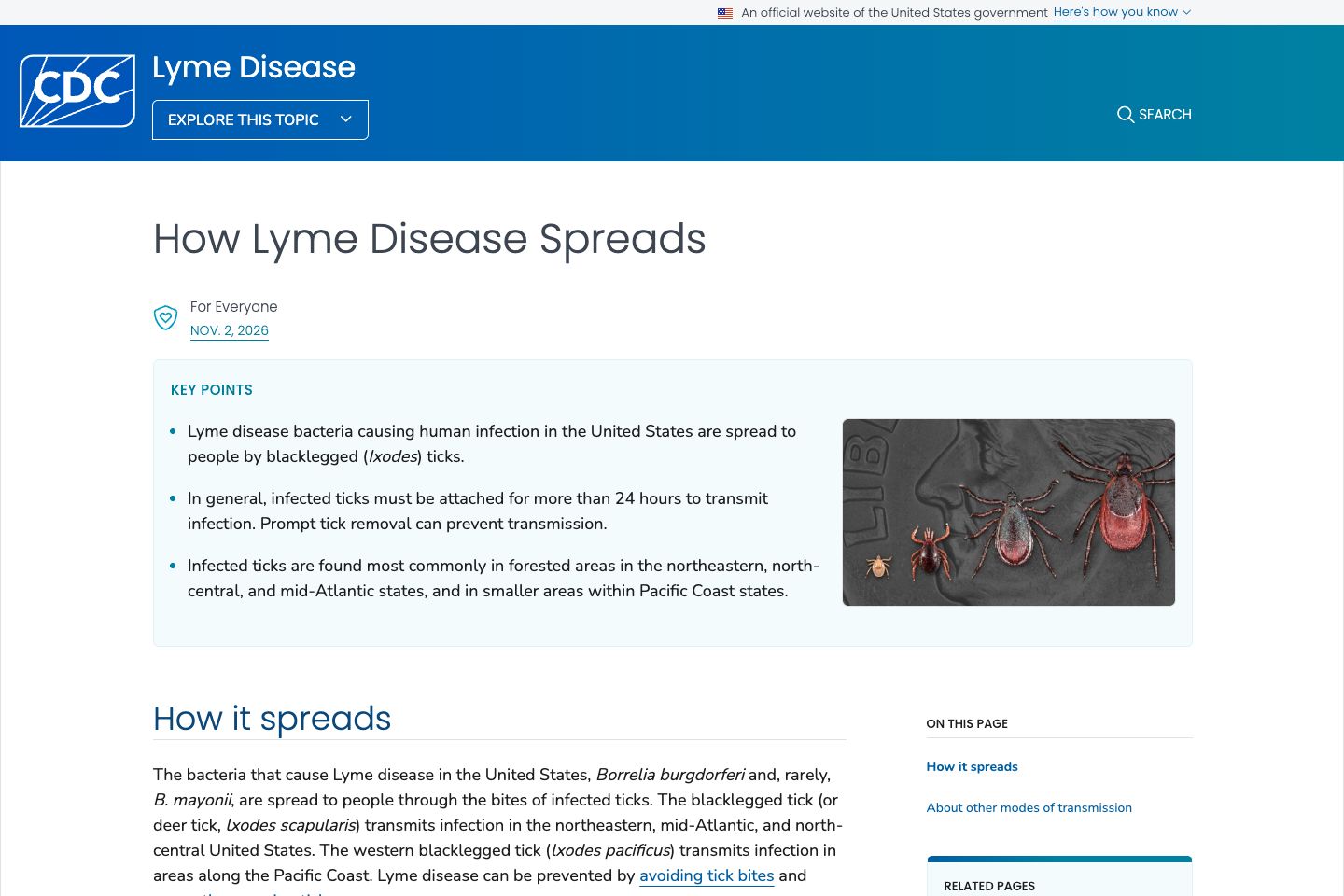
Deer ticks can give you Lyme disease, but the deer aren’t the ones handing it out. The blacklegged tick, the one everybody calls the deer tick, picks up Lyme bacteria from infected wildlife, usually rodents, and CDC says deer “are not infected with Lyme disease bacteria and do not infect ticks” (CDC). For a hunter, the risk is the tick on your pant leg, not the backstrap in your freezer, and CDC says that in most cases a tick has to be attached for more than 24 hours to pass Lyme along (CDC).
Key Takeaways
- Attachment time matters. “In most cases, a tick must be attached for more than 24 hours before the Lyme disease bacterium can be transmitted” (CDC).
- Nymphs cause the most trouble because they’re small and plentiful. Adults, the ones on deer in the fall, get noticed and pulled more often (CDC).
- You won’t get Lyme from venison. But CDC warns that “hunting and dressing game animals may bring you into close contact with infected ticks” (CDC).
- Permethrin at 0.5% on clothing, a shower within two hours, and 10 minutes in a hot dryer are CDC’s core steps (CDC).
- Cutting deer numbers dropped Lyme cases sharply in one Connecticut community, but a CDC-led review found “insufficient evidence” to recommend it as a general prevention measure (CDC Stacks).
For where deer ticks live and how they find you, start with our deer ticks guide. This page sticks to the Lyme question.
How do deer ticks spread Lyme disease?
Two species do it: the blacklegged tick in the Northeast, mid-Atlantic and north-central U.S., and the western blacklegged tick along the Pacific Coast. Lone star ticks, American dog ticks and the rest “cannot transmit Lyme bacteria,” though they carry other diseases (CDC).
A young tick gets infected by feeding on an infected animal, then passes the bacteria to the next thing it bites. That next thing might be you.
Why are nymphs the bigger threat?
CDC says “nymphal ticks pose a particularly high risk due to their abundance and small size.” They’re most active April through July. Adult females can transmit too but “are more likely to be noticed and removed before transmission,” and adults are most active in early spring and fall, right when you’re sitting in a stand.
What are the chances a tick bite gives you Lyme?
There’s no clean per-bite number on CDC’s pages, and we won’t make one up. What CDC does give you are the factors that move the odds: whether it’s a blacklegged tick, whether it’s a hard-to-see nymph, whether you live where Lyme is common, and above all how long it stayed on. Removing a tick within 24 hours greatly reduces the chance of infection. The scale is big, though. More than 80,000 cases are reported to CDC each year, and CDC estimates 476,000 people may be diagnosed and treated annually (CDC).
Do deer carry Lyme disease?
No. Deer feed ticks, but they don’t infect them. CDC’s line: deer “are a source of blood for ticks and important to tick survival and movement to new areas.”
The real reservoir is smaller. The Cary Institute of Ecosystem Studies says the white-footed mouse “infects between 40% and 90% of feeding larvae,” with chipmunks and shrews as moderately competent backups. Cary’s researchers also tied acorn crops to mouse numbers the next year and to infected ticks after that, a chain that can predict Lyme risk “almost two years in advance” (Cary Institute). A big white oak mast year, in other words, is good news for your deer and bad news for your ankles two summers later.
So where do deer come in? University of Maine Cooperative Extension says adult deer ticks “prefer deer,” with activity peaks in April or May and again in late October (UMaine Extension). The University of Rhode Island’s TickEncounter calls white-tailed deer the tick’s “reproductive host” (URI TickEncounter). Deer feed the adults that lay the eggs. Mice infect the babies.
What’s a hunter’s risk in the field and at the skinning shed?
Higher than a backyard gardener’s, mostly because of when and how you’re out there. Glen Needham, an Ohio State emeritus medical entomologist, wrote in a tick guide published by Ohio DNR that hunters can pick up ticks on the walk in, “while field dressing the animal,” on the way back to the truck, and while skinning and processing. He adds that “ticks may remain attached to the deer for several days after being killed,” and warns that ticks that were already feeding on a deer “may transmit Lyme disease in a very short time,” so pull any attached tick the moment you find it (ODNR tick information for deer hunters). One more of his: check a hide before you compost it, or you may be seeding your own yard.
Illinois’ health department tells hunters to “wear gloves when dressing or butchering game and wash hands thoroughly afterwards” (IDPH).
Quick gut check: when was the last time you looked behind your knees after dragging a buck out?
How do you know if a deer tick gave you Lyme?
Watch the bite and watch yourself. CDC says early signs show up 3 to 30 days after a bite: fever, chills, headache, fatigue, muscle and joint aches and swollen lymph nodes. The telltale erythema migrans rash shows up in about 70 to 80 percent of infected people, starting at the bite “after a delay of 3 to 30 days (average is about 7 days)” and spreading up to 12 inches or more. It doesn’t always look like a bull’s-eye (CDC).
If you get a rash or fever within several weeks of a tick bite, see a doctor and tell them when and where you were bitten (CDC). Needham suggests saving the tick so it can be identified. CDC adds a caution: testing the tick generally isn’t recommended to guide treatment, and a negative result can be falsely reassuring.
Can Lyme disease be cured, and what about long-term effects?
Caught early, it usually clears up. CDC says most cases can be treated with 10 days to 4 weeks of antibiotics, and people treated early “usually recover rapidly and completely.” CDC also says a single dose of doxycycline after a bite where Lyme is common may lower the risk; ask your doctor if that fits you (CDC).
Left alone, it can spread. CDC’s list of later signs includes severe headaches and neck stiffness, facial palsy, arthritis in the knees and other big joints, heart palpitations, and nerve pain or numbness in the hands and feet. Some people feel lousy for months after treatment. CDC says that at six months, prolonged symptoms are 5 to 10 percent more common in people who had Lyme than in people who didn’t, that patients “usually get better over time without additional antibiotics,” and that “extended treatment with antibiotics is no better than placebo” (CDC).
How do you keep ticks off you during deer season?
You spend hours in leaf litter, edges and brush where blacklegged ticks quest, so CDC’s prevention advice fits a deer hunt almost line for line (CDC prevent Lyme). Here’s its list, translated for hunters (CDC tick prevention):
- Treat your hunting clothes and boots with 0.5% permethrin. It holds up “through several washings.” CDC also lists EPA-registered repellents such as DEET and picaridin.
- Tuck shirt into pants and pants into boots, per Needham and Illinois.
- Hot dryer, 10 minutes, on dry clothes when you get home. Washing in cold or medium water won’t kill them.
- Shower within two hours. CDC says it’s been shown to reduce your risk of Lyme.
- Check the hiding spots: under the arms, in and around the ears, inside the belly button, behind the knees, in the hair, between the legs and around the waist. Check your pack and your dog, too.
Pulling one off: use clean, fine-tipped tweezers close to the skin and pull straight out with steady pressure. No petroleum jelly, no lighter, no nail polish, and don’t crush it with your fingers (CDC).
Does killing more deer reduce Lyme disease?
Sometimes, in the right place, and the research is honest about the limits.
The case for it. In a 13-year study of one residential community in Connecticut, Howard Kilpatrick and colleagues found Lyme cases per 100 households were strongly tied to deer density. Cutting deer to 5.1 per square kilometer was associated with a 76 percent drop in tick abundance and an 80 percent drop in resident-reported Lyme cases (Journal of Medical Entomology, 2014, doi:10.1603/ME13232).
The caution. A review led by CDC researchers (Kugeler and colleagues, Zoonoses and Public Health) concluded that “there is insufficient evidence to recommend deer population reduction as a Lyme disease prevention measure,” except in specific ecological circumstances. Removing deer entirely from islands and isolated areas can cut tick reproduction, but “reduction short of complete elimination has yielded mixed results,” and most studies came from places that don’t look like where most Lyme risk lives (CDC Stacks).
Read together: deer hunting can help on an isolated peninsula. Across a whole county full of mice, it’s not a Lyme cure.
Related reading on RAD:
- Deer ticks: where they live and how they find you
- Deer disease: what’s out there and what you can eat
- Can chronic wasting disease spread to humans?
The other side of it
“Blame the mice” can be oversold too. CDC still calls deer important to tick survival and to moving ticks into new areas, and the Connecticut study did see Lyme cases fall when deer numbers dropped hard. So the fair answer on deer ticks and Lyme disease is that deer don’t infect anybody, but they keep the tick business running. Then again, anyone who blames the whole Lyme problem on “too many deer” has never explained why the mouse living in his truck’s air filter gets a free pass.
Keep reading
Latest deer news
Sources
- CDC (cdc.gov)
- CDC tick prevention (cdc.gov)
- CDC (cdc.gov)
- Lyme Disease [Research]
- Blacklegged Tick or Deer Tick - Cooperative Extension: Tick Lab - University of Maine Cooperative Extension
- Blacklegged (Deer) Tick – TickEncounter
- ODNR tick information for deer hunters (dam.assets.ohio.gov)
- 2021.9.30 - Illinois Department of Public Health Warns Hunters About Tickborne Illness
- CDC (cdc.gov)
- CDC (cdc.gov)
- CDC (cdc.gov)
- CDC (cdc.gov)
- The Relationship Between Deer Density, Tick Abundance, and Human Cases of Lyme Disease in a Residential Community
- CDC Stacks (stacks.cdc.gov)
- CDC prevent Lyme (cdc.gov)
Comments