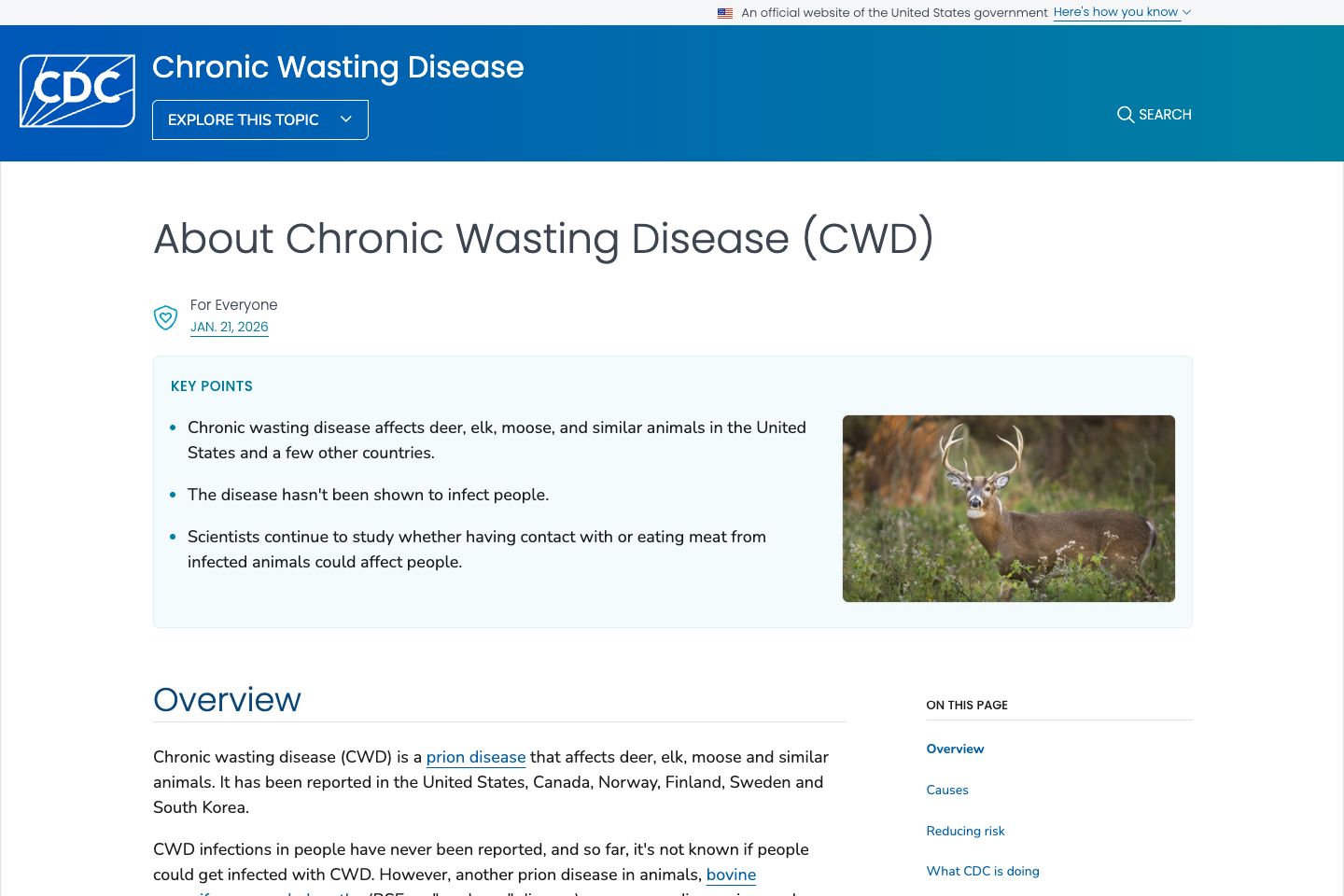
Chronic wasting disease has never been confirmed to infect humans. CDC’s page, dated Jan. 21, 2026, says “CWD infections in people have never been reported, and so far, it’s not known if people could get infected with CWD” (CDC). That second half is why CDC still says “in theory, CWD could be considered a risk to people” and tells you not to eat a deer that tests positive.
Key Takeaways
- No confirmed human case. “To date, no cases of CWD infection in humans have been reported” (NPDPSC).
- The 2024 “two hunters” report was a conference abstract, not a study. Its authors wrote “causation remains unproven” (AAN 2024 abstract).
- Human brain organoids soaked in CWD prions for 180 days did not get infected, suggesting “a significant species barrier” (Groveman et al., EID 2024).
- Macaque studies disagree: none infected in NIH’s 13-year study (NIH, 2018); low-level prion seeding, no classic disease, in a University of Calgary study (CIDRAP).
- The advice hasn’t changed: test deer from CWD areas, don’t eat positives, and cooking does nothing to prions (Virginia DWR).
Is there a human version of chronic wasting disease?
Not exactly. The human prion diseases are the Creutzfeldt-Jakob family; CWD is its own disease of deer, elk, moose and reindeer. What people are really asking is whether deer prions can jump the species barrier and start a prion disease in a person. That has happened once with another animal prion: variant CJD, tied to eating beef from cattle with BSE, “mad cow disease” (CDC). Mad cow is why anyone takes this question seriously. Nobody has shown the same thing with deer.
What is Creutzfeldt-Jakob disease?
CJD is a rapidly fatal brain disease caused by a prion. CDC puts it at “about 1 to 2 deaths per 1 million people per year,” roughly 500 to 600 reported U.S. cases a year. About 85 percent are sporadic, meaning the prion misfolds on its own for reasons nobody fully understands, with an average age of onset in the late 60s. “Once symptoms begin, it can lead to death in months to a year” (CDC).
Hold onto two numbers: one in a million, and sporadic. They are the whole key to reading the 2024 report.
What did the 2024 “two hunters” report actually show?
In April 2024, a UT Health San Antonio team presented a poster at the American Academy of Neurology meeting titled “Two Hunters from the Same Lodge Afflicted with Sporadic CJD: Is Chronic Wasting Disease to Blame?” The abstract was reprinted in Neurology (doi 10.1212/WNL.0000000000204407). In 2022, a 72-year-old man “with a history of consuming meat from a CWD-infected deer population” developed rapid confusion and aggression and died within a month. Autopsy confirmed sporadic CJD, MM1 subtype. A friend who ate venison from the same population had recently died of CJD too (AAN 2024 abstract).
Here is what it did not show. Nobody established that either man ate a deer that tested positive. “CWD-infected deer population” means they hunted where the disease exists. USGS counted CWD in wild or captive herds in 37 states as of June 2026 (USGS). The authors wrote that “it is not possible to definitively rule out CWD in these cases” and that “causation remains unproven.” Two cases of a one-in-a-million disease in one social circle is strange and worth investigating. It is not a diagnosis of CWD in a person.
Why did the headlines say hunters died from eating infected venison?
Because “abstract reprinted in a journal” reads like “study published in a journal,” and nobody clicks on the first one. A Neurology representative told Outdoor Life it was “a scientific abstract presented at the 2024 American Academy of Neurology Annual Meeting and reprinted in Neurology.” Arizona Game and Fish wildlife science coordinator Jim Heffelfinger: “This is not a study and this is not a scientific paper.” UT Health San Antonio’s own spokesperson said “there remain no proven cases of transmission to date” (Outdoor Life).
Mississippi State deer researcher Steve Demarais made the plain point: “we don’t know if they ingested meat that tested positive for CWD.” His colleague Galen Collins, a biochemist, called two cases very unusual against a one-in-a-million baseline and said the concern was reasonable (Mississippi State University). Both things can be true.
What do the lab studies say about CWD crossing to humans?
This is where it gets genuinely unsettled, so here is the scorecard.
| Study | What was done | What it found | Source |
|---|---|---|---|
| NIH macaques (J. Virology, 2018) | 14 macaques fed or injected with brain matter from CWD-infected deer and elk; monitored up to 13 years | “no clinical, pathological or biochemical evidence suggesting that CWD was transmitted” | NIH release |
| NIH human brain organoids (Emerging Infectious Diseases, June 2024) | Human cerebral organoids exposed to high doses of mule deer, whitetail and elk CWD prions; followed 180 days; CJD prions as control | CJD seeded by day 56; CWD never did. “a significant species barrier exists” | Groveman et al. |
| University of Calgary macaques (Science Advances) | 18 macaques inoculated in 2009, orally or into the brain, with elk, mule deer and whitetail CWD; results reported for seven, followed up to 7.5 years | Most showed nothing. Two developed unsteadiness and tremors; standard tests negative, but ultrasensitive assays found prion seeding in brain and sometimes spleen, and that material caused disease in transgenic mice and bank voles | CIDRAP |
Does the species barrier hold?
The organoid authors said their result points to a barrier even when human brain tissue sits in high-dose CWD for months, but added, “Although we cannot rule out the possibility of CWD crossing into humans.” They didn’t test the 129VV genotype, and new CWD strains could emerge (Groveman et al.). CIDRAP’s working group called it evidence of “a strong species barrier,” then listed why it isn’t the last word: the 180-day endpoint “may have been insufficient,” and “it is unclear which prion strains were represented” (CIDRAP statement).
The Calgary study cuts the other way, carefully. Senior author Hermann Schatzl: “We clearly say that the concept that there is no zoonotic potential is likely not correct.” Also Schatzl: “We do not imply efficient transmission.” Prion researcher Olivier Andreoletti, not an author, said “the study does not demonstrate efficient transmission of CWD to macaques.” CDC’s Ryan Maddox: “Thankfully, based on these studies, CDC has found no evidence of CWD in people,” with more years of study needed (CIDRAP).
So: a barrier exists, it may not be absolute, and nobody has watched it fail in a person. If a jump ever happened, would it look like sporadic CJD or like something new? Nobody can promise you the answer, which is why the national surveillance center keeps looking at prion cases from CWD areas (NPDPSC).
Should humans eat meat from a CWD-positive deer?
No. CDC: “if your animal tests positive for CWD, do not eat meat from that animal” (CDC via NPDPSC). CDC treats eating meat from infected deer or elk as the most likely pathway if the disease ever crosses the species barrier (CDC about CWD; Missouri MDC human health & CWD). Virginia DWR relays the same: CDC advises discarding venison from infected animals, and “CWD will not be destroyed through normal cooking” (Virginia DWR). Grilling, canning and smoking are not prion treatments.
The rest of CDC’s list for hunters: don’t shoot, handle or eat a deer that looks sick or acts strange; wear gloves while field dressing; stay out of the brain and spinal cord; keep kitchen knives out of it; and consider testing before you eat (CDC). NDA adds: test every deer from a CWD zone and wait for the result before the backstraps hit the pan (NDA).
One more thing Virginia makes clear. The test is not a food-safety test. A result reads “positive” or “no prions detected,” and a deer early in infection can fall below the detection limit. Mark every package from each deer so a late positive means pulling one deer’s meat, not the whole freezer (Virginia DWR).
Is there a cure for chronic wasting disease in humans?
There is no human disease to cure, and there is no treatment for any prion disease, deer or human. CJD is fatal within months to a year of symptoms (CDC). That is the real reason the chronic wasting disease and humans question gets a cautious answer from every agency, even with zero confirmed cases. The cost of being wrong is not symmetrical.
Related reading on RAD:
- What is chronic wasting disease in deer?
- Are CWD restrictions necessary, or have some gone too far?
- Is hunting deer over bait really hunting?
The other side of it
The case for worrying more than this article does: variant CJD took years to show up after people started eating BSE beef, prion incubation can run decades, and Minnesota’s Peter Larsen worries “we’re underestimating the amount of positive venison being consumed in the US and Canada” because current tests miss early infections (CIDRAP). Zero cases found is not the same as zero cases. Then again, the guy sharing the “zombie deer” video at Thanksgiving will eat gas-station sushi on the drive home and sleep like a baby.
Keep reading
Latest deer news
Sources
- CDC about CWD (cdc.gov)
- USGS CWD distribution by state and county, ver. 4.0 (usgs.gov)
- Chronic Wasting Disease (CWD) | Pathology | School of Medicine | Case Western Reserve University
- 2024 American Academy of Neurology Abstract Website
- Lack of Transmission of Chronic Wasting Disease Prions to Human Cerebral Organoids - Volume 30, Number 6—June 2024 - Emerging Infectious Diseases journal - CDC
- NIH release (eurekalert.org)
- After lab study finds interspecies spread of CWD prions, experts debate significance for humans | CIDRAP
- Human Health and CWD | Virginia DWR
- CDC (cdc.gov)
- Viral Articles Falsely Suggest Chronic Wasting Disease Jumped to Humans
- MSU experts address Chronic Wasting Disease potential risk in humans | Mississippi State University
- CIDRAP statement on NIH study into CWD species barrier | CIDRAP
- NDA CWD (deerassociation.com)
- Missouri MDC human health & CWD (mdc.mo.gov)
Comments