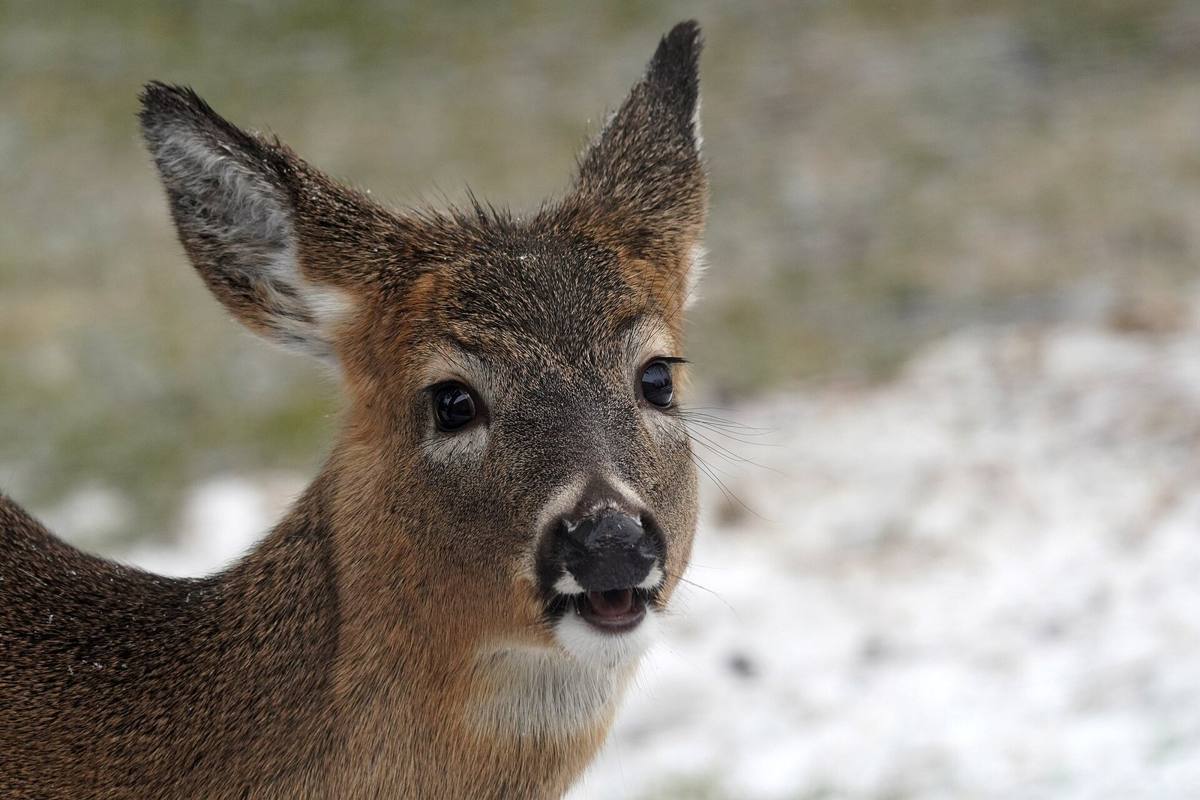
Yes, deer can see colors, just not as many as we do. University of Georgia research found whitetails have two types of color-sensing cones instead of our three, one most sensitive to blue and one to green, with no cone for long-wavelength reds and oranges (NDA). So deer see blue well, see green and yellow, and see reds and oranges as shades of brown or gray. The National Deer Association’s verdict: “exactly zero” whitetails are colorblind, they just see differently (NDA).
Key Takeaways
- Deer have dichromatic vision, with cone peaks around 450 to 460 nanometers (blue) and about 537 nanometers (green) (Jacobs et al. 1994).
- They lack the ultraviolet filter in human eyes, so they see blue and UV light far better than we do, especially at dawn and dusk (NDA).
- Pattern and movement matter more than color. The UGA researchers found “scent and movement are far more important than the color of your clothing” (NDA).
- No flashlight color hides you. Pennsylvania’s Game Commission says “a deer can see your flashlight at night regardless of the color” (PGC).
How do we know what colors deer see?
From measuring their eyes. In August 1992, researchers from the University of Georgia, the University of California and the Medical College of Wisconsin used electroretinograms, recordings of the eye’s electrical response to light, to estimate what deer can see (NDA).
The resulting paper found a rod pigment peaking near 497 nanometers and two cone types in whitetails: a short-wavelength cone peaking around 450 to 460 nanometers and a middle-wavelength cone peaking about 537 nanometers. Two cone types is “the requisite retinal basis for dichromatic color vision.” The authors compared the setup to protanopes, people with one form of red-green color blindness (Jacobs et al. 1994).
The UGA Deer Lab has since measured deer sensitivity to different light spectrums, visual acuity and how fast deer process images (UGA Deer Lab).
What colors can deer see best?
Blue. Humans have an ultraviolet filter that blocks about 99 percent of UV light and sharpens fine detail. Deer don’t, so they gain sensitivity at the short, blue end of the spectrum and lose sharpness (NDA). The NDA says deer see blue “nearly 20 times better than us,” and that’s most useful at dawn and dusk when short-wavelength light is most abundant (NDA).
Pennsylvania’s Game Commission puts it in hunter terms: deer are “less sensitive to light of long wavelengths (orange and red) and rely upon their perception of only 2 colors – yellow and blue” (PGC).
Can deer tell green from red?
Probably not. Per the 1992 study, deer “likely can distinguish blue from red, but not green from red, or orange from red” (NDA). That’s why blaze orange works for hunter safety without much cost in the woods. We cover that in can deer see orange?
What should you wear so deer don’t see you?
Anything but blue, in a pattern that breaks up your outline. The study’s authors concluded hunters “would be equally suited wearing green, red, or orange clothing but disadvantaged wearing blue,” and that solid, light-colored patterns and shiny vinyl or plastic should be avoided (NDA).
Can deer see your blue jeans?
Yes, better than almost anything else you could wear. Blue is the color deer are most sensitive to, and the NDA’s 2026 piece puts it bluntly: keep the orange hat and vest, “but leave your blue jeans at home” (NDA).
Do UV brighteners in detergent make you glow to deer?
They can. Because deer see into the UV range, clothes washed with UV brighteners may stand out. The UGA team’s test is simple: shine a UV or blue light on your hunting clothes. If they glow, treat them with a UV-killing product. If they don’t, just avoid detergents with brighteners from here on (NDA).
How well do deer see in the dark?
Far better than you. Deer have about 20 times more rods than cones, and with that setup they “see 18 times better than us in low light situations,” according to the NDA. They also have a reflective layer behind the retina, a 300-degree field of view with a narrow blind spot behind the head, and they process visual information about four times faster than people. That’s why they catch movement so well, even with their heads down (NDA).
Can deer see red light at night?
Yes. Pennsylvania’s Game Commission says “a deer can see your flashlight at night regardless of the color. They may not be able to distinguish the color of the light but this will not reduce their ability to detect it.” Their rods, which do most of the work in the dark, “respond very little to red” (PGC). Red is simply the color deer are least sensitive to, since they lack the long-wavelength cone (NDA).
Is a green light any better?
No. Deer cones peak near 450 to 460 and about 537 nanometers, and rods near 497 (Jacobs et al. 1994), so a green lens sits close to where deer see best.
A dim red lamp pointed at your feet may draw less attention than a white one. But no light color is camouflage, and a swinging beam gives you away.
Related reading on RAD:
The other side of it
The fair caveat is that an electroretinogram measures what a deer’s eye responds to, not what the deer’s brain makes of it, and the UGA researchers called their result a “scientific best guess.” Behavioral tests point the same way, but nobody has asked a deer. Still, if you’re buying a new camo pattern every year to fool a color-limited animal that mostly busts you for fidgeting, the deer aren’t the ones being fooled.
Keep reading
Latest deer news
Comments