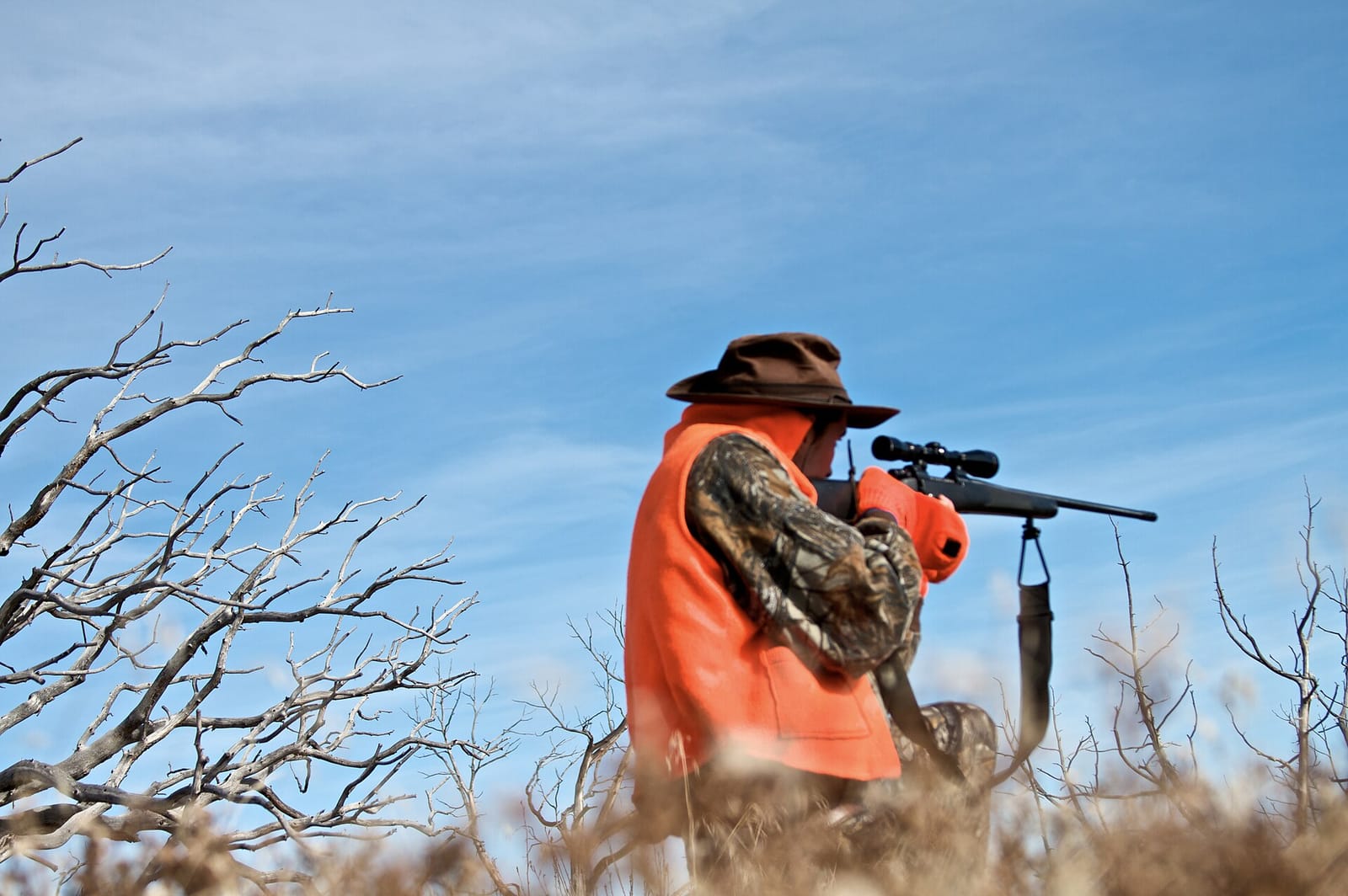
Can deer see orange? Not the way you do. A whitetail’s eye has two kinds of color-sensing cones instead of your three, and the missing one picks up long wavelengths like red and orange. University of Georgia researchers say blaze orange most likely lands on a deer’s retina as a muted yellow, brown or gray. The vest isn’t invisible, though. Deer see its shape and anything it does. What they don’t see is a screaming orange blob.
Key Takeaways
- Deer have two cone types, not three. The 1992 University of Georgia study “confirmed that deer possess two (rather than three as in humans) types of cone photopigments,” and the missing one is the long-wavelength “red” cone (National Deer Association).
- The published retina measurements put a whitetail’s cones at roughly 450 to 460 nanometers (blue) and about 537 nanometers (green), the basis for dichromatic color vision (Jacobs et al., 1994, Journal of Comparative Physiology A).
- A 2014 behavioral test trained seven deer to pick out lit LEDs. They showed “a greater perceptual sensitivity to shorter wavelengths and lower sensitivity to longer wavelengths,” plus some sensitivity to ultraviolet (Cohen et al., 2014, Wildlife Society Bulletin).
- UGA’s Dr. Gino D’Angelo on what that means for your vest: “We believe that they see those oranges and reds, those longer wavelengths, more like a muted yellow or a muted brown” (Outdoor Life).
- Orange is a law, not a suggestion, during gun seasons in most states. Wisconsin’s Fall 2026-Spring 2027 rule requires at least 50% blaze orange or fluorescent pink above the waist during an open firearm deer season (Wisconsin DNR).
What do deer actually see when they look at blaze orange?
Picture the color wheel with the red end chopped off. In NDA’s write-up of the UGA work by Dr. Karl Miller and Dr. Gino D’Angelo, the researchers put it this way: “Deer would not perceive the longer wavelengths of color, so the oranges and reds have turned to brown or gray” (NDA).
So does orange disappear? No. UGA researcher Blaise Newman told Outdoor Life: “Deer don’t see blaze orange the way that we do, but it’s not like you disappear.” A solid vest still reads as a human-shaped block, which is why she suggests breaking it up with pattern (Outdoor Life).
Why can’t deer see red and orange the way we do?
Hardware. You have three cone photopigments tuned to short, middle and long wavelengths. The 1992 UGA study, done with vision scientists from the University of California and the Medical College of Wisconsin, found deer have only the short and middle ones (NDA). The follow-up paper measured those cones with electroretinography: a blue cone peaking around 450 to 460 nanometers and a green cone peaking near 537 nanometers in whitetails (Jacobs et al., 1994).
The practical read from the NDA: deer “likely can distinguish blue from red, but not green from red, or orange from red.” Which is why the same article says a hunter “would be equally suited wearing green, red, or orange clothing” as far as color goes (NDA).
What colors can deer see, and which ones should you worry about?
Deer aren’t color-blind. They’re shifted toward the blue end of the spectrum and toward low light.
First, deer have “ultra-sensitive” rods for dawn and dusk (NDA). Second, there’s the lens. Yours has yellow pigment that filters most ultraviolet light. A deer’s doesn’t. D’Angelo’s line: “The lens in a deer’s eye are perfectly clear, where ours are more like yellow shooting glasses” (Outdoor Life). The NDA notes the human filter blocks about 99 percent of UV, and without it deer “see much better in the UV spectrum but lack the ability to see fine detail” (NDA).
The 2014 behavioral study checked those retina numbers against live animals. Cohen and colleagues trained seven whitetails to tell lit from unlit LEDs and kept dimming them until the deer couldn’t. Most sensitive at the short end, least at the long end, some response in the ultraviolet (Cohen et al., 2014).
So which color should worry you? Blue. The NDA says flat out that hunters are “disadvantaged wearing blue” (NDA). Your orange vest is fine. Your blue jeans are the problem.
Do UV brighteners in laundry detergent make you glow to a deer?
Many laundry detergents contain optical brighteners. The NDA’s guidance is to check your hunting clothes under a UV or blue light and, if they glow, stop “washing them in laundry products containing UV brighteners” (NDA). Newman’s version was shorter: “Be careful about what detergents you use and watch out for UV brighteners or general brighteners” (Outdoor Life).
Keep it in proportion, though. A deer’s eye is a movement detector first. “If you can see a deer’s eyes, they are sure to capture any movements you may make” (NDA). Worry about brighteners after you’ve worried about the wind and your fidgeting.
Do you have to wear blaze orange when deer hunting?
Where a gun season is open, almost always yes, and the rule exists for other hunters, not deer. The amount varies by state, so check your own agency.
Wisconsin’s rule for the Fall 2026-Spring 2027 seasons, verified against the DNR’s online regulations on November 4, 2026: “When and where a firearm deer season is in progress, it is illegal to hunt any game, except waterfowl, unless at least 50% of the hunter’s outer clothing above the waist is colored blaze orange or fluorescent pink.” A hat, if worn, must also be at least 50% orange or pink, camo-blaze counts only if half the material is the safety color, and the DNR “recommends 100% solid blaze orange or fluorescent pink” (Wisconsin DNR).
Can deer see blaze pink?
Wisconsin treats fluorescent pink as a legal equal to blaze orange (Wisconsin DNR). We couldn’t find a published deer-vision test that used blaze pink specifically. Reasoning from the cone data, pink is a long-wavelength color with white mixed in, so it should sit in the same muted zone as orange. That’s an inference from the physiology, not a tested result, but nothing in the science says pink costs you anything orange doesn’t.
Here’s the question to take to the stand: if a deer can’t tell your orange vest from a brown one, why did that doe pick you off last Saturday? Probably because you turned your head.
Related reading on RAD:
The other side of it
The case against relaxing about orange: the cone studies measure what a retina can detect, not what a deer notices in a real woodlot, and a big block of any single tone stands out against broken cover more than a pattern does. On a pressured property, deer may also have learned that a certain shape in a certain tree means trouble, orange or not. Of course, the guy who swears blaze orange cost him a buck is usually the same guy who checked his phone eleven times before the deer showed up.
Keep reading
Latest deer news
Sources
- National Deer Association (deerassociation.com)
- Jacobs et al., 1994, Journal of Comparative Physiology A (europepmc.org)
- Cohen et al., 2014, Wildlife Society Bulletin (doaj.org)
- Do Hunters Really Need to Wear Camouflage? Here Are the Colors Deer Can See | Outdoor Life
- Wisconsin Hunting Regulations, Fall 2026-Spring 2027 | Hunting Regulations | Wisconsin DNR
- NDA (deerassociation.com)
Comments