For most small plots, the food plot seeder you actually need is a broadcast spreader that throws seed evenly at a low setting, plus something to press that seed into the dirt afterward. A drill places seed better and uses less of it, and it can hold up better in a drought. But the seeder is rarely what kills a plot: Arkansas Extension says planting too deep “is a common cause of establishment failure, especially when planting small-seeded forages” (UA FSA3110), so the drag or cultipacker you pull behind the spreader matters about as much as the spreader.
Key Takeaways
- Mississippi State Extension says to plant clovers “no more than ¼ inch deep.” It puts cool-season small grains at ½ inch (MSU P3604).
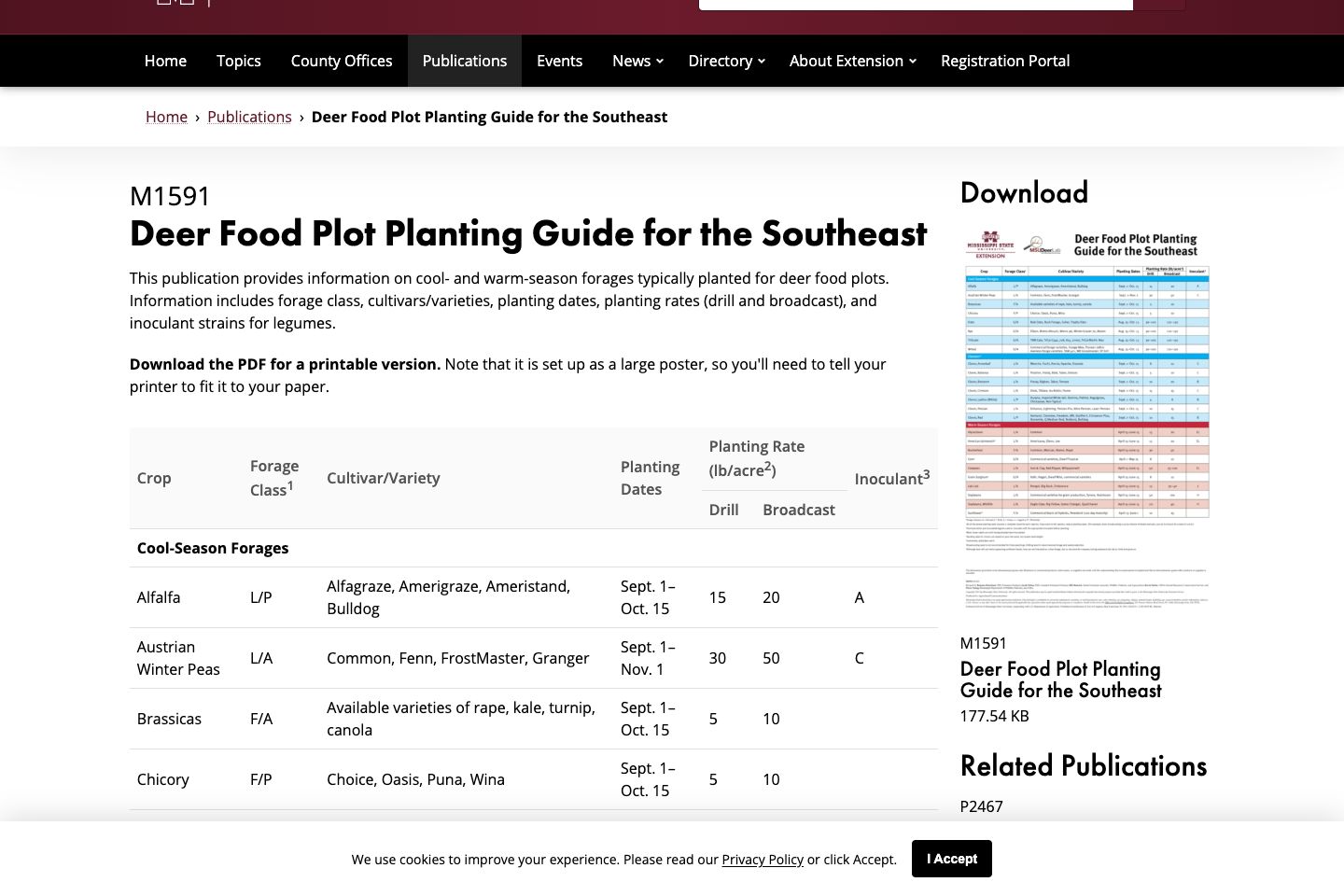
- Drilling takes less seed. MSU’s Southeast guide lists white clover at 4 lb/acre drilled vs 8 broadcast, and brassicas at 5 drilled vs 10 broadcast (MSU M1591).
- Arkansas Extension says planting on a poor or weedy seedbed “results in emergence of only 33 percent of the seed” (UA FSA9092).
- No-till drilled plots tend to hold up better in drought than conventional or no-till top-sown plots, according to Oklahoma State Extension wildlife specialist Mark Turner (NDA).
- A homemade food plot drag can be a section of chain-link fence, old bed springs or the top of a cedar tree pulled behind a pickup or ATV (UA FSA9092).
Broadcast, drill or no-till: which method fits your plot?
It depends on how far back in the woods the plot is and what you’re planting. Here’s how the extension and NDA sources describe each:
| Method | How it works | Fits | Watch out for |
|---|---|---|---|
| Hand-held broadcast spreader | Throws seed over the surface | Small plots. Arkansas suggests one “with multiple seed settings” for small seed like clover (FSA9096) | Seed sits on top until you cover or pack it |
| ATV, truck or tractor broadcast seeder | Same idea, mounted. Arkansas says most food plot seed is broadcast this way (FSA9092) | Plots you can drive to | Birds and rodents eat uncovered seed |
| Grain drill or no-till drill | Places seed in the soil at a set depth | Plots you can get a tractor to, and grain mixes | Use drilled rates, not broadcast rates (M1591) |
| No-till top-sowing | Spray or knock down existing vegetation, broadcast, then rain does the covering | Hidey-hole plots with no tillage | Depends on rain; holds up worse in drought than drilled plots, per Turner |
Can you broadcast right after spraying?
The NDA’s Cheyne Matzenbacher says yes, because “the herbicide works on actively growing vegetation, not seeds.” He plants between rains, or right before rain in the forecast, so moisture works the seed in (NDA). Ryan Basinger, writing for the NDA on brassicas, kills existing vegetation with glyphosate a few weeks before no-till planting (NDA). Read the herbicide label either way.
Do you need a cultipacker or a food plot drag?
You need something that makes good seed-to-soil contact, and for small seed you want a firm bed. They do different jobs.
MSU describes the sequence for a tilled plot. Disk a few weeks ahead so the turned-under thatch can break down. Disk again, then drag with a harrow to break up clods. Then firm the seedbed with a cultipacker. “A firm seedbed produces the best results for most forage crops, especially small-seeded crops such as clovers” (MSU P3604). Arkansas says the site “should be well tilled and firmed with a drag or roller,” and warns that rough, cloddy seedbeds let seed get planted too deep (UA FSA3110).
After seeding, Arkansas says rolling or dragging holds soil moisture, improves seed-to-soil contact, and may keep the seed from being eaten (UA FSA9092). For clover, the NDA’s clover guide recommends a cultipacker before and after planting (NDA).
Can you make your own food plot drag?
Easily. Arkansas Extension lists a section of chain-link fence, old bed springs or the top of a cedar tree, towed behind a pickup or ATV (UA FSA9092). Matzenbacher’s version is a piece of chain-link fence with a 2x4 attached at the front and back, pulled by a rope tied to the front board. On a tiny plot, he says, a leaf rake works as the drag (NDA).
A drag smooths and covers. A cultipacker firms. If you only own a drag, drag lightly after seeding small seed so you don’t bury it.
How do you set a food plot seeder for a small plot?
Measure the plot first, then convert the rate. Arkansas Extension’s numbers (UA FSA3110):
- 1 acre is 43,560 square feet, or about 209 by 209 feet.
- 1,000 square feet is about 32 by 32 feet. Pace it off if you don’t have a tape.
- Divide any per-acre rate by 43.56 to get pounds per 1,000 square feet.
- For commercial mixes, follow the rate on the seed package.
Arkansas’s example is wheat at 180 lb/acre, which works out to 4.1 lb per 1,000 square feet, or 41 lb for a 100-by-100-foot plot. It also suggests a container you’ve pre-measured to hold a known weight of seed, so the scale can stay home.
When’s the last time you actually weighed what came out of your spreader?
Does seed size change how you plant a mix?
Yes. Big seed and small seed want different depths. Arkansas says small legume and ryegrass seed should go “no deeper than 1/2 inch.” Oats, wheat, beans and peas can go 1 to 1½ inches. For a grain and clover mix, it suggests broadcasting the wheat and covering it first, then broadcasting the clover and lightly rolling it (UA FSA9092). MSU puts small grains shallower, at ½ inch, so check your own state’s guide. The grain side is covered on our winter rye page.
Seed coating changes the math too. MSU says a bag of coated clover is in most cases half pure seed (MSU P3604). Our clover food plot guide walks through that.
What equipment do you need for a hidey-hole plot?
Less than the catalogs suggest. Matzenbacher’s list for a one-eighth to one-quarter-acre plot is a chainsaw to open the canopy “at least 20-30%,” a string trimmer, a backpack sprayer, a rake, a seeder and a homemade drag. Add a soil probe, since he calls the soil test “worth its weight in gold” (NDA). Arkansas notes that garden tractors and ATVs can stand in where a full tractor can’t reach, and that a disk or sprayer can be hitched to a pickup (UA FSA9092). The lime and fertilizer that seeder will spread get their own math on our food plot fertilizer guide.
Related reading on RAD:
The other side of it
The case for buying real equipment is better than the chain-link crowd admits. A drill places seed at a set depth, MSU’s rates say it takes about half the clover and brassica seed of broadcasting, and Turner’s observation is that drilled plots hold up better when it doesn’t rain. If you plant several acres every fall, a food plot seeder that drills may pay for itself in seed and saved replantings. Then again, nobody ever bought a no-till drill for a quarter-acre plot because of the math. They bought it because the neighbor has one.
Keep reading
Latest deer news
Sources
- A Cost-Production Comparison of Common Food Plot Plantings for Deer
- Deer Food Plot Planting Guide for the Southeast | Mississippi State University Extension Service
- Establishing Wildlife Food Plots - FSA9092
- NDA (deerassociation.com)
- Grasses and Forbs for Wildlife: Fall/Winter Wildlife Food Plots - FSA-9096
- NDA (deerassociation.com)
- NDA (deerassociation.com)
- Seeding and Fertilization Rate Conversion for Wildlife Food Plots and Small Areas FSA3110
- NDA (deerassociation.com)
Comments