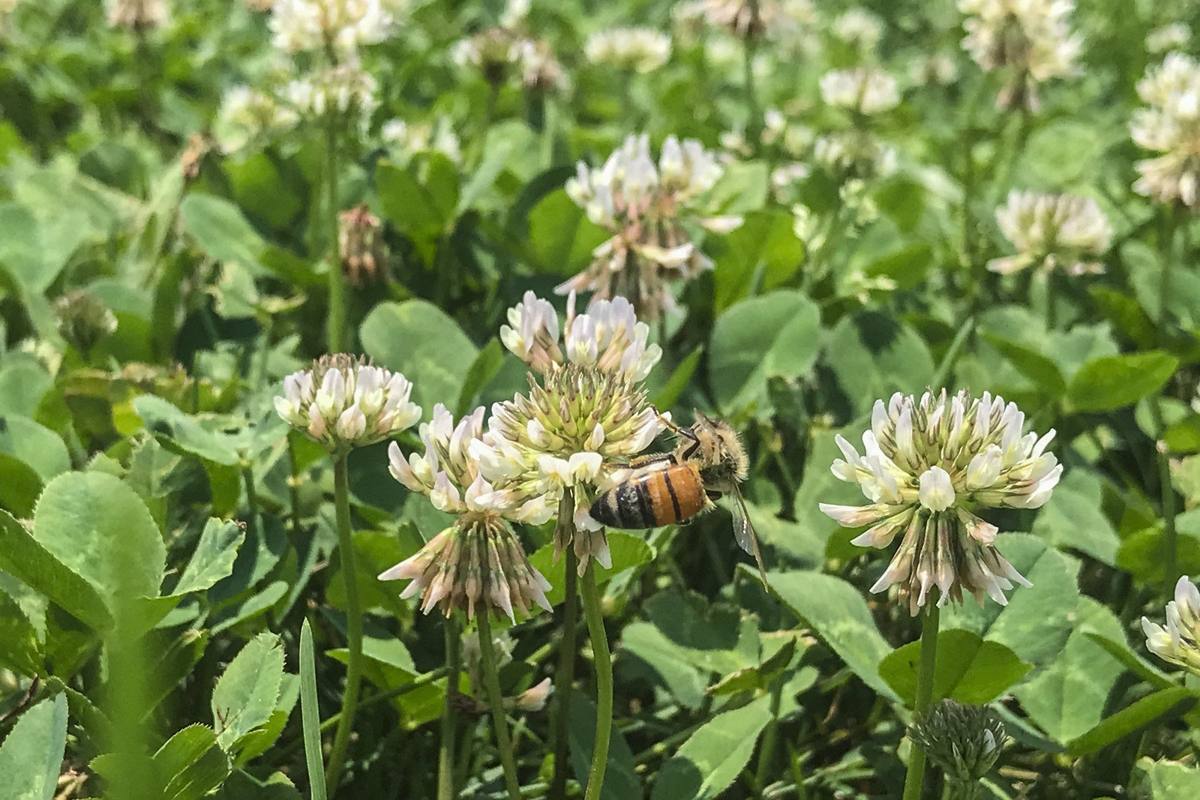
You plant a clover food plot that lasts by choosing a perennial like ladino white or red clover, getting the soil pH right before any seed goes out, then setting that seed no deeper than a quarter inch. Do that and the National Deer Association says ladino can persist “four to five years, particularly in northern climates” (NDA). Skip the soil test and you’ve mostly paid for seed coating.
Key Takeaways
- Mississippi State Extension’s Southeast guide lists ladino/white clover at 8 lb/acre broadcast or 4 lb/acre drilled, and red clover at 15 broadcast or 10 drilled, planted Sept. 1 to Oct. 15 (MSU Extension M1591).
- In MSU variety trials, red clover out-yielded Durana and Ladino white clovers by more than 1,300 lb/acre over two years and cost $13.14 per 1,000 lb of forage, against $20.87 for Ladino and $29.81 for Durana (MSU P3604).
- Frequent mowing doesn’t improve clover forage quality and can cut production by more than 50% over a season, according to Oklahoma State Extension wildlife specialist Mark Turner. He says one mowing in late summer or early fall is needed to maintain perennial clover (NDA).
Which clover is best for a food plot?
The one that fits your calendar. Annuals are a one-season deal, usually tucked into a fall grain plot. Perennials are what people mean by “a clover plot.” Mississippi State’s cost comparison lays out the common choices (pure live seed per acre, Southeast):
| Clover | Type | MSU rate (lb/acre) | MSU optimum pH | What MSU says |
|---|---|---|---|---|
| Ladino white | Perennial | 8 | 6.0–6.5 | Highly productive, fairly low-maintenance, produces October through June |
| Durana | Perennial (ladino variety) | 8 | n/a | More tolerant of heavy grazing, moderately drought tolerant |
| Red | Biennial in most of Mississippi | 15 | 6.0–7.0 | Produces March into July; best value in MSU’s trials |
| Crimson | Annual | 25 | 5.8–7.0 | Grows quickly, good re-seeder, tolerant of acidic soils |
| Balansa | Annual | 8 | 5.8–7.5 | Very cold tolerant, highly productive |
| Berseem | Annual | 20 | 6.0–7.5 | Not as cold tolerant as other annual clovers |
Source: MSU P3604. MSU’s cost figures are averages from 10 Mississippi seed retailers, so your co-op will differ.
Annual or perennial clover?
Region matters here. The NDA’s clover guide says crimson is a cool-season annual in the South, but it doesn’t handle cold, so northern managers do better planting it in spring. Arrowleaf is a heavy re-seeder. Berseem re-seeds poorly and isn’t winter-hardy (NDA). Red clover can persist three or more years in the mid-South and North with good management, per the same guide.
Is clover or alfalfa better for a deer food plot?
For most food plots, clover is the easier choice. University of Florida IFAS calls alfalfa a high-quality legume but says it “requires a soil pH of 6.5–7.0, high soil fertility, well-drained soils, and good management, making it difficult to manage in wildlife food plot situations,” and it doesn’t recommend alfalfa for most Florida soils. It also warns that many commercial food plot blends use mid- or high-dormancy alfalfas that don’t grow well in the southern United States (UF/IFAS). The exception is drier ground: Oklahoma State Extension says legumes other than alfalfa “do not fair well in central and western Oklahoma” (OSU Extension).
What soil pH does a clover food plot need?
Higher than most woods dirt starts out. The sources don’t agree on one number, which tells you how much your soil test matters:
- MSU puts ladino at 6.0–6.5 and red clover at 6.0–7.0 (P3604).
- University of Georgia Extension’s Bob Westerfield gives ladino 6.0–6.5 and says it handles more acidity than most clovers (NDA).
- Arkansas Extension says pH “needs to be between 6.8 and 7.0 for establishing clover in a food plot, though a pH of 6.5 may suffice,” and that lime goes out several months before planting (UA FSA9092).
As the NDA puts it, “Without a soil test, you have no way of knowing how much lime and/or fertilizer your food plot needs” (NDA). Clover makes its own nitrogen, so lime, phosphorus and potassium are what count. The math lives on our food plot fertilizer guide.
How do you plant a clover food plot?
Shallow, firm and patient. MSU says to plant clovers “no more than ¼ inch deep” and firm the seedbed with a cultipacker (P3604). The NDA suggests packing before and after seeding so the seed doesn’t end up too deep (NDA). Seeders, drags and packers get their own page: food plot seeders.
Timing depends on where you are. MSU’s Southeast guide lists ladino and red clover for Sept. 1 to Oct. 15 only, with no spring window for any clover (MSU Extension M1591). Westerfield gives August through October for fall planting depending on location, and late January through April for spring planting in northern states (NDA). He also warns ladino is slow in its first season. Plant it in fall and expect it to start producing the following spring.
Legume seed needs the right inoculant. MSU notes most clover seed is sold already inoculated (M1591).
Why don’t the seeding rates match?
Arkansas Extension lists white clover at 2–4 lb/acre broadcast for Arkansas (UA FSA9096), while MSU says 8. Before you blame either one, check what your bag is counting. MSU’s clover rates are based on “pure live seed, not coated seed weight” (M1591). In MSU’s crimson clover example, a 50-lb bag that was 50% pure seed with 90% germination meant sowing 56 lb of coated seed to hit a 25-lb rate (P3604).
Can you frost seed clover?
Yes. You spread seed on frozen ground in late winter and let the freeze-thaw cycle work it in. The NDA’s Kip Adams does it from late February through March in northern Pennsylvania, and puts the window at January and February in the South. It works best with little competing vegetation, and germination runs lower than on a prepared seedbed (NDA).
For the rate, Penn State Extension’s frost-seeding table lists 1 to 2 pounds per acre of white clover and 1 to 4 pounds of red clover for pasture renovation (Penn State Extension). NDA writers split on whether to go lighter or heavier than a normal planting rate (NDA).
Should you mow a clover food plot?
Less than you think. Turner cites University of Tennessee work by Craig Harper and Bonner Powell. He says frequent mowing doesn’t improve forage quality, can cut production by more than 50% in a growing season, and doesn’t control weeds. One mowing in late summer or early fall is the maintenance he says a perennial stand needs (NDA).
So how do you handle weeds?
With the right herbicide, applied by the label. Turner names clethodim for annual grasses and 2,4-DB or imazethapyr for many broadleaves, and warns against 2,4-DB where chicory is in the mix. Carolina horsenettle he calls “nearly impossible to eradicate” from clover. At that point you rotate.
How long does a clover food plot last?
Ladino can go four to five years, longest in the North (NDA). In the Southeast, Westerfield says it can struggle through hot, dry summers. Turner’s rule for when to quit: rotate out when you can’t control the weeds. Follow with grains or brassicas, which open up different herbicide options. Our brassica food plot mix guide covers the second option. If your clover is thin by fall, our winter rye page has the warning on why rye at full rate will smother it.
How old is the clover in your best plot, and when did anyone last test the dirt under it?
Is a clover plot legal where feeding is banned?
The bans we covered in our Colosseum debate on feeding bans target the pile and the lick, not the plot. Your state’s rule is the one that counts.
Related reading on RAD:
The other side of it
A perfect clover food plot still isn’t a deer herd. Arkansas Extension says food plots “rarely sustain a wildlife population,” that overall land management like controlling shade is “far more important than food plots,” and that in a bumper acorn year a fall plot does little for deer that would rather eat acorns (UA FSA9092). Plenty of ground would do more for deer with a chainsaw than a seed bag. And the fellow whose clover “never lasts” is usually mowing it every Saturday because the riding mower needed a reason to leave the shed.
Keep reading
Latest deer news
Sources
- Frost Seeding: A Technique for Interseeding Cover Crops and Improving Forage Stands | Penn State Extension
- Deer Food Plot Planting Guide for the Southeast | Mississippi State University Extension Service
- A Cost-Production Comparison of Common Food Plot Plantings for Deer
- NDA (deerassociation.com)
- NDA (deerassociation.com)
- NDA (deerassociation.com)
- Establishing Wildlife Food Plots - FSA9092
- Grasses and Forbs for Wildlife: Fall/Winter Wildlife Food Plots - FSA-9096
- NDA (deerassociation.com)
- UF/IFAS (programs.ifas.ufl.edu)
- OSU Extension (extension.okstate.edu)
Comments