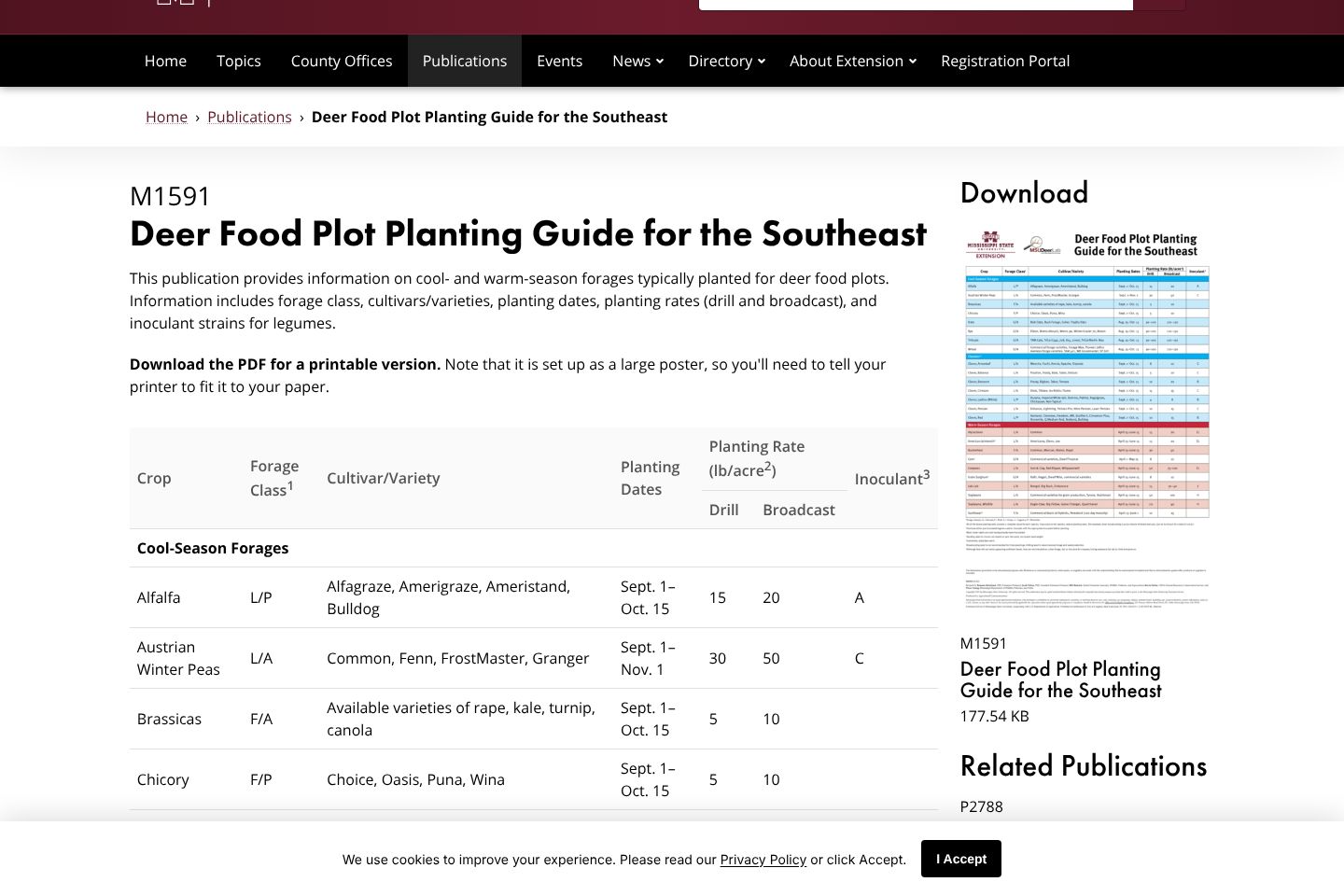
Alyceclover is the heat-season ground cover Mississippi State University Extension uses when summer bare dirt would otherwise bake between spring legumes and fall cool-season plantings. M1591 classes alyceclover L/A annual (Common) for April 15 through June 15 at 15 lb drilled or 20 lb broadcast with inoculant EL (Mississippi State University Extension). P2111 describes a warm-season annual legume that provides forage in summer and early fall, is especially important to white-tailed deer, and holds up well to grazing pressure on moderate to well-drained soils including bottomland sites (MSU Extension P2111). P2111 planting dates run May 1 through June 15 at the same 15/20 lb rates with 1/4 inch cover depth (MSU Extension P2111). Bare-ground insurance means those inoculated seedings own midsummer when cool-season clovers are done (MSU Extension P2111; Mississippi State University Extension). Without that canopy, openings default to weeds or dust until September drills return (MSU Extension P2111).
Key Takeaways
- M1591: Common; 15/20 lb; Apr 15-Jun 15; inoc EL (Mississippi State University Extension).
- P2111: summer-early fall forage; holds under deer pressure (MSU Extension P2111).
- Soils: moderate to well-drained including bottoms (MSU Extension P2111).
- pH 5.5-7.0; cover 1/4 inch (MSU Extension P2111).
- Companions: cowpeas and/or jointvetch (MSU Extension P2111).
- Late October mow/disk may help reseeding (MSU Extension P2111).
Insurance against summer bare ground
Cool-season plots end; without a warm-season legume, openings go to weeds or dust (MSU Extension P2111). Alyceclover’s summer-early fall window fills that gap for deer (MSU Extension P2111; Mississippi State University Extension).
Pressure tolerance
P2111’s note that alyceclover holds up well to grazing pressure is why it pairs with jointvetch on high-density properties (MSU Extension P2111). It is still an annual - budget seed or rely on October reseeding management (MSU Extension P2111).
Rates and fertility
Use 15/20 lb with EL inoculant (Mississippi State University Extension; MSU Extension P2111). P2111 fertility example applies about 100 lb/ac 0-46-0 and 50 lb/ac 0-0-60 postemergence once the stand is up, then again the following May (MSU Extension P2111).
Bottomland suitability
Unlike lablab, alyceclover is suited to bottomland sites among moderate to well-drained soils (MSU Extension P2111). That makes it a heat-season option where drainage is imperfect but not flooded (MSU Extension P2111).
Mixtures
P2111 companions are forage cowpeas and/or joint vetch (MSU Extension P2111). Cut each species under M1591 footnote 2 when blending (Mississippi State University Extension).
Cover rule
Plant alyceclover at 15/20 lb with EL inoculant from late April into June to keep summer ground covered and browsed, and manage October mowing or disking if you want reseeding help (Mississippi State University Extension; MSU Extension P2111).
Herbicide options
P2111 lists preemergence Pursuit or Prowl and postemergence Select or Poast Plus lanes also used on related warm-season legumes; confirm current labels for alyceclover before spraying (MSU Extension P2111). Grass escapes that shade the canopy erase the ground-cover benefit (MSU Extension P2111).
Calendar bridge detail
April 15-June 15 on M1591 and May 1-June 15 on P2111 both aim to have canopy before peak summer heat (Mississippi State University Extension; MSU Extension P2111). Late June seedings miss the insurance window and compete with worse weed flushes (MSU Extension P2111).
Reseeding calendar
P2111 says mowing and/or disking in late October may help reseeding, with another 0-46-0 and 0-0-60 pass the following May (MSU Extension P2111). That cycle is how heat-season cover returns without buying a full seed load every spring (MSU Extension P2111).
Bottom line
Seed alyceclover at M1591/P2111’s 15/20 lb rates with EL inoculant as heat-season ground cover and deer forage that holds under pressure between cool-season cycles (Mississippi State University Extension; MSU Extension P2111).
The other side of it
It’s an annual, so you’re buying seed or betting on reseeding every year, all to cover ground during months most folks aren’t hunting. A manager on a budget could argue that money does more in a fall plot. Even the two MSU sources don’t agree on when planting starts. Then again, some plot guys plant summer clover mostly so the neighbors driving by know they’re serious.
Keep reading
Latest deer news
Comments