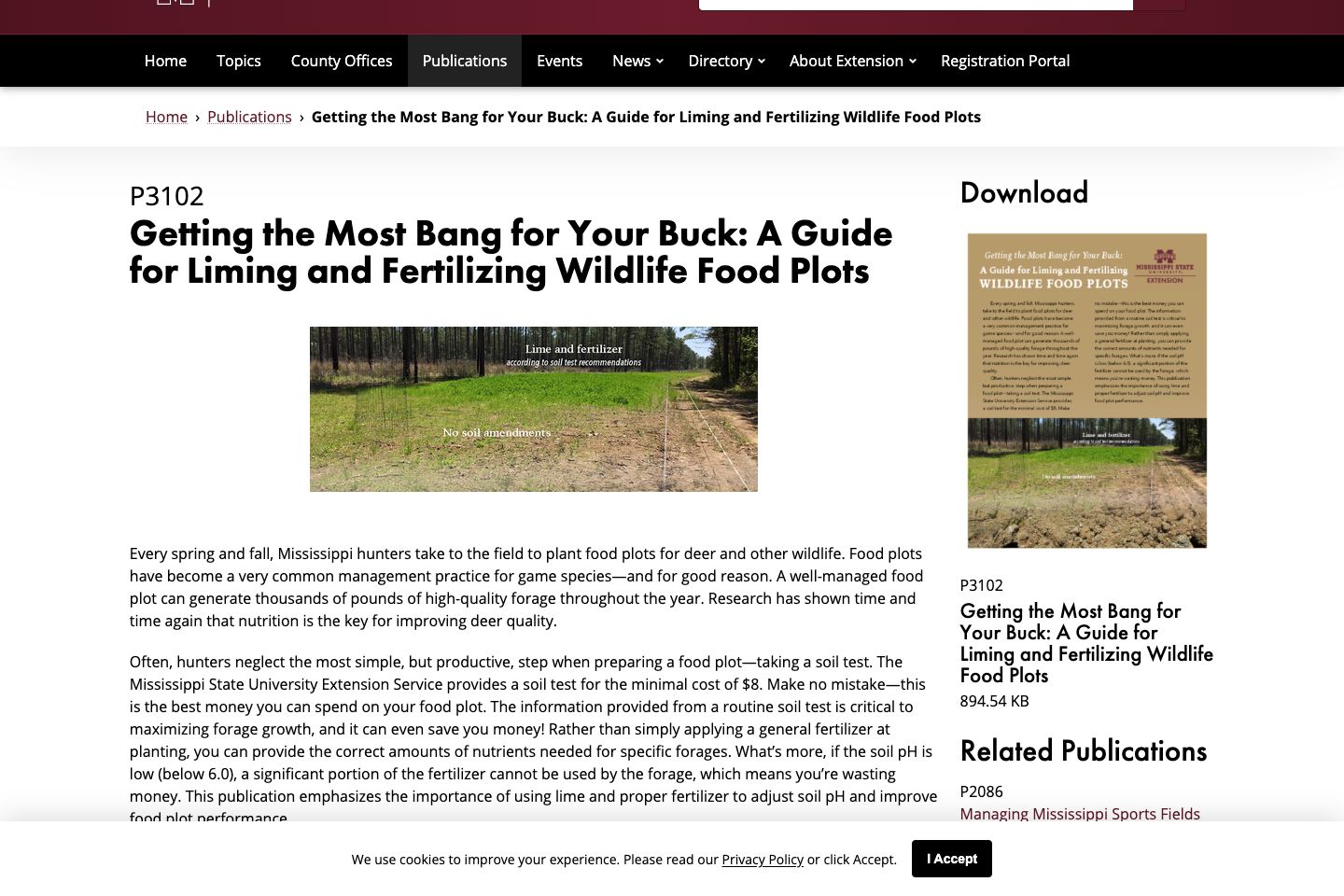
The food plot fertilizer you should use is whatever your soil test calls for, and that isn’t a dodge, because every extension publication we read starts there. Mississippi State’s sample soil report shows one plot at pH 6.9 needing no lime and another at pH 4.8 needing 4 tons per acre, which is why MSU calls a routine soil test “the best money you can spend on your food plot” (MSU P3102). MSU’s soil test order page charges “$12.00 per sample” (MSU Submit a Soil Test; MSU Soil Test Order). Lime usually comes before fertilizer, too, since a lot of what you spread on low-pH ground just sits there.
Key Takeaways
- If soil pH is below 6.0, much of the fertilizer you apply can’t be used by the forage, according to Mississippi State Extension (MSU P3102).
- The three numbers on a bag are the percent by weight of nitrogen, phosphate (P2O5) and potash (K2O). A 50-lb bag of 13-13-13 holds 6.5 lb of each (Auburn ACES).
- To convert any per-acre rate to a small plot, divide by 43.56 to get pounds per 1,000 square feet (UA FSA3110).
- Legumes like clover don’t need nitrogen fertilizer, because root bacteria fix it from the air (UA FSA3110).
- Lime starts raising pH within a few weeks, but the full effect takes six months or longer (Auburn ACES).
Why soil test before you fertilize a food plot?
Because guessing costs more. A soil test tells you the pH, how much lime it takes to move it, and how much phosphorus and potassium the ground already has. MSU’s routine test covers pH, buffer pH, phosphorus, potassium, calcium, magnesium, sodium and zinc (MSU P3102).
Taking one is easy:
- Pull 10 to 12 subsamples across a 1- to 10-acre plot, from the top 0 to 6 inches (MSU). The NDA says at least 10 cores, about 6 inches deep, mixed in a plastic bucket, not a metal one (NDA).
- Tell the lab what you’re planting. Auburn says to list the specific crops rather than just “Food Plot,” because the recommendations change by crop.
- Retest every two years on existing plots (MSU) or every two to three years (Auburn).
When was the last time your plot got a test, and was it before or after you bought the fertilizer?
What happens if you skip it?
Arkansas Extension lists both “More is better” and “Not fertilizing” among common food plot mistakes. On the second one it doesn’t waste words: “Soil test – don’t guess” (UA FSA9096). MSU’s publication includes a deer vetch trial where the unlimed, unfertilized plot made 1,083 lb/acre at 13.9% crude protein. With lime and fertilizer it made 1,525 lb/acre at 16.83%. MSU doesn’t describe that trial’s design, so read it as an example, not a guarantee (MSU P3102).
How do you read N-P-K on a food plot fertilizer bag?
The numbers are percentages, and the math is division. Take the pounds of a nutrient your test recommends, divide by that nutrient’s percentage in the bag, and you get pounds of product per acre. Arkansas Extension’s examples (UA FSA3110):
| Soil test calls for | Product | Math | Product per acre |
|---|---|---|---|
| 50 lb each of N, P2O5, K2O | 13-13-13 | 50 ÷ 0.13 | 385 lb |
| 50 lb nitrogen | Ammonium nitrate (34-0-0) | 50 ÷ 0.34 | 147 lb |
| 50 lb phosphate | DAP (18-46-0) | 50 ÷ 0.46 | 109 lb, plus about 19.6 lb of N along for the ride |
Most deer plots aren’t an acre, so convert. Arkansas says to divide the per-acre rate by 43.56 for pounds per 1,000 square feet. Its worked example: a 90-by-90-foot plot (8,100 square feet) at 385 lb/acre of 13-13-13 takes about 71 lb of fertilizer. That’s not quite a bag and a half. Arkansas also suggests carrying a container you’ve pre-measured to hold a known weight, so you don’t haul a scale to the back forty (UA FSA3110).
How much lime does a food plot need?
Whatever the test says, and get it out early. The NDA’s Kip Adams says to lime three to six months before planting (NDA). Arkansas puts it more bluntly: “Don’t skimp on lime; it is that important to plant growth” (UA FSA9092). Both Arkansas and Auburn suggest working lime into the soil during seedbed prep for an even pH change.
Lime comes in three main forms, and the price gap is huge. MSU priced each against a 1-ton-per-acre recommendation (MSU P3102):
| Lime type | Amount for a 1-ton/acre recommendation | MSU’s cost per acre | Note |
|---|---|---|---|
| Bulk ag lime | 3,080 lb | $81.62 | Cheapest; needs a spreader truck. Most cost-effective at 1 acre or more |
| Pelletized | 2,222 lb (56 40-lb bags) | $210 | Fits small plots and hard-to-reach spots |
| Liquid | about 139 gallons | $1,512 | Very fine; may need more frequent sampling |
Spreading isn’t included, and the prices are MSU’s assumptions. Auburn adds that pelletized lime is easier to spread but offers no benefit beyond that over regular ag lime. It may act faster, but it doesn’t last as long (Auburn ACES).
What’s CCE on a lime label?
Calcium carbonate equivalent is the lime’s neutralizing strength. Adams explains that soil test recommendations assume 100% CCE, so you adjust: 100 ÷ CCE × recommended rate. At 70% CCE, a 1,000 lb/acre recommendation becomes 1,429 lb. He also caps lime at 8,000 lb/acre in one year, with the rest going on in year two. If your test shows a magnesium need, use dolomitic lime. If not, calcitic (NDA).
What fertilizer does each food plot crop need?
Here’s what the extension specialists we read actually say. The rates are theirs, from Southern states, and your soil test overrides all of them.
| Crop | Nitrogen | What the sources say |
|---|---|---|
| Clover and other legumes | None | Arkansas: no need for N, inoculate instead (FSA3110). Auburn: no extra N if legumes are more than 30% of a mixed stand. UGA Extension’s Bob Westerfield suggests 300 lb/acre of 5-10-15 at establishment for clover alone, then a non-nitrogen topdress such as 0-20-20 sized to a soil test (NDA). |
| Brassicas (turnips, rape, kale) | High | Westerfield suggests about 300 lb/acre of 19-19-19 at planting for turnips, with a soil test for accuracy (NDA). |
| Wheat and other small grains | Moderate | Arkansas: at least 50 lb of actual N per acre for wheat, sorghum or sunflowers, and seldom any need for more than 100 lb in one application (FSA3110). |
Which crop to plant is a separate question. See our clover food plot guide and brassica food plot mix guide. Cereal rye is the forgiving one on poor, acidic dirt, as our winter rye page explains.
When should you fertilize a food plot?
Auburn says to spread fertilizer just before planting, and that discing it in is optional. Avoid spreading right before a long dry spell or a heavy rain, since both lose nutrients (Auburn ACES). Arkansas notes that wheat benefits from planned nitrogen at certain growth stages, and that periodic liming “can be critical for maintaining clover” (UA FSA9096).
Is a deer-branded fertilizer better?
We don’t rank products. Auburn says high-analysis fertilizers often work out cheaper across several acres (Auburn ACES). None of the extension publications we read tell you to buy by the picture on the bag. All of them say to buy to the soil test.
Related reading on RAD:
The other side of it
Soil testing and precise food plot fertilizer math matter most on real acreage. On a one-eighth-acre kill plot, the whole bill is small enough that a hunter could argue a bag of balanced fertilizer and good timing get him most of the way. Arkansas Extension even says that if you must cut costs, “either don’t plant or reduce the fertilizer rate,” and save the money for lime (UA FSA9092). Still, the hunter who skips the $12 test to save money and then buys the bag with the biggest buck on it has done math a seed company would frame.
Keep reading
Latest deer news
Sources
- Getting the Most Bang for Your Buck: A Guide for Liming and Fertilizing Wildlife Food Plots | Mississippi State University Extension Service
- Submit a Soil Test | Mississippi State University Extension Service
- MSU Soil Test Order (order portal linked from MSU Extension)
- Soil Testing, Liming, and Fertilizing Wildlife Food Plots - Alabama Cooperative Extension System
- Seeding and Fertilization Rate Conversion for Wildlife Food Plots and Small Areas FSA3110
- NDA (deerassociation.com)
- Grasses and Forbs for Wildlife: Fall/Winter Wildlife Food Plots - FSA-9096
- NDA (deerassociation.com)
- Establishing Wildlife Food Plots - FSA9092
- NDA (deerassociation.com)
- NDA (deerassociation.com)
Comments