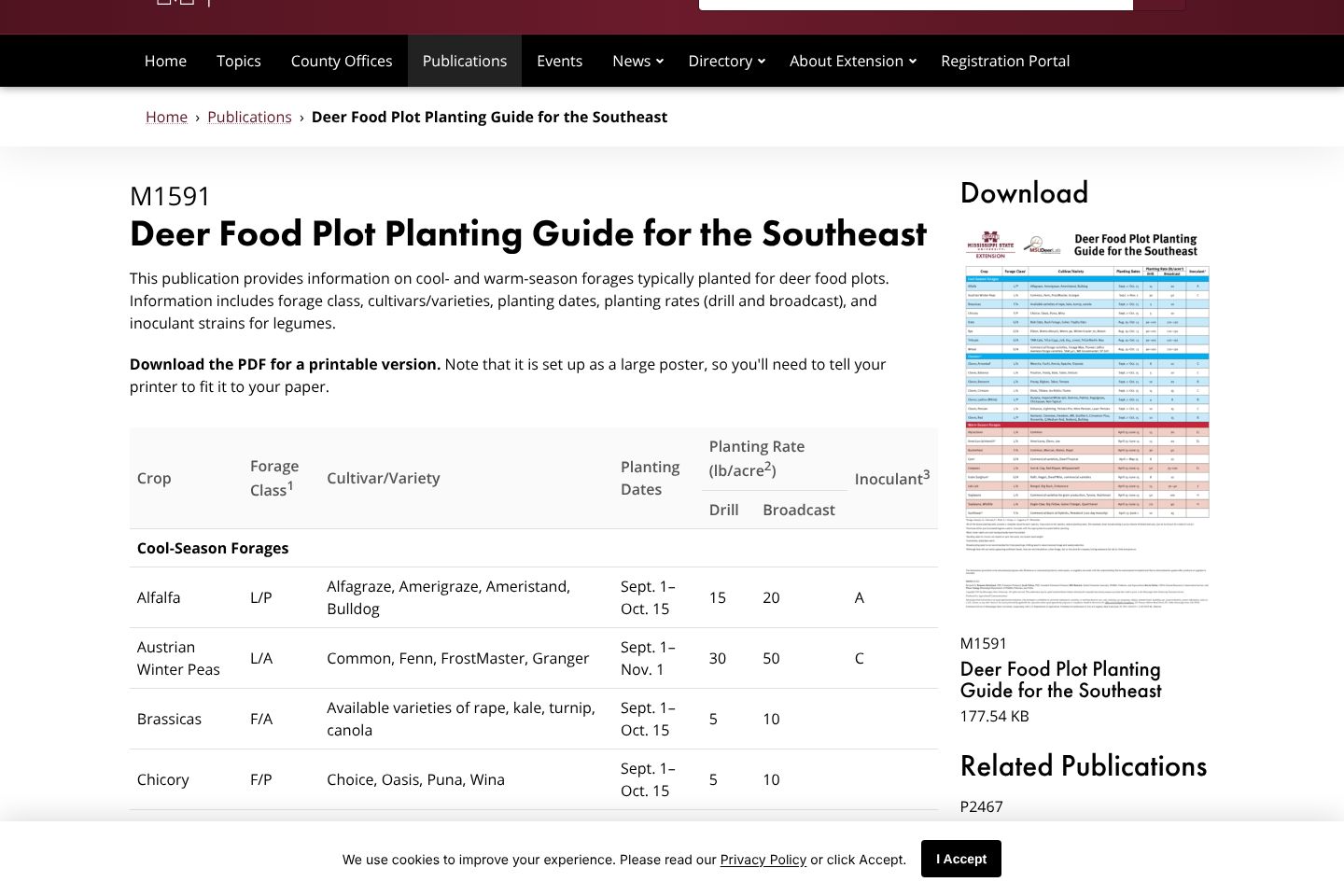
Alfalfa is the high-cost, high-management perennial on Mississippi State University Extension’s deer food-plot poster - and variety choice starts with geography. M1591 classes alfalfa L/P perennial, lists Alfagraze, Amerigraze, Ameristand, and Bulldog, and sets 15 lb drilled or 20 lb broadcast for September 1 through October 15 (Mississippi State University Extension). The MSU alfalfa forage page recommends the crop mainly for the northern part of the state, with mid-August to early September plantings and optional spring seedings farther north (Mississippi State University Extension Forages). Stand persistence is described as still questionable, with 2 to 3 years considered acceptable on well-drained soils (Mississippi State University Extension Forages). P2111 calls alfalfa the most expensive and labor-intensive supplemental food planting, used by deer from spring through fall on fertile, well-drained loams (MSU Extension P2111). Pick grazing-type lines and northern sites before you chase southern acreage that will not hold a crown (Mississippi State University Extension Forages; MSU Extension P2111).
Key Takeaways
- M1591 cultivars: Alfagraze, Amerigraze, Ameristand, Bulldog; 15/20 lb; Sept 1-Oct 15 (Mississippi State University Extension).
- Best fit northern Mississippi; well-drained soils only (Mississippi State University Extension Forages).
- Expect about 2-3 years of stand life (Mississippi State University Extension Forages).
- pH about 6.5+; high P, K, S, B demand; no N required if inoculated (Mississippi State University Extension Forages).
- Rotational rest 20-35 days; summer dormancy needs ~4 weeks recovery (Mississippi State University Extension Forages).
- P2111: expensive/labor-intensive; weevil and leafhopper scouting required (MSU Extension P2111).
Grazing-type names on the deer poster
Alfagraze-class entries on M1591 signal grazing tolerance rather than pure hay types (Mississippi State University Extension). Amerigraze, Ameristand, and Bulldog sit beside them on the same cultivar line (Mississippi State University Extension). The forage page notes newer glyphosate-resistant varieties can simplify weed control during establishment (Mississippi State University Extension Forages). Match the bag to a grazing or wildlife use, not a dairy hay specialty, when deer browse is the goal (Mississippi State University Extension; Mississippi State University Extension Forages).
Northern bias and drainage
MSU recommends alfalfa for northern Mississippi and flags well-drained soils; sandy Coastal Plain sites face major nematode pressure (Mississippi State University Extension Forages). P2111 repeats the well-drained fertile loam requirement and mild drought tolerance (MSU Extension P2111). Southern wet flats that suit persian clover or ladino are the wrong alfalfa bet (Mississippi State University Extension Forages).
Fertility gate before seed
Maintain pH near 6.5 or higher. Nitrogen is not required, but phosphorus, potassium, sulfur, and boron are (Mississippi State University Extension Forages). Optimum soil-test targets cited by MSU include about 65 lb P and 350 lb K per acre; split K between fall and after first cutting (Mississippi State University Extension Forages). If soil B is 1 ppm or less, topdress at least 2 lb B per acre (Mississippi State University Extension Forages). P2111 adds roughly 20 lb/ac of 10% borax every three years as a practical boron program (MSU Extension P2111).
Rest intervals under browse
Rotational grazing with 20 to 35 days of rest is recommended; allow at least four weeks of growth to rebuild carbohydrate reserves around summer dormancy (Mississippi State University Extension Forages). Southern productivity can run March to November; northern windows are closer to April to October (Mississippi State University Extension Forages). Continuous deer pressure without alternate forage acres shortens the already modest 2-3 year life (Mississippi State University Extension Forages).
Pests that end stands early
Sclerotinia crown and stem rot, alfalfa weevil, leafhoppers, and nematodes are named establishment and persistence threats (Mississippi State University Extension Forages). P2111 urges close insect scouting and lists labeled options managers must verify on current specimen labels before use (MSU Extension P2111). Variety choice cannot replace scouting on a high-value alfalfa acre (MSU Extension P2111).
Selection rule
Choose M1591 grazing-type cultivars for northern, well-drained, high-pH ground, budget 2-3 years, and skip alfalfa when drainage or labor cannot meet P2111’s intensive standard (Mississippi State University Extension; Mississippi State University Extension Forages; MSU Extension P2111).
Bottom line
For southern deer programs, plant M1591 alfalfa varieties only on northern well-drained high-pH soils, expect 2-3 years, and enforce rotational rest - otherwise pick a less demanding perennial clover (Mississippi State University Extension Forages; Mississippi State University Extension).
The other side of it
Rotational rest is cattle advice. You can move cows, but deer graze where they please, and this piece concedes that steady deer pressure shortens an already short stand life. Every source is Mississippi State, too, so “southern” here mostly means one state. There’s always one guy at the co-op who’ll pay for alfalfa seed before he pays for a soil test.
Keep reading
Latest deer news
Comments