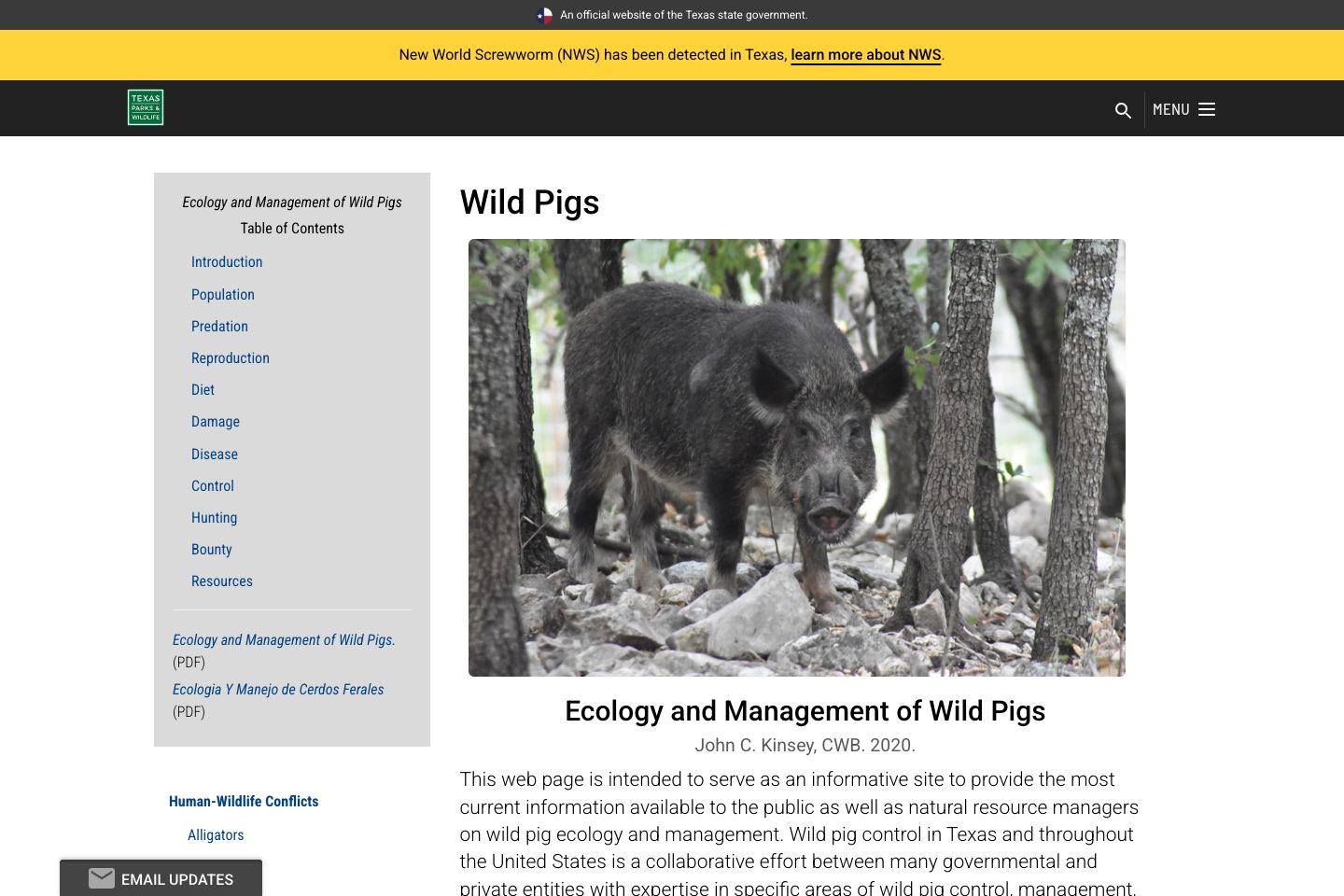
Where deer bait or supplemental feed concentrates animals, wild pigs often show up for the same calories. Texas Parks and Wildlife’s wild pig ecology overview notes that in areas where forage is not limiting - including lands in cultivation or where supplemental feeding for wildlife is common - wild pig reproduction rates can run higher than average (Texas Parks and Wildlife). Wild pigs are opportunistic omnivores that typically consume about 3 to 5 percent of their body mass daily and are documented intentional predators of white-tailed deer fawns among other vertebrates (Texas Parks and Wildlife). They are capable of carrying and transmitting at least 30 bacterial, fungal, and viral diseases that threaten humans, livestock, and wildlife, including brucellosis, leptospirosis, toxoplasmosis, and trichinosis among those that can infect people (Texas Parks and Wildlife). Bait piles meant for deer therefore become shared disease and competition nodes, not just deer magnets (Texas Parks and Wildlife).
Key Takeaways
- Supplemental feeding sites can elevate wild pig reproduction where forage is not limiting (Texas Parks and Wildlife).
- Wild pigs eat 3-5 percent of body mass daily as opportunistic omnivores (Texas Parks and Wildlife).
- Documented predation includes white-tailed deer fawns (Texas Parks and Wildlife).
- At least 30 bacterial, fungal, and viral diseases; several infect humans (Texas Parks and Wildlife).
- Largest disease threat framed as transmission to domestic livestock (Texas Parks and Wildlife).
Why bait and feed sites pull pigs
Texas Parks and Wildlife states that where forage is not a limiting factor - cultivated land or places with supplemental wildlife feeding - wild pig reproduction can exceed average rates (Texas Parks and Wildlife). That is a direct management link between deer feeders and pig productivity on the same landscape (Texas Parks and Wildlife). Opportunistic pigs that already consume 3 to 5 percent of body mass daily will exploit concentrated grain the same way deer do (Texas Parks and Wildlife). Recreational pig hunting over baited areas is itself listed among control tactics, underscoring how reliably pigs find bait (Texas Parks and Wildlife).
Competition and fawn predation
Studies cited by Texas Parks and Wildlife document intentional predation by wild pigs on juvenile domestic livestock, white-tailed deer fawns, ground-nesting bird nests, and various reptiles and amphibians (Texas Parks and Wildlife). Damage is not limited to crops: wild pigs are listed among the world’s top 100 worst exotic invasive species, with earlier research estimating substantial per-pig economic damage (Texas Parks and Wildlife). At a bait site, that means deer face both caloric competition and elevated fawn risk where pig density rises around the same attractant (Texas Parks and Wildlife).
Disease list hunters should not shrug off
Wild pigs can carry and transmit at least 30 bacterial, fungal, and viral diseases threatening humans, livestock, and wildlife (Texas Parks and Wildlife). Human-infecting examples include brucellosis, leptospirosis, toxoplasmosis, and trichinosis (Texas Parks and Wildlife). Texas Parks and Wildlife frames the largest threat as potential transmission to domestic livestock - swine brucellosis, pseudorabies, classical swine fever, and African swine fever among diseases that can cause birth defects and death in livestock and wildlife (Texas Parks and Wildlife). Classical swine fever and foot-and-mouth disease have been eradicated from the U.S. pork industry as foreign-animal diseases, yet wild pigs can act as reservoirs that make reintroduction scenarios devastating (Texas Parks and Wildlife).
Shared ground with deer management
When deer bait is legal in your unit, assume pigs may use it and plan disease and competition hygiene accordingly (Texas Parks and Wildlife). Gloves when handling pig carcasses, careful meat care, and not treating every free-ranging swine contact as harmless follow from the multi-disease list (Texas Parks and Wildlife). Where agencies restrict baiting partly for disease concentration reasons - as in CWD anti-congregation logic elsewhere - pig overlap is another reason concentrated feed is not a free lunch (Texas Parks and Wildlife).
Control context at the feeder
Texas Parks and Wildlife notes recreational hunting over baited areas has only limited potential to reduce localized high-density pig populations, and that increased human activity can change pig behavior (Texas Parks and Wildlife). That means a deer bait pile is rarely a pig-eradication tool even if it draws shootable pigs (Texas Parks and Wildlife). Integrated control beyond recreational harvest is the agency framing for meaningful density reduction (Texas Parks and Wildlife). Deer hunters who only shoot an occasional pig at the feeder should not assume they solved the overlap problem (Texas Parks and Wildlife).
Bottom line
Deer bait and supplemental feed can raise wild pig reproduction, fawn predation risk, and shared disease exposure - treat feeders as multi-species nodes, not deer-only gear (Texas Parks and Wildlife).
The other side of it
Every claim here traces back to one Texas agency overview, and its reproduction point covers cultivated land as well as feeders. On a property already ringed by crops, one corn pile may not change pig numbers much, and the occasional hog shot at the feeder is still a hog that won’t breed again. The overlap is real; how much the feeder itself adds is less settled. Then again, the guy calling his feeder a hog-control program is mostly running a pig daycare with a shooting rail.
Keep reading
Latest deer news
Comments