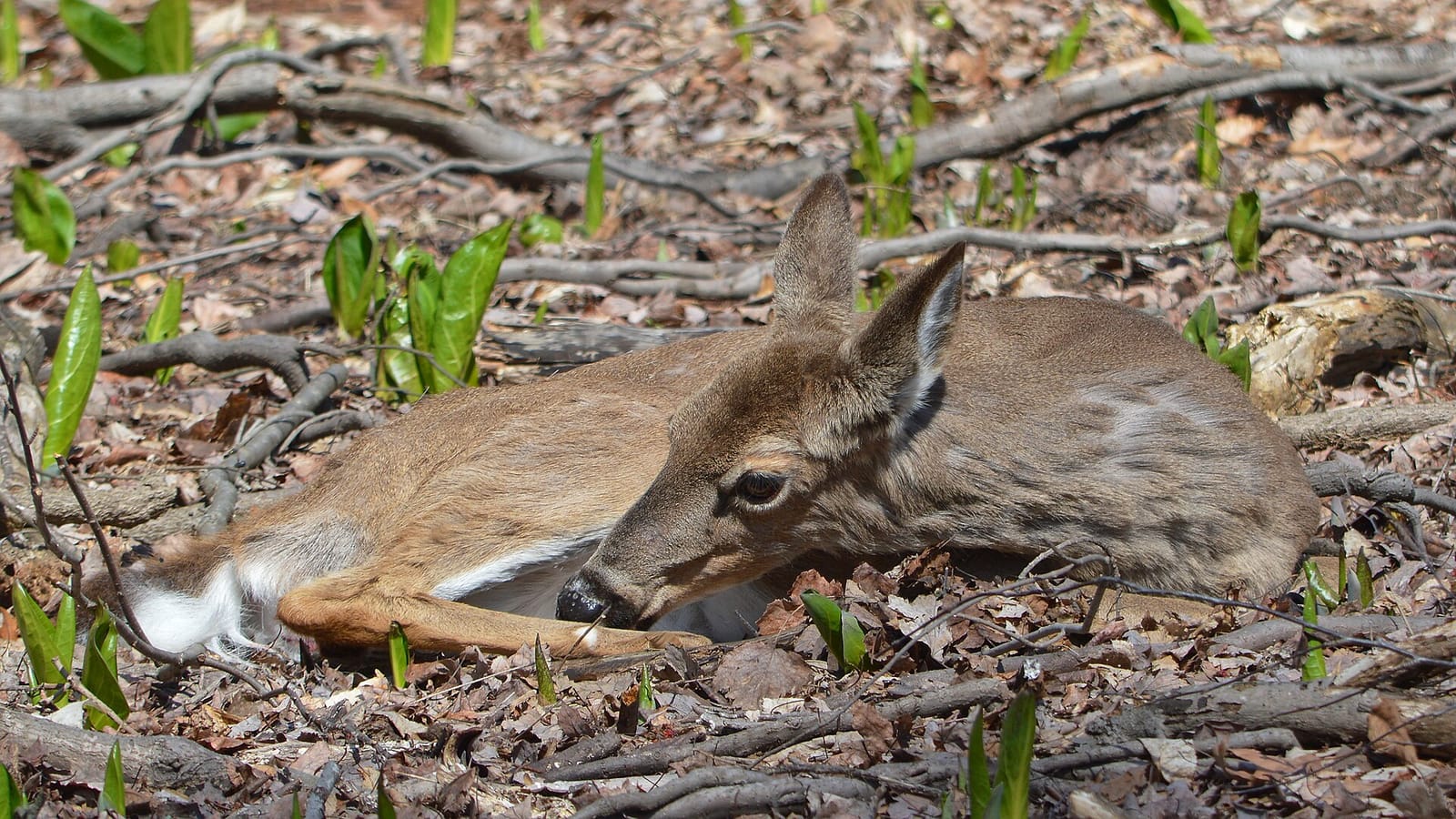
Deer bedding happens in cover thick enough to block your view, and in far more spots than most of us want to believe. GPS collars show an adult Mississippi buck using about 31 bedding areas in one season, about half of them only once. Bucks and does both lean on thick daytime cover and move to food after dark, and snow, the rut and hunting pressure all reshuffle where they lie down.
Key Takeaways
- Sixty GPS-collared adult bucks in Mississippi averaged about 31 bedding areas per season. The range ran from 8 to 87, and about half the areas were used once (NDA on the MSU Deer Lab study).
- In a separate Mississippi State analysis, bucks were bedded at 64% of daytime GPS locations versus 38% at dawn and 35% at dusk (MSU Extension).
- Bucks’ most-used bedding sites had about twice the screening cover of sites they never used, 33% versus 15% (MSU Extension).
- In South Carolina, both sexes picked hardwood drains and planted pines by day and food plots at night (Stewart et al., 2022).
Where do deer bed during the day?
In cover you can’t see through. Mississippi State’s Deer Lab logged collared adult bucks every 15 minutes on a 50,000-acre study area along the Big Black River and found them bedding in bottomland hardwoods, pine stands and old fields. Then they measured cover at each buck’s two most-used bedding areas against two random spots that buck never used. The bedding sites had about twice the screening cover and about twice the herbaceous and thicket-forming plants, which hide a deer and feed it at the same time (MSU Extension).
In South Carolina, researchers working from an Auburn University Deer Lab dataset of 111 collared deer, on a 14,000-acre property that was 60% natural pine, found that “both bucks and does selected for hardwood drains and planted pines during the day,” while food plots were the top pick for both sexes at night (NDA).
Do deer bed high or low?
Often a little high. Illinois Learn to Hunt says deer often pick bedding spots that are slightly elevated, or in open woods, where they can watch for predators (INHS).
In swamp country, look at the oxbows. Illinois Learn to Hunt describes an oxbow bed as a bend in a river or creek that forms a bowl-shaped loop with a small land bridge to the mainland (INHS scouting).
When do deer bed down for the day?
Not only in daylight. The Mississippi researchers expected mostly daytime beds, but the split was 50/50, with day beds averaging 1.75 hours and night beds 1.6 hours. A typical buck spent about 3.5 hours of daylight hunting hours bedded, in two bouts (NDA). That sits oddly beside the 64% figure above, and the last research section explains why.
Do bucks use the same bed every day?
Rarely. In the MSU study, a “bedding area” was one or more bed sites at least 100 yards from any other bed. Bucks averaged about four bed sites a day over two areas. About 3% of bedding areas got used more than 200 times, so most bucks had a favorite or two, but those favorites sprawled across dozens of acres with beds scattered through them. Over the whole season a buck took about six days to circle back to the same bedding area. Within a single rut phase it was about a day and a half (NDA).
Agency guides put it more loosely. Washington’s WDFW says deer may return to the same spot over many days (WDFW). Illinois Learn to Hunt says bucks shift their beds around to limit the scent trails they leave (INHS).
Luke Resop, who wrote up the work for the NDA, put the history bluntly: “To our knowledge, there has never been a scientific study on buck bedding habits” (NDA).
Do bucks and does bed in different places?
Less than camp talk says, at least by day. In the South Carolina data, both sexes favored hardwood drains in daylight. The difference was risk. The study found “females (p = .41) were more likely than males (p = .16) to use risky areas containing abundant food resources,” and bucks avoided food plots more strongly by day. The authors’ read: larger males can afford to skip a meal when the woods feel dangerous, and does sometimes can’t (Stewart et al., 2022).
Bucks also tend to bed alone. Illinois Learn to Hunt calls them generally solitary bedders, and says that during the rut they often move closer to doe bedding areas and hang downwind to smell when does come into estrus (INHS).
Why do fawns bed alone?
Because that’s how they’re raised. Mississippi State’s Deer Lab says does tend to tuck fawns into low, dense vegetation, often fields tall enough to hide them (MSU Deer Lab). MU Extension says fawns can move within the first day but don’t follow the doe constantly until about 1 month old. Until then the doe comes back to nurse while the fawn beds quietly, so a fawn lying alone usually hasn’t been abandoned (MU Extension G9479).
How does deer bedding change through the season?
| When | What the research shows |
|---|---|
| Pre-rut through peak rut | Share of buck locations bedded fell from 49% to 39%, then recovered to 47 to 48% after the rut (MSU Extension). Bucks used more bedding areas, spaced farther apart, as the rut built (NDA). |
| Gun season | In an Oklahoma study by the same lab, daytime cover use rose 240% by the second weekend of gun season, and hunters’ sightings of collared bucks fell 62% (MSU Extension). |
| Deep snow | Use of dense conifer climbed with snow depth across four Minnesota winter ranges (DelGiudice et al., 2013). Where snow stays over about 1 to 2 feet, deer yard up, often on south-facing slopes in hill country (MSU Deer Lab). |
Where do deer bed in the winter?
Under conifer when the snow piles up, but not because of the cold. On the coldest days, Minnesota does used open habitat more, which the authors tie to sunshine (DelGiudice et al., 2013). The conifer is for snow.
How pressure changes movement, hour by hour, is on our deer movement today guide. Where deer go in wet weather lives on do deer move in the rain.
How do you find buck bedding areas?
Start on a map. You’re looking for the cover the collared bucks kept choosing: thick, brushy understory you can’t see far into, near food. The Mississippi team flagged the corridors linking bedding cover to food as the useful spots for hunters, archery hunters especially (MSU Extension).
Then walk it once, in late winter, when the season is closed and it costs you nothing. Our shed hunting guide covers that trip. What a bed, rub line or trail looks like on the ground is on how to read deer sign, so we won’t repeat it here.
If a buck rotates through 31 bedding areas, the one you found in March may be one he used once (NDA). Ask yourself: are you hunting a bed, or a type of cover?
What does a deer bedding area look like?
Messier than the photos online. By the MSU definition, a bedding area is often a loose chain of beds each less than 100 yards apart, spread through dozens of acres of cover (NDA). On the ground that’s a few flattened spots in grass, leaves or snow, in brush so thick the photo is mostly stems. Illinois Learn to Hunt describes a single bed as a shallow oval about 3 to 4 feet long and 2 to 3 feet wide, often lined with flattened plants or leaves (INHS). The wide shot matters as much as the close-up.
How close can you hunt to a bedding area?
We couldn’t find a study that puts a yardage on it, so we won’t invent one. What the GPS work supports is sitting longer. Since bucks moved and bedded all day, the Mississippi authors advise staying on stand from before sunrise until after sunset (MSU Extension). The South Carolina authors concluded that “hunting pressure is a better predictor of deer behavior than cover type alone” (NDA). Penn State researchers say the same thing about big woods: the deer that survive find a “safe zone” in their home range where hunters don’t disturb them, and keep going back to it (Penn State).
Can you build deer bedding on your own land?
You can, but skip the shortcut. The Mississippi team recommends good cover spread across a property, built with sunlight management, fire in different seasons, selective herbicide and soil disturbance. Scattered little hinge-cut patches with poor cover between them, Resop writes, are unlikely to meet bucks’ bedding needs (NDA). Opening a canopy by thinning or clear-cutting grows cover that also feeds deer (MSU Extension). Our guides to deer bedding grass and hinge cutting trees go deeper.
What don’t the bedding studies settle?
Two big things. First, “bedded” depends on who’s counting. MSU Extension reports bucks bedded at 64% of daytime locations, while the bed-site study only counted a bed if a buck held still an hour or more, which its authors call conservative, and lands near 3.5 daylight hours (NDA).
Second, it’s Southern data. Cover is everywhere on the MSU site, and Midwest farm-country bucks may bed very differently (NDA). Analyses of wind and topography are still coming.
Related reading on RAD:
The other side of it
The case against chasing deer bedding at all: the best data says a buck’s bed is a moving target, and every scouting lap through thick cover is the same pressure that pushed Oklahoma bucks deeper into it. The hunter who never steps into a bedding area and sits the food-to-cover edge all day is following the research more closely than the guy with 40 bed pins on his phone. And the fella who swears he knows “the exact bed” his buck uses should know the buck has about 30 others he hasn’t been told about.
Keep reading
Latest deer news
Sources
- NDA on the MSU Deer Lab study (deerassociation.com)
- Understanding Buck Movement: How, When, and Why Bucks Navigate the Landscape | Mississippi State University Extension Service
- Stewart et al., 2022 (pmc.ncbi.nlm.nih.gov)
- NDA (deerassociation.com)
- Habitat Cover | Deer Ecology & Management Lab | Mississippi State University
- A Long-Term Assessment of the Variability in Winter Use of Dense Conifer Cover by Female White-Tailed Deer | PLOS One
- White-Tailed Deer Ecology | Illinois Learn to Hunt | Illinois Natural History Survey | Prairie Research Institute
- Post-season Deer Scouting Strategies | Illinois Learn to Hunt | Illinois Natural History Survey | Prairie Research Institute
- The Ultimate Guide to Hunting Big Woods Deer | Penn State Deer-Forest Study
- Living with Deer | Washington Department of Fish and Wildlife
- Ecology and Management of White-Tailed Deer in Missouri | MU Extension
Comments