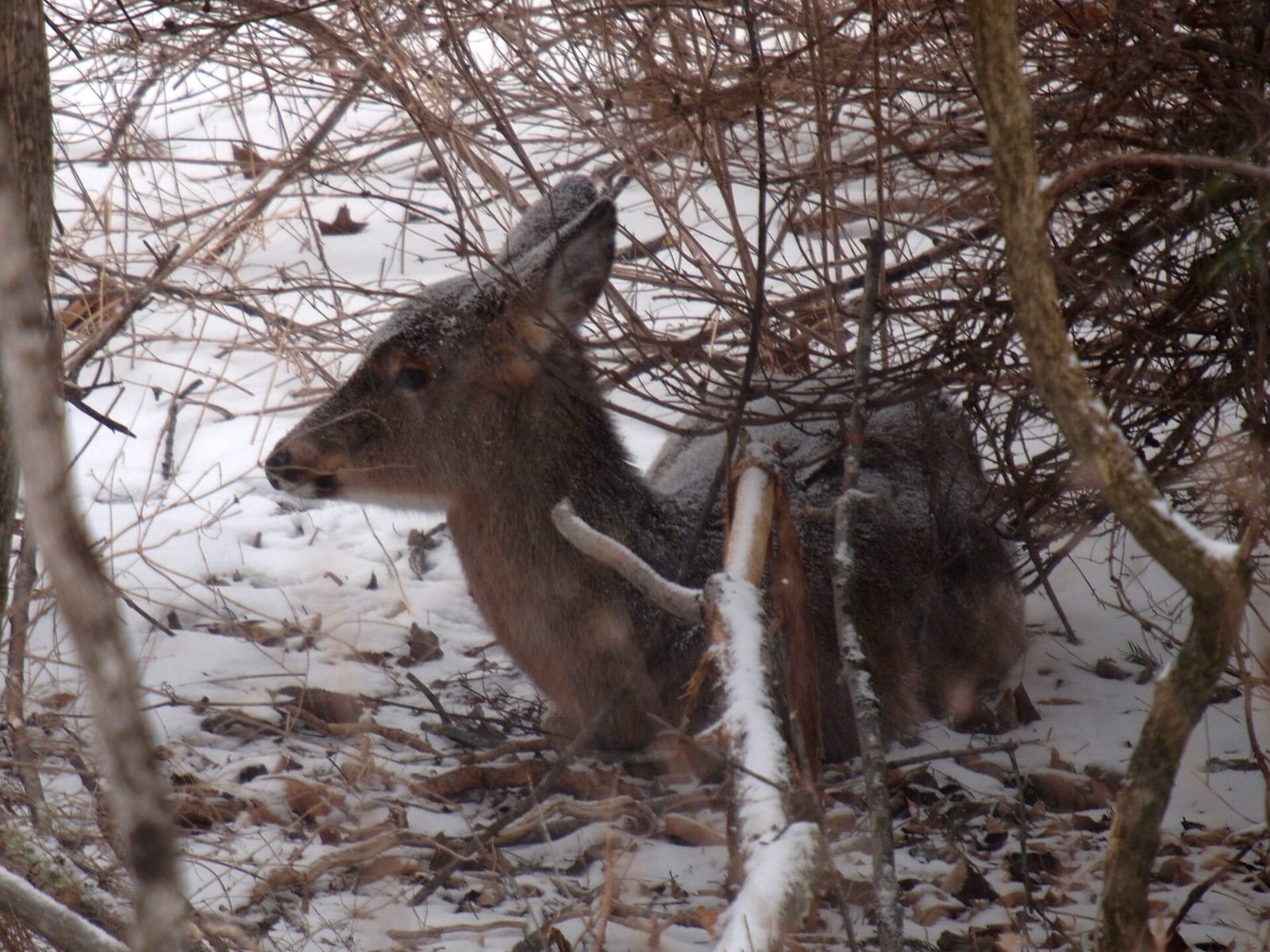
White-tailed deer do not pick beds at random. A Wildlife Biology GPS study of adult bucks in Texas tested whether midday summer habitat selection was driven more by thermal environment than by forage or concealment alone, and found the best of 97 models used forage quality, vegetation height, operative temperature and concealment cover together, though bucks did not pick spots with more concealment cover at any time of day (Wildlife Biology). Northern winter guidance from University of New Hampshire Extension and Michigan DNR likewise treats dense softwood cover as a thermal and mobility tool when snow, wind, and cold dominate the energy budget (UNH Extension; Michigan DNR).
Key Takeaways
- Texas summer GPS: at midday, operative temperature, vegetation height and woody canopy together predicted use better than any one of them alone (Wildlife Biology).
- Bucks selected taller vegetation morning and midday, shorter vegetation evening and night (Wildlife Biology).
- Concealment cover was a variable in the best model, but bucks did not select areas with more of it in any activity period (Wildlife Biology).
- Northern winter beds favor dense softwood that intercepts snow and cuts wind exposure (UNH Extension; Michigan DNR).
- Illinois beds are shallow oval depressions about 3-4 ft by 2-3 ft in dense cover (Illinois Learn to Hunt).
What the Texas midday test actually asked
Researchers fitted male white-tailed deer with GPS collars and modeled June-July 2008-2009 resource selection across activity periods (Wildlife Biology). Candidate models compared a forage index (standing crop, crude protein, ADF) against vegetation height, operative temperature, concealment cover, and interactions with time of day (Wildlife Biology). Among 97 models, the winner included forage, vegetation height, operative temperature, concealment cover, and their activity-period interactions (Wildlife Biology). The practical reading is that bucks seek cooler operative environments at midday while still tracking better forage - not shade alone and not browse alone (Wildlife Biology).
Height and canopy are part of the thermostat
Males selected taller vegetation in morning and midday periods but shorter vegetation during evening and nighttime (Wildlife Biology). A combination of operative temperature, vegetation height, and woody plant canopy cover predicted midday habitat use better than any of those three variables alone (Wildlife Biology). Deer did not select greater concealment cover during any activity period in that analysis, which undercuts the idea that “thicker always wins” when heat is the binding constraint (Wildlife Biology).
Winter beds flip the physics
UNH Extension describes deer wintering areas with a dense mature softwood core that improves mobility in snow, plus adjacent forage habitats (UNH Extension). Hemlock and northern white cedar are called out for superior snow intercept; spruce and fir also matter (UNH Extension). Deer often bed on west-facing softwood slopes by day to pick up solar warmth while still using cover (UNH Extension). Michigan DNR wintering-complex guidance likewise stresses conifer cover that shelters deer from snow, wind, and cold and that intercepts snow so travel costs drop (Michigan DNR).
What a bed looks like on the ground
Illinois Learn to Hunt describes adult beds as shallow oval depressions roughly 3 to 4 feet long and 2 to 3 feet wide in forested areas with dense undergrowth, often lined with flattened vegetation (Illinois Learn to Hunt). Deer bed multiple times through a day to rest and ruminate between feeding bouts (Illinois Learn to Hunt). Bucks often bed alone; does more often in social groups; bucks may shift beds daily to limit scent trails while does tending fawns reuse familiar dense cover (Illinois Learn to Hunt).
Stand and scouting takeaways
In hot weather, map tall woody canopy and cooler aspects for midday beds rather than only screening cover (Wildlife Biology). In deep-snow country, protect or expand softwood cores before inventing new yards, because deer learn wintering areas from their mothers and return for life (UNH Extension). Trail cameras on the lee side of dense conifers or on west-facing winter slopes are reading microclimate, not just “deer sign” (UNH Extension; Michigan DNR).
Bottom line
Treat beds as microclimate decisions: cooler tall canopy at summer midday, snow-intercept softwoods in winter, and oval depressions in dense cover you can measure on the ground (Wildlife Biology; UNH Extension; Illinois Learn to Hunt; Michigan DNR).
The other side of it
The summer evidence is one Texas GPS study of bucks in June and July, and the winter half comes from extension advice on yards, not measured bed sites. Even the Illinois note quoted here says bucks shift beds daily to limit scent trails, which sounds like security talking as loud as temperature. Some hunters will now swear their buck picks a bed by thermometer, right up until a four-wheeler rolls past it.
Keep reading
Latest deer news
Comments