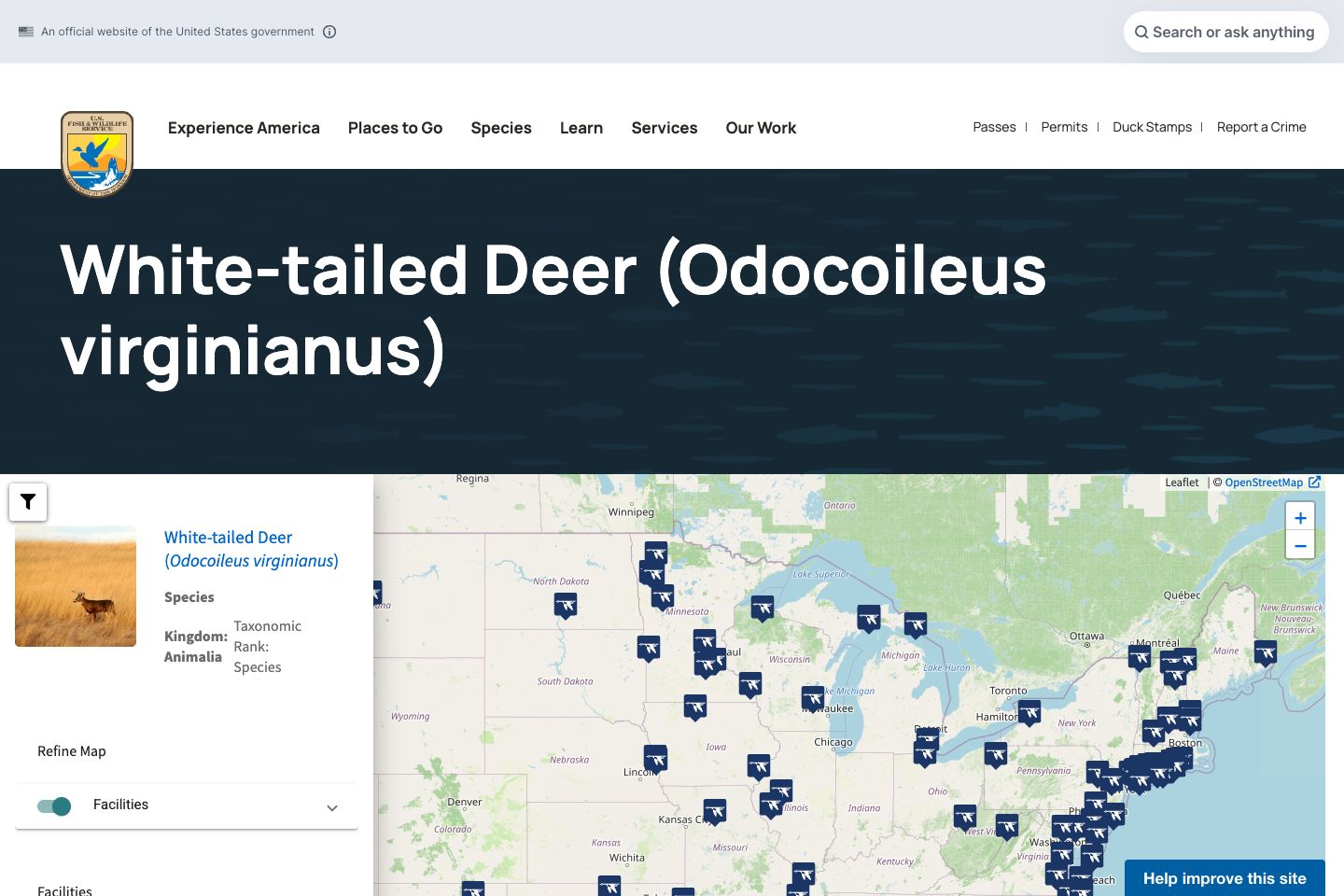
White-tailed deer carry one species name - Odocoileus virginianus - plus dozens of subspecies labels tied to regions. Whitetails Unlimited’s distribution booklet states roughly 30 subspecies names exist across the range, with about 16 used north of the Mexico/U.S. border (Whitetails Unlimited). Named examples hunters meet include northern woodland O. v. borealis, Texas O. v. texanus, Coues deer O. v. couesi, and the isolated Columbian white-tailed deer O. v. leucurus along the lower Columbia and Umpqua (Whitetails Unlimited). U.S. Fish and Wildlife Service species pages map O. virginianus as a continental species for conservation context (U.S. Fish and Wildlife Service). Treat subspecies maps as geography and morphology guides, not as separate hunting species where state regs list “white-tailed deer” (Whitetails Unlimited; MU Extension G9479).
Key Takeaways
- ~30 subspecies names range-wide; ~16 north of Mexico (Whitetails Unlimited).
- O. v. borealis = northern woodland form (Whitetails Unlimited).
- O. v. texanus spans much of Texas habitats (Whitetails Unlimited).
- O. v. couesi = Coues deer of the Southwest (Whitetails Unlimited).
- O. v. leucurus = Columbian whitetail in OR/WA river pockets (Whitetails Unlimited).
How the naming works
Dale Deckman’s WTU overview explains that the subspecies epithet attaches to populations in specific regions - morphology and geography first (Whitetails Unlimited). Hunters still buy a white-tailed deer tag unless a state splits Coues or other forms in regulation language (Whitetails Unlimited). Missouri ecology guides discuss O. virginianus as the statewide species without hunter-facing subspecies splits (MU Extension G9479). FWS maps the species’ continental footprint for managers tracking range, not trophy subspecies scorecards (U.S. Fish and Wildlife Service).
Northern woodland borealis
WTU opens with O. v. borealis photos and text for the northern woodland whitetail that dominates much of the Northeast and Upper Midwest hunting culture (Whitetails Unlimited). Larger body size and winter coat adaptations fit that northern niche where deep snow and yarding define winter strategy (Whitetails Unlimited; Maryland DNR). Maryland notes whitetails occur in every county and across much of the United States and southern Canada - the borealis and related northern forms sit inside that broad map (Maryland DNR).
Texas and Coues forms
O. v. texanus - the Texas whitetail - is described as incredibly diverse across gulf prairies, oak savannas, and South Texas brush country (Whitetails Unlimited). Coues deer (O. v. couesi) appear with other western named forms in WTU’s western set alongside leucurus and ochrourus (Whitetails Unlimited). Those Southwest and Texas labels cue habitat and body-size expectations when outfitters advertise “Coues” versus “Texas whitetail” hunts (Whitetails Unlimited).
Columbian leucurus special case
O. v. leucurus occupies isolated pockets in south-central Oregon near the Umpqua and along the Columbia River on the Washington/Oregon border (Whitetails Unlimited). The Columbian White-tailed Deer National Wildlife Refuge was established in 1972 to protect and study those small populations (Whitetails Unlimited). Refuge status is why that subspecies shows up in federal conservation talk more than in Midwest deer camps (Whitetails Unlimited; U.S. Fish and Wildlife Service).
Map use for hunters
Use subspecies maps to set expectations for body size, antler character, and habitat - not to invent genetics excuses for culls (Whitetails Unlimited). When traveling, read the destination state’s deer definition and any Coues or blacktail distinctions carefully (Whitetails Unlimited; MU Extension G9479). Geneticists may debate some boundaries; the hunting paperwork still follows agency species lists (Whitetails Unlimited). Illinois Learn to Hunt similarly treats O. virginianus as the only deer species available to hunt in Illinois - a single-species frame inside the continental subspecies mosaic (Illinois Learn to Hunt).
Bottom line
Learn the named forms - borealis, texanus, couesi, leucurus - as geography, then hunt the legal white-tailed deer definition in the state you buy a tag (Whitetails Unlimited; U.S. Fish and Wildlife Service).
The other side of it
A sharp skeptic will point out these lines are drawn on morphology and geography, and the article admits geneticists still debate some of the boundaries. A buck living near one of those borders isn’t wearing a label, so leaning on a map for body-size or antler expectations can mislead you about as often as it helps. Funny how subspecies talk always picks up right after somebody shoots a small one and needs a reason.
Keep reading
Latest deer news
Sources
- North American White-tailed Deer Distribution & Subspecies
- U.S. Fish and Wildlife Service (fws.gov)
- Ecology and Management of White-Tailed Deer in Missouri | MU Extension
- White-tailed Deer Biology
- White-Tailed Deer Ecology | Illinois Learn to Hunt | Illinois Natural History Survey | Prairie Research Institute
Comments