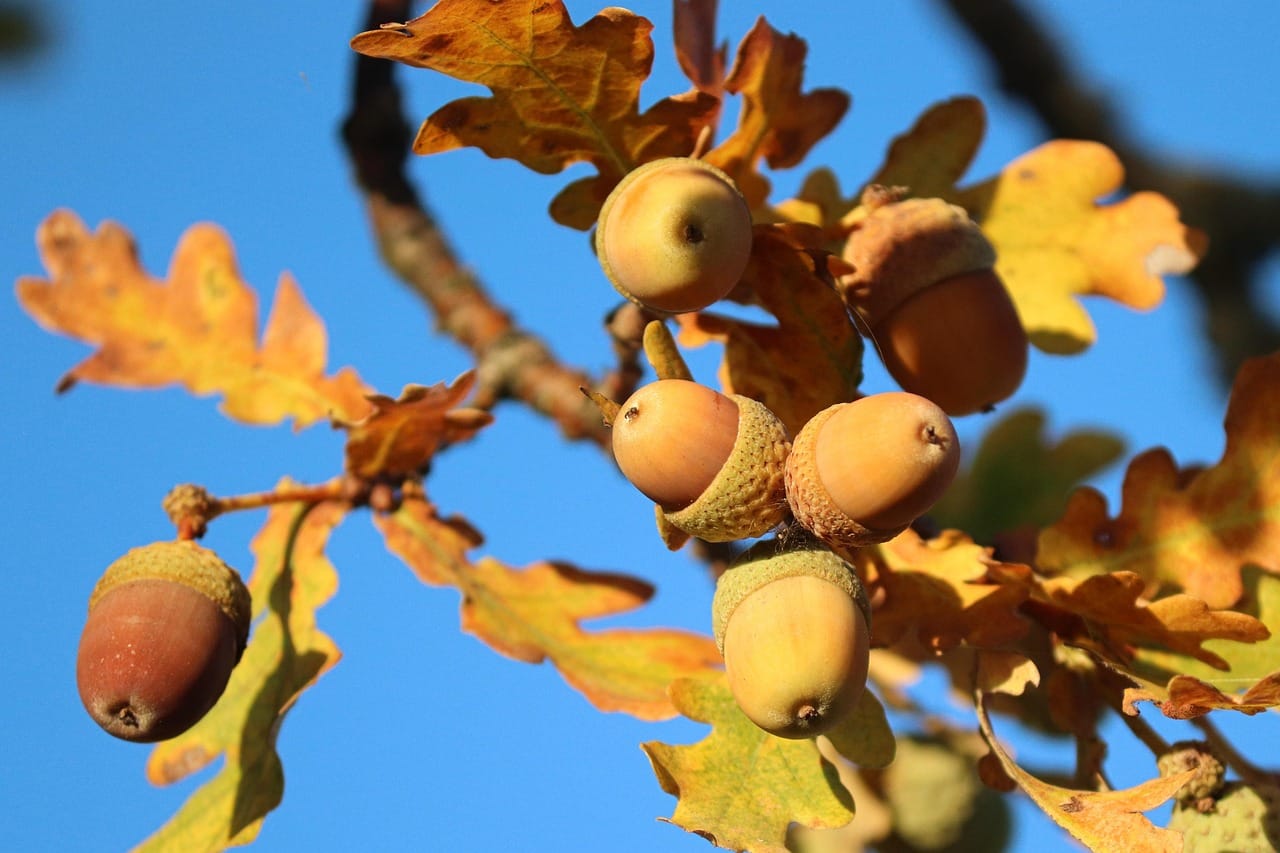
White oak acorns look like three-quarter-inch to one-inch nuts with a shallow, bumpy cap that covers only about the top quarter of the nut, and they drop in September and October of the same year they set (MDC). You’ll find them under a tree with rounded leaf lobes and light gray, flaky bark. In a good year they fall almost all at once, and some years they don’t fall at all.
Key Takeaways
- White oak (Quercus alba) leaves have “6–10 lobes; lobes rounded at the tip.” The acorn is “¾–1 inch long” with a “cup covering up to ¼ of the nut,” and acorns “ripen in autumn of the first year” (Missouri Department of Conservation).
- “The acorns of white oaks need 1 year to mature; red oaks require 2 years” (University of Tennessee).
- At a Georgia site tracked by the University of Florida Deer Lab, “64% of the total white acorn crop fell in” one week (NDA).
- White oaks reliably produce a crop only about two years out of five, and “a minority of the white oaks in a stand may produce a majority of the acorns” (Purdue Extension).
- “Deer will eat the white oak acorns first and turn to red oaks only when the others are gone” (NDA).
How do you identify a white oak tree?
Three checks, in the order you’ll actually use them in the woods.
The leaf
Rounded lobes, no bristles. That one rule splits the oak world in half. “White oaks have lobed leaves or ones with rounded teeth,” while red oaks “generally have sharp-lobed, bristle-tipped leaves” (University of Tennessee). On a true white oak the leaf is 5 to 9 inches long with 6 to 10 rounded lobes, bright green and often shiny on top, whitish and hairless underneath (MDC). Pick up a leaf off the ground. If it’s got little hair-like points on the lobe tips, keep walking.
The bark
Light gray, with shallow grooves and flat, loose ridges (MDC). The NDA’s shorthand is “light and flaky, especially higher up the trunk” (NDA). Bark is your 50-yard check. From the stand, a white oak reads pale and scaly next to the darker, more furrowed red oaks around it.
The acorn and its cap
This is the confirmation. A white oak acorn is ¾ to 1 inch long, widest near the base or middle, tapering to a rounded tip. The cap is bowl- to saucer-shaped, light brown, and “warty or corky, flattened, knobby” on the outside, covering only up to a quarter of the nut (MDC; University of Nebraska–Lincoln). They hang in clusters of two or three and “are often green when they first fall, maturing to a rich brown” (University of Tennessee). A deep, smooth cap that swallows half the nut is telling you red oak.
What month do white oak acorns fall?
September and October across most of the whitetail range. Missouri’s field guide puts fruit on the ground September through October and notes that because white oak acorns mature in one season, “none are present on the tree in winter” (MDC). The NDA puts the white-oak timeline at about six months from flower to falling, versus 18 months for the red oak family (NDA).
The part most hunters miss is how short the window is. At a Georgia site tracked by the University of Florida Deer Lab, “64% of the total white acorn crop fell in” one week (NDA). And white oak acorns don’t keep. They sprout fast and go bitter on deer, while red oak acorns “remain viable, and edible, far longer on the ground” (NDA). So a white oak flat is a two-to-three-week hunt, not a two-month one. Your exact dates depend on latitude and the year. Find the peak on your own ground and plan around it.
Why don’t white oaks drop acorns every year?
Because they can’t afford to. Oaks mast: they throw a huge crop some years and little or nothing in others. Purdue Extension says “a large mast event may happen every two to five years, depending on the species of oak and several other factors,” and that a big crop costs the tree so much it grows less that year (Purdue). The leading explanation is predator satiation: lean years knock back the squirrels, deer, turkeys and weevils that eat acorns, then “the sudden flood of acorns overwhelms” them and some seed survives to sprout (NC State Extension).
White oaks are the streakier of the two families. Purdue says they reliably produce only about two years out of five, versus a good red oak crop every two to five years and a bumper every five to seven (Purdue). The one-year cycle is also why a late spring frost can wipe out a white oak crop that same fall while leaving the red oaks alone. Weather during pollination, summer drought and heat all cut production (Purdue).
Why is one white oak loaded and the one beside it bare?
Trees are individuals. A University of Tennessee study followed more than 100 white oaks for ten years and found that “39% of the white oak trees produced 69% of the total acorn crop” (NDA). Purdue’s breakdown of the same work: poor producers were half the trees but 15 percent of the acorns, while excellent producers were 13 percent of the trees and 40 percent of the crop (Purdue). Which raises the only scouting question that matters: do you know which of your white oaks are the 13 percent?
Which white oak acorns do deer eat?
All of them, in roughly this order of enthusiasm, with the tell that separates each tree.
| Species | How to tell it | Acorn | Where it grows | Source |
|---|---|---|---|---|
| White oak (Q. alba) | 6–10 rounded lobes, light gray flaky bark | ¾–1 in., shallow warty cap (≤¼ of nut) | Dry upland slopes and ridges, also valley bottoms | MDC |
| Swamp chestnut oak (Q. michauxii) | 4–9 in. leaves with 9 to 14 lateral veins per side, thick scaly light-gray bark | “Exceedingly large (1½ inches long),” about 85 per pound, “very palatable and eaten by white-tailed deer” | Southeast floodplains and bottomland terraces | NDA |
| Swamp white oak (Q. bicolor) | Leaves dark and shiny on top, “downy-whitish” below, so they flash white in a storm wind; acorns on 2½-inch stalks | ¾–2½ in. with stalk; cup covers up to half the nut | Moist bottomlands, stream banks, wet poorly drained ground | MDC |
| Chestnut oak (Q. montana) | Leaves with rounded teeth, not lobes; deeply ridged bark | Up to 1½ in. with “a thin, warty cap,” shiny brown to black | Dry ridges, mostly Appalachian | University of Tennessee |
| Post oak (Q. stellata) | Middle lobes “squarish, resembling a cross” | Up to ¾ in., cup covers ⅓ to ½ | Dry, rocky uplands and glades | MDC; UT |
| Bur oak (Q. macrocarpa) | Broad spatula-shaped leaves | Up to 2 in. with “a distinctive fringed cup” | Midwest, into northwest Tennessee | University of Tennessee |
| Live oak (Q. virginiana) | Thick, nearly evergreen, untoothed leaves 1.4–3.5 in.; dark scaly to blocky bark | 0.6–1.0 in., barrel- to egg-shaped, dark brown to black, up to five per cluster, matures in one season | Coastal Southeast and Gulf; acorns are “valuable forage for waterfowl, turkey, wild pigs, raccoons, and deer” | USDA NRCS |
The NDA’s working list of the white oak family for deer hunters is white, bur, chestnut, chinkapin, swamp white and post (NDA). Swamp chestnut oak is the one Southern hunters whisper about. The NDA’s forester calls it a top choice for Southeast deer ground and notes good crops come only every three to five years (NDA).
Do deer prefer white oak acorns?
Yes, when they have the choice. “Deer will eat the white oak acorns first and turn to red oaks only when the others are gone” (NDA). Purdue’s one-line reason: white oak acorns “tend to be selected by wildlife more than red oak acorns because they contain less tannins” (Purdue).
The full white-vs-red comparison, tannins included, and what it means for a late-season sit, lives on the white oak vs. red oak acorns page.
How do you scout a white oak that’s about to drop?
Start before the drop, not during it. Purdue’s advice is to walk your oaks in “the late summer and early fall, just prior to or at the beginning of acorn drop,” when you can see the crop in the crown and on the ground, and to note which trees are loaded on your way to stands (Purdue). Binoculars pointed up in late August beat a trail camera pointed sideways in October.
Then confirm the tree. The NDA’s method is simple: find the oaks that are dropping, then check leaf and cap to be sure each one is a white oak and not a red that happens to be early (NDA). Once the first green acorns hit the leaves, the clock starts. Deer will leave field edges and plots for a dropping white oak, and a single hot tree can hold them for the length of the drop. Hunt it now. In three weeks the acorns will have sprouted, the deer will have moved to the red oaks, and you’ll be telling someone at camp how good it was.
One more thing to carry from the research: keep a few red oaks in your plan. Purdue recommends a balance that favors red oak so one late frost doesn’t erase your whole mast year (Purdue).
Related reading on RAD:
The other side of it
A big white oak acorn year is not automatically a big hunting year. The NDA points to Connecticut data from 1993 to 2018 showing hunter success tends to drop when acorns are abundant, because deer don’t have to walk anywhere to eat (NDA). In a bumper year every ridge is a food plot, your hot tree is one of a thousand, and the deer may never leave the bedding timber. Somehow, though, the fellow who missed the whole white oak drop always discovers that “the acorns had ‘em patterned weird this year” right about the time he’s explaining the empty tag.
Keep reading
Latest deer news
Sources
- White Oak | Missouri Department of Conservation
- Forest Resources Center & Arboretum - White Oaks
- Purdue Extension (purdue.edu)
- NDA (deerassociation.com)
- Basic Tree | Tree Identification | Regional and Community Forestry | School of Natural Resources | Unviersity of Nebraska–Lincoln
- NDA (deerassociation.com)
- Purdue (purdue.edu)
- The Secret Life of Acorns: Oaks, Wildlife, and the Science of Mast Years - Beaufort County Center | N.C. Cooperative Extension
- NDA (deerassociation.com)
- Swamp White Oak | Missouri Department of Conservation
- Post Oak | Missouri Department of Conservation
- Plant Guide
Comments