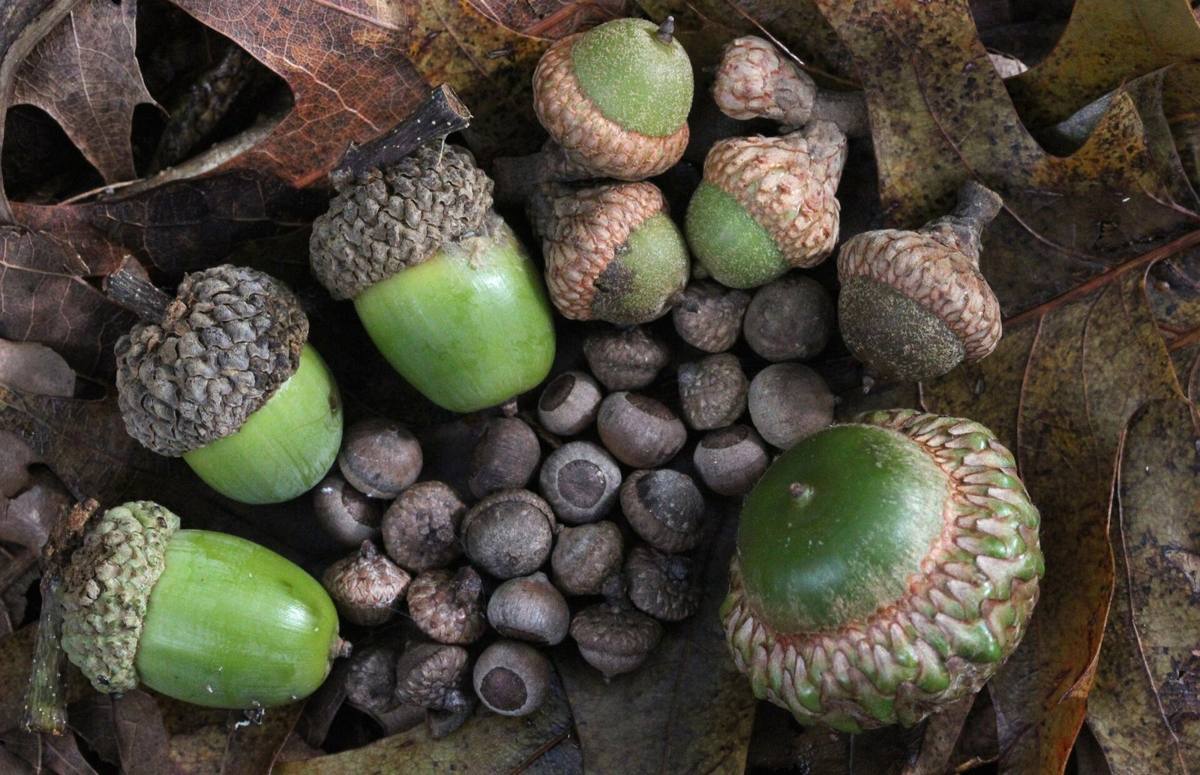
When it comes to white oak acorns vs red oak acorns, deer usually eat the white oaks first, because they carry fewer tannins and taste less bitter (University of Tennessee). But white oak acorns sprout fast and disappear early, while red oak acorns sit on the ground through winter (NDA). So white oaks are your early-season spot, and red oaks are the ones that keep paying off into November and beyond.
Key Takeaways
- White oak acorns are lower in tannins and “particularly selected” by deer, according to the University of Tennessee.
- White oak acorns mature in about 6 months; red oak acorns take about 18 months (Illinois Natural History Survey).
- White oak acorns can germinate “within a day or two of falling” if there’s moisture, while red oak acorns don’t germinate until spring (National Deer Association).
- Deer will eat red oak acorns “as readily” as white oaks when white oaks aren’t available (University of Tennessee).
- Because the two groups run on different schedules, one can fail while the other produces a bumper crop in the same year (NDA).
Do deer prefer white oak or red oak acorns?
White oak, when they have the choice. It comes down to taste. Every acorn carries tannins, the bitter compounds that make your mouth pucker. Red oak acorns carry more of them. The National Deer Association explains why: red oak acorns have to survive on the branch or the ground for a long time, so they’re built with more tannins, which makes white oak acorns “much more digestible and highly selected by deer and other wildlife” (NDA).
The University of Tennessee’s deer researchers put it simply: white oak acorns, like those of Quercus alba, are “naturally sweeter – actually less bitter – than other acorns” (UT).
Deer can handle the bitterness better than most animals. Mississippi State’s Deer Lab says mast rises from about 11% of the diet in summer to as much as 28% in autumn, “primarily hard mast, such as acorns,” and deer saliva has enzymes that deactivate tannins, letting them eat “a quantity of acorns that would kill a cow” (MSU Deer Lab). Acorns are low in protein but high in energy, which is why they’re staples where available as deer build fat for the rut and winter (MU Extension).
Which oak tree is best for deer?
For a fall hunting spot, a white oak that’s dropping acorns, based on the preference data above. Over a whole season, it helps to have both kinds. White oak acorns go fast, while red oak acorns stay on the ground into winter (see the drop timing below). The NDA calls red oaks “an excellent winter food source” and says writing them off is “a major oversight.” Mixing both groups also creates “a buffer effect for wildlife,” because if a late frost wipes out the white oak crop, red oaks may still produce (NDA).
Will deer still eat red oak acorns?
Yes. Same UT source: deer “may eat acorns of red oaks as readily as they do those of white oaks if white oak acorns are not available” (UT). Bitter beats hungry.
How do you tell red oak acorns from white oak acorns?
You don’t need a forestry degree. Check three things:
- Leaves: White oaks have rounded, smooth lobes. Red oaks have bristle tips on the ends of the lobes (NDA).
- Bark: White oak bark tends to be lighter and flaky. Red oak bark is darker and firmer (NDA).
- Inside the acorn cap: The University of Arkansas Extension notes the inside of a white oak acorn cap is hairless, and a red oak’s is hairy (UA Extension).
That cap trick is handy in November, when the leaves are down and you’re standing over a pile of acorns wondering what dropped them.
What month do white oak acorns fall?
Usually September. White oaks drop early. American Hunter puts the white oak drop around mid- to late September depending on latitude, with the whole crop falling over a short window, and the red oak drop starting in early October and stretching into November (American Hunter). Your timing will vary with where you hunt, so trust what you see under your own trees.
Why do white oak acorns disappear so fast?
Because they start growing right away. “Almost as soon as a white oak acorn hits the ground, it begins shooting out a radicle, the beginning of a root,” Pennsylvania Game Commission forester David Gustafson told American Hunter. That root burns the acorn’s carbohydrates, so its food value drops. The University of Arkansas Extension adds that the taproot can reach 10 inches deep before cold weather stops it (UA Extension).
Red oak acorns stay dormant until they’ve had enough winter chill, so they’re still sitting there, edible, after the white oaks are gone.
Why do red and white oaks produce acorns in different years?
Timing. Red oak flowers take about a year and a half to become mature acorns, while white oaks mature the same fall they bloom (NDA). A late spring frost that wipes out this year’s white oak crop may not touch red oak acorns that started the year before. The Illinois Natural History Survey notes that longer maturation makes red oaks “less susceptible” to weather events like drought (INHS).
How often do white oaks have a good year?
Not as often as you’d hope. The University of Tennessee’s long-term records say white oaks only produce an abundant acorn crop about two out of every five years (UT). That’s why one “can’t-miss” white oak spot can go dead the next season.
How do you hunt white oaks vs red oaks?
Here’s the season in two halves:
- Early season: find the dropping white oaks. Look for fresh acorns, caps and droppings under them. The NDA notes deer will switch fast when a new tree starts dropping fresh acorns, so a hot tree can go cold overnight (NDA).
- Mid to late season: move to the red oaks. The NDA calls writing off red oaks “a major oversight,” because they “can be a dynamite food source late in the season.” American Hunter’s advice is the same: for a mid- to late-season stand, “find a loaded red oak” (American Hunter).
Stay mobile. Acorn hunting rewards the guy who keeps checking trees, not the guy who hangs a stand in August and never moves it.
Can you count on acorns at all?
Acorns aren’t a sure thing, and a property that’s all closed-canopy oak woods may be starving deer in summer. The UT researchers argue that a closed canopy blocks the sunlight needed for the forbs deer eat in summer, and that “there still are about as many years with few to no acorns as there are years with abundant acorns” (UT). If you manage land, a mix of both oak groups plus open, sunny areas spreads your risk.
Big acorn years also spread deer out. NDA cites Connecticut data from 1993 to 2018 showing private-land hunter success fell in years with abundant acorns, because deer didn’t have to travel to find food (NDA).
Related reading on RAD:
The other side of it
Some hunters will tell you the whole white-versus-red debate is overthought. In a bumper year, acorns are everywhere, deer don’t have to travel to find them, and the “right tree” barely matters. And in a total mast failure, neither group helps you at all. Of course, those are usually the same guys who blame “the acorns” every time they don’t see a deer.
Keep reading
Latest deer news
Sources
- University of Tennessee (fwf.tennessee.edu)
- White-Tailed Deer Ecology | Illinois Learn to Hunt | Illinois Natural History Survey | Prairie Research Institute
- National Deer Association (deerassociation.com)
- Acorns Galore
- Know-How: Red or White? | An Official Journal Of The NRA
- What Do Deer Eat? | Deer Ecology & Management Lab | Mississippi State University
- Nutritional Requirements of White-tailed Deer in Missouri | MU Extension
- NDA (deerassociation.com)
Comments