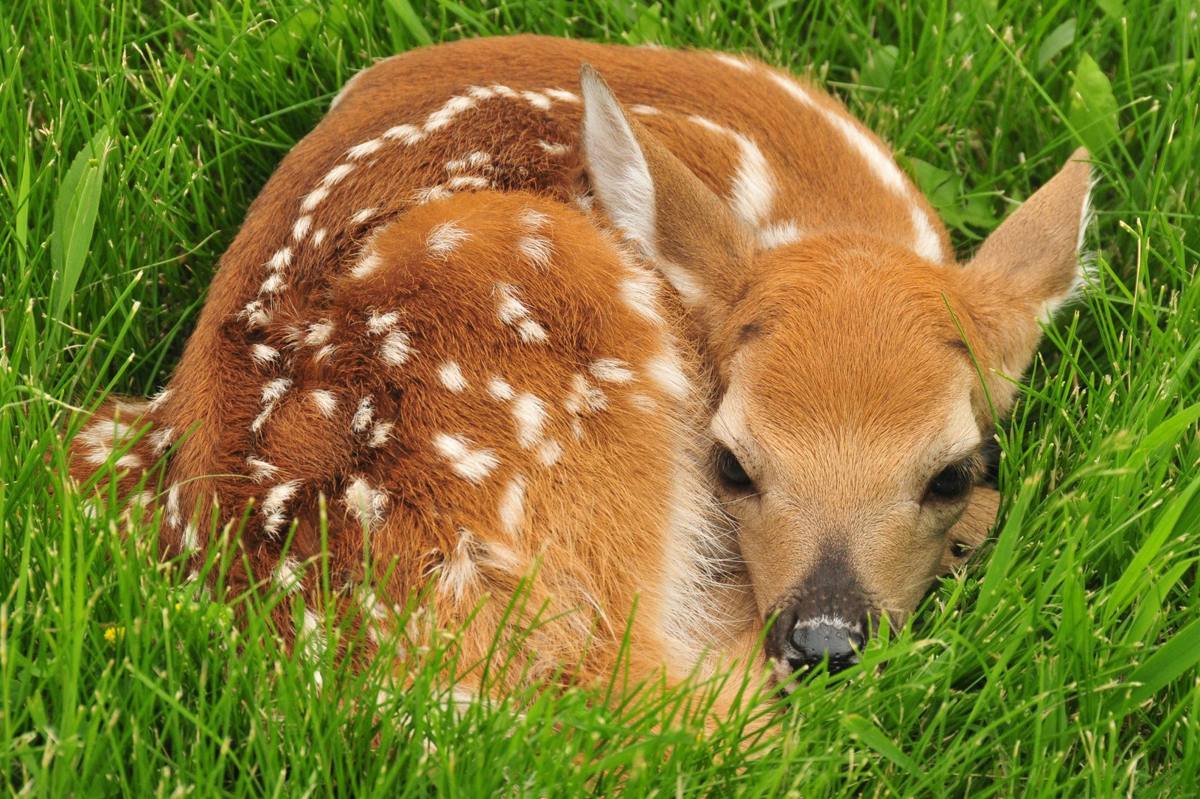
A lone bedded fawn is usually executing an antipredator program, not waiting to be rescued. University of Georgia’s Deer Lab states that white-tailed deer neonates exhibit cryptic behavior until about 4 to 6 weeks of life, bedding down through the day and constantly changing bed sites to avoid detection (UGA Deer Lab). UGA also notes that fawns lack developed scent glands in the first few weeks, so bedsite selection and visual concealment are central to survival (UGA Deer Lab). Journal of Wildlife Management research comparing coyote-killed and surviving neonate bedsites reports that fawns are largely immobile early and rely primarily on remaining undetected, aided by reduced scent production (Journal of Wildlife Management). That paper places the end of the hider strategy at approximately 10 ± 5 days of age on average (range 3-43 days, n=166) and full initiation of the follower strategy at about 37 ± 10 days (range 10-64, n=129) (Journal of Wildlife Management). Mothers select broader parturition landscapes trading forage and cover; within those areas fawns pick micro-bedsites and remain separated except for brief nursing and grooming visits (Journal of Wildlife Management; UGA Deer Lab).
Key Takeaways
- UGA: cryptic bedding about 4-6 weeks (UGA Deer Lab).
- JWM: mean hider end ~10 days with wide range (Journal of Wildlife Management).
- Follower phase mean ~37 days (Journal of Wildlife Management).
- Early scent glands undeveloped; cover matters (UGA Deer Lab).
- Bed sites rotate to break predator search patterns (UGA Deer Lab).
- Leave lone fawns in place (Journal of Wildlife Management; UGA Deer Lab).
Hider mechanics
Immobile neonates cannot outrun coyotes, so taller concealment cover reduces visual detection while they hide (Journal of Wildlife Management). Reduced scent production supports that visual strategy during the same window (Journal of Wildlife Management; UGA Deer Lab). UGA’s emphasis on changing bed sites keeps predators from patterning a single form (UGA Deer Lab).
Doe scheduling
JWM describes mothers leaving immediately after grooming and nursing so an attended pair is not advertising the bed (Journal of Wildlife Management). That separation also frees does to seek higher-quality forage for lactation without dragging a neonate through every feeding bout (Journal of Wildlife Management). UGA’s cryptic-phase summary matches that brief-visit nursing pattern (UGA Deer Lab).
Cover that changes with mobility
During the hider window, denser or taller vegetation helps because flight is weak (Journal of Wildlife Management). As fawns enter the follower phase, more open structure can aid escape routes, while dense shrub thickets that once hid them may impede running (Journal of Wildlife Management). Northern Great Plains work cited in that lineage shows similar cover tradeoffs (Journal of Wildlife Management).
Why recruitment studies care
UGA frames neonate spatial ecology as a window on population health because early survival is a recruitment bottleneck (UGA Deer Lab). JWM’s coyote-bedsite contrast tests whether cover traits differ between depredated and surviving fawns under modern predator communities (Journal of Wildlife Management).
Landowner and public behavior
Do not remove bedded fawns; alone time is the design (UGA Deer Lab; Journal of Wildlife Management). Keep dogs out of fawning cover in May and June (Journal of Wildlife Management). Avoid mowing every herbaceous edge flat during peak parturition if recruitment is a property goal (Journal of Wildlife Management; UGA Deer Lab).
Twin spacing
Keeping siblings apart so one discovery does not yield the whole litter is part of the same hider logic described across these sources (Journal of Wildlife Management; UGA Deer Lab). Finding one fawn does not mean its twin is meters away in the same clump (UGA Deer Lab).
Bottom line
Neonatal whitetails are hiders first: bedded, low-scent, site-shifting fawns that should be left alone while does nurse on short visits before the follower phase begins (UGA Deer Lab; Journal of Wildlife Management).
The other side of it
The data behind this is looser than the tidy version. That JWM paper has hiding ending anywhere from day 3 to day 43, and UGA’s cryptic window runs 4 to 6 weeks, so nobody can tell which phase a given fawn is in just by looking at it. Leaving it alone is a strong default, not proof the doe is coming back to that bed. Still, the folks who “rescue” a fawn every June are mostly running a kidnapping service with good intentions.
Keep reading
Latest deer news
Comments