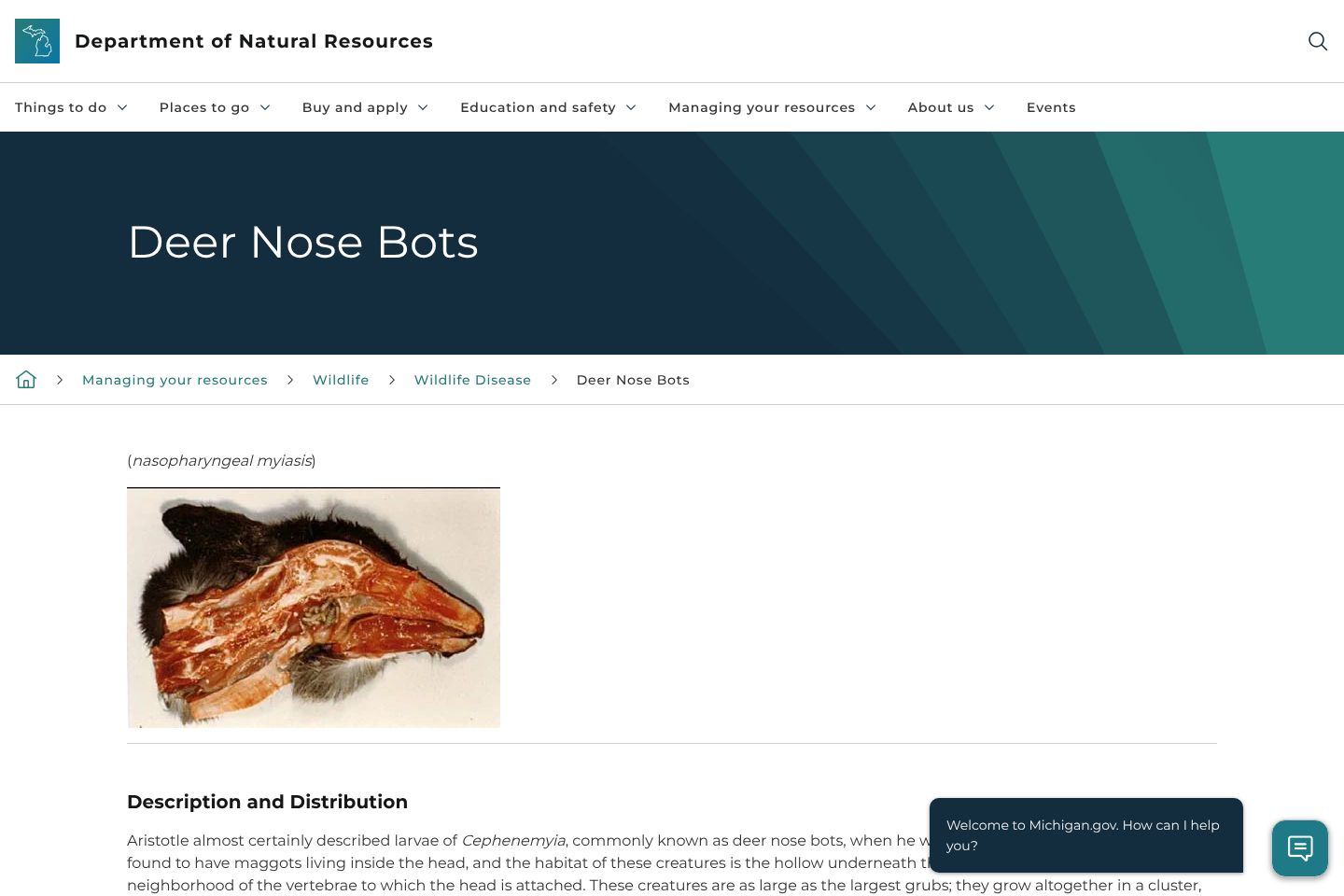
Nasal bots are larvae of Cephenemyia bot flies that develop in deer nasal and throat passages. Michigan DNR, Wisconsin DNR, and Indiana DNR describe them as common, species-adapted parasites that deer usually tolerate, that do not infect people, and that do not ruin venison (Michigan DNR deer nose bots; Wisconsin DNR nasal bot flies; Indiana DNR nasal bots).
Key Takeaways
- Larvae live in nasal/pharyngeal pockets; mature bots exit through the nostrils, which can make deer snort or shake their heads (Michigan DNR deer nose bots; Wisconsin DNR nasal bot flies).
- Not a human parasite; handling carcasses does not put bots in people (Michigan DNR deer nose bots; Indiana DNR nasal bots).
- Meat remains fine; bots are a head issue, not a muscle disease (Wisconsin DNR nasal bot flies).
- Heavy loads can look dramatic when you open a throat on the gutting beam - ugly, not emergency (Michigan DNR deer nose bots).
- Do not confuse bots with CWD drooling or neurological disease (WDFW hemorrhagic vs CWD context).
Life cycle in plain language
Adult bot flies deposit larvae near deer nostrils. Larvae migrate into nasal cavities and retropharyngeal pouches, feed, then drop to the ground to pupate (Wisconsin DNR nasal bot flies; Michigan DNR deer nose bots). Hunters meet them when splitting a skull or trimming a cape. Maggot-like appearance triggers panic texts that agencies have answered for years: normal parasite.
What you will see while processing
Cream to yellow grubs in the throat or nasal area, sometimes wriggling after death. They are not gut maggots from spoiled meat. Rinse the head area, discard bots with inedible waste, and continue butchering muscle as usual (Indiana DNR nasal bots; Michigan DNR deer nose bots). Wear gloves for general hygiene, not because bots seek humans.
Health of the deer
Most infected deer look healthy. Extreme loads are uncommon talking points; agencies still frame the parasite as well tolerated (Michigan DNR deer nose bots; Wisconsin DNR nasal bot flies). Head-shaking on hoof can be bots exiting, insects, or other irritation - not a solo diagnosis.
Differential for worried hunters
CWD involves progressive weight loss and behavior change over months, not a pocket of grubs (CDC about CWD). Hemorrhagic disease clusters in late summer near water (Virginia DWR HD). Brain abscesses present different neurologic signs tied often to antler injuries. Nasal bots are a processing surprise more than a field symptom set (Michigan DNR deer nose bots).
Communication at the processor
Tell commercial processors you saw bots so they do not assume spoilage. Keep heads out of the food stream if you are mounting; taxidermists know the parasite. Do not “treat” wild deer with livestock dewormers without a wildlife veterinarian plan - illegal and unhelpful at herd scale.
Bottom line
Nasal bots are gross, common, deer-adapted, not a human threat, and not a reason to trash the venison (Michigan DNR deer nose bots; Wisconsin DNR nasal bot flies; Indiana DNR nasal bots).
Related: Deer fibromas and Liver flukes.
Prevalence and hunter surprise
Agency disease pages treat nasal bots as expected findings across much of the whitetail range, which is why Michigan, Wisconsin, and Indiana publish nearly identical calm guidance (Michigan DNR deer nose bots; Wisconsin DNR nasal bot flies; Indiana DNR nasal bots). First-year hunters who have only seen clean grocery meat overreact; mentors should normalize the sight once.
Cape and skull-mount notes
Taxidermists routinely flush nasal passages. Tell them you saw bots so nothing is a surprise. For European mounts, thorough boiling and cleaning remove remnants. None of that workflow changes steak care (Michigan DNR deer nose bots).
What not to do
Do not put livestock pour-ons on wild deer. Do not abandon a legal deer in the field because of grubs in the head. Do not claim bots prove the deer was “sick” in a CWD argument - different disease systems (CDC about CWD; Michigan DNR deer nose bots). Do photograph if your club wants a teaching library, then dispose of bots with inedible waste per local carcass rules.
Comparison to other larval finds
Muscle cysticerci or other parasites are separate conversations. Nasal bots stay associated with the head. If you find unfamiliar larvae in loin, pause and ask a wildlife disease lab rather than assuming they are Cephenemyia (Wisconsin DNR nasal bot flies; Indiana DNR nasal bots).
Seasonal timing of hunter finds
Bots are noticed whenever heads are opened, but exit activity that makes live deer snort is often discussed in warmer months as larvae mature (Wisconsin DNR nasal bot flies; Michigan DNR deer nose bots). Opening-weekend firearm hunters still find them in November throats. Freeze does not instantly clear a life cycle already underway inside a deer.
Social media hygiene
If you post a bot photo, caption it with the agency line: common, not harmful to people, meat OK (Indiana DNR nasal bots; Michigan DNR deer nose bots). Uncaptioned gore spreads panic and rumor that wardens then spend time correcting. Link the DNR page in the comments.
Gear note
Use a sharp knife and good light when investigating a throat so you do not mistake connective tissue for larvae. Forceps help lift bots for a teaching photo without smearing (Wisconsin DNR nasal bot flies). Wash hands. Continue quartering.
Keep a printed DNR bot FAQ in the skinning shed so opening weekend arguments end in thirty seconds (Michigan DNR deer nose bots; Wisconsin DNR nasal bot flies).
The other side of it
The reassurance comes from three agencies repeating nearly identical guidance, and none of it tells you how heavy a load gets before a deer is actually suffering. The article also concedes that larvae turning up in the loin are a different conversation, so ‘it’s just bots’ only covers the head. None of which will stop the first-year hunter who sees one wriggling in a throat from trying to leave a perfectly good deer in the woods.
Keep reading
Latest deer news
Comments