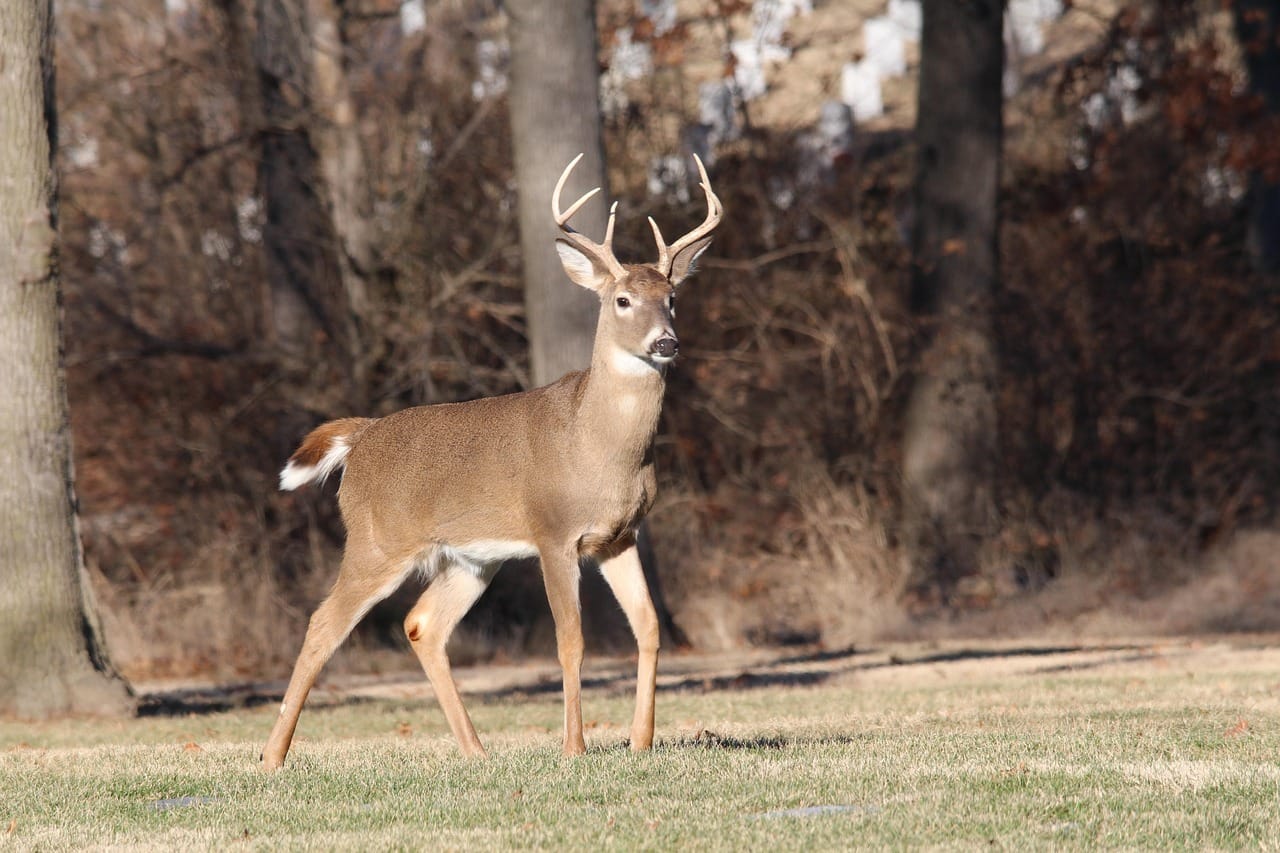
How do you count points on deer antlers? Count every projection that’s at least one inch long and longer than it is wide, then add the tip of each main beam. That’s the Boone and Crockett Club rule, and most scoring systems use it. B&C defines a point as “any projection at least one inch long and longer than it is wide at one inch or more of length” (Boone and Crockett Club). Your state’s legal-buck rules may count a little differently, so read those before you shoot.
Key Takeaways
- A point must be at least 1 inch long, and its length must exceed its width at 1 inch or more of length.
- The tip of each main beam counts as a point. On the official score chart, it’s “counted as a point but not measured as a point.”
- Brow tines count when they meet the 1-inch rule.
- B&C uses both styles of naming. A buck with two standing points per side is “a 4x4 or 8-pointer.”
- Point count isn’t score. Score comes from lengths, spread and mass, not the number of points.
How do you count points on deer antlers, step by step?
1. Start with one antler. Find the main beam, the long curved spine of the antler. Its tip is a point. The B&C score chart, hosted by South Carolina DNR, says “Beam tip is counted as a point but not measured as a point” (SCDNR B&C score sheet).
2. Check each projection against the 1-inch rule. The chart says that “to be counted a point, the projection must be at least one inch long, with the length exceeding width at one inch or more of length.” Noble Research Institute phrases it this way: a point “must be longer than its broadest width at least 1 inch from the tip” (Noble Research Institute). A short, wide bump fails even if it’s an inch tall.
3. Measure where the point starts. SCDNR explains how to find the base: lay a tape “along the top of the main beam or along the parent point across the base of the point being measured,” then measure “from the tip to this base along the center line of the point” (SCDNR).
4. Count the brow tine if it qualifies. B&C labels the main points “G1, G2, G3, etc., with G1 being the brow tines or eye-guards,” per SCDNR.
5. Repeat on the other antler and add them up. Or name each side separately. More on that below.
What counts as a point on a deer?
For scoring, any projection that passes the 1-inch rule, whether it’s normal or abnormal. B&C’s scoring tips say “the official definition of a point for measurement is any projection that is one inch or more in length, and where the length exceeds the width” (B&C scoring tips).
Normal points “arise from the top of the main beam and are usually symmetrically paired,” SCDNR says. “Any point that does not arise from the top of the main beam is considered an abnormal point. Abnormal points include drop tines and points arising off other points or the burr line.” Abnormal points still count in the point total if they pass the 1-inch rule. They’re just scored differently. See our guide to abnormal point definitions on non-typical frames.
Is an 8-pointer the same as a 4x4?
Yes. Both describe the same rack. B&C’s field-judging guide counts this way: assume a brow tine and beam tip on each side, count “the standing normal points G-2, G-3, G-4, etc., and quickly add that to the number 2.” With that method, “a buck with two standing normal points per side is a 4x4 or 8-pointer, and with three standing points per side he is a 5x5 or 10-pointer” (B&C).
So “8-point” totals both antlers, and “4x4” names each side. When someone tells you a number, ask which way they counted.
How do states count antler points for legal bucks?
Their own way, sometimes. Pennsylvania is a good example. Its Game Commission defines a point as “any antler projection (including the brow tine) at least one inch in length from base to tip.” That definition mentions length only. In areas under the standard restriction, a legal buck needs a “Minimum of three points on one side (including the tip of the main bean and brow tine, each counting as one of the points).” That’s the Commission’s wording, typo included. In “three up” areas, the rule is “three points, including the main beam counted as one of the points, on one side, excluding the brow tine” (PGC antler restriction areas).
Take a buck with a brow tine, one more tine and a beam tip on each side. That’s a 6-pointer. It meets the three-point minimum in most of Pennsylvania, but in a “three up” area it has only two countable points per side. The Commission’s map shows which areas follow which rule, and the current digest has the final word for the 2026-27 season. Always use your state’s definition in the field. For why states do this, see antler point restrictions: biology, goals and hunter tradeoffs.
Do points count toward a buck’s score?
Not directly. The score adds up measurements, not the count. B&C lists “the lengths of the main beams, lengths of the points, the inside spread of the main beams, and the mass or circumference of the main beams at four locations” as what goes into a score. Two bucks with the same point count can score very differently. For the full method, see how are deer scored. For damaged racks, see broken tine scoring and deductions.
The other side of it
You could argue the 1-inch rule is fussy for a hunting-camp conversation, and nobody at the gas station is checking width at one inch of length. Fair. But the rules exist because “8-point” means nothing if every bump counts, and in a state like Pennsylvania the definition decides whether a buck is legal. Count it the official way, then round up at the gas station like everybody else.
Keep reading
Pennsylvania's biggest bucks in the record book →
Latest deer news
Sources
- Field Judging - Whitetail Deer, Boone and Crockett Club
- Tips on Scoring a Whitetail Deer, Boone and Crockett Club
- Typical Whitetail and Coues' Deer score chart (Boone and Crockett Club), hosted by SCDNR, Boone and Crockett Club / South Carolina Department of Natural Resources
- Scoring deer antlers, South Carolina Department of Natural Resources
- White-tailed Deer Antler Score, Noble Research Institute
- Antler Restrictions Area Rules (map layer), Pennsylvania Game Commission
Comments