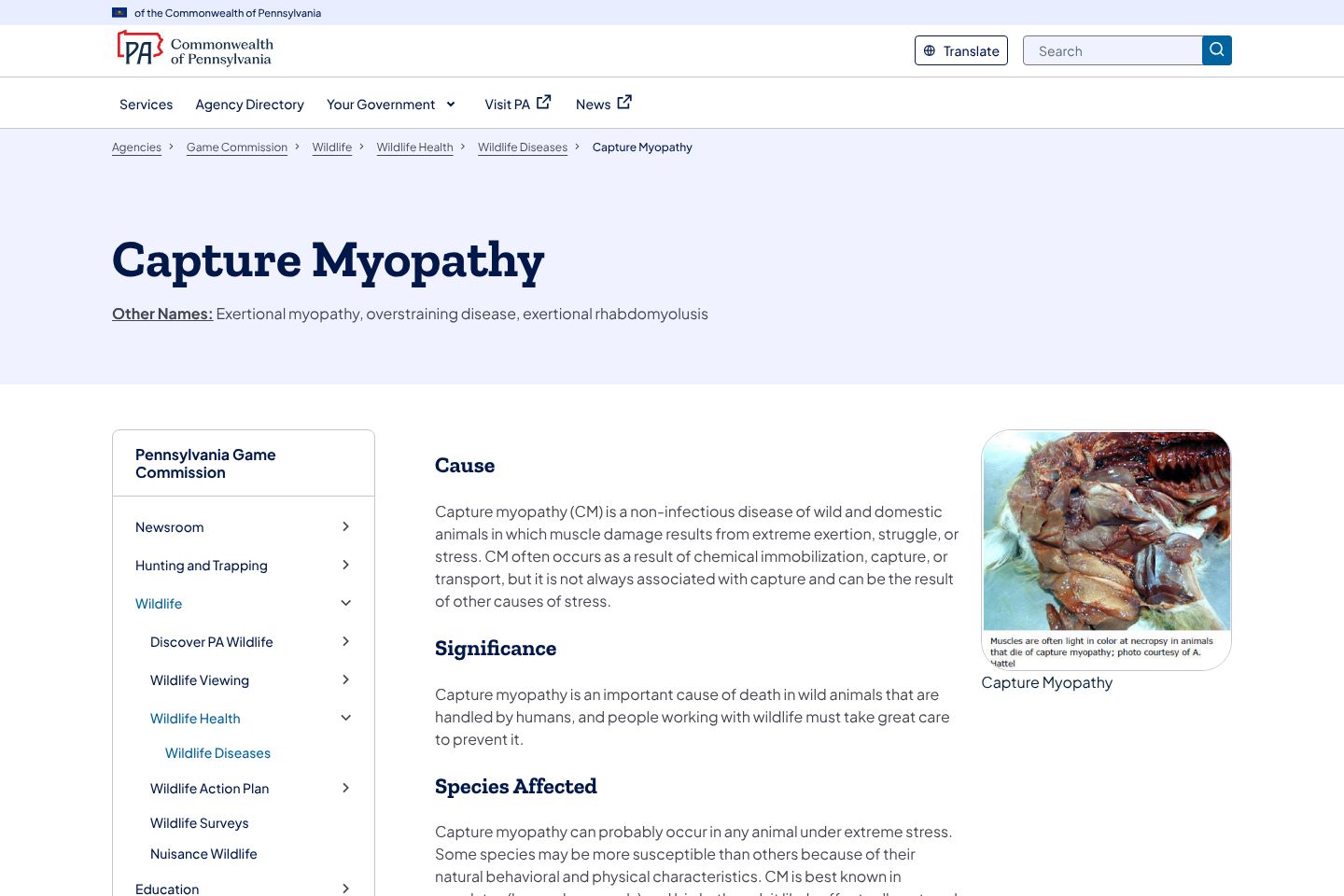
Capture myopathy is a stress-driven muscle disease that can kill deer after pursuit, netting, trapping, or rough handling - sometimes hours or days later. Pennsylvania Game Commission and University of Florida IFAS both describe the pathway: extreme exertion and fear produce muscle damage, lactic acidosis, and kidney strain that may not show while the animal first stands up (PA Game Commission capture myopathy; UF/IFAS capture myopathy). Landowners who help with captures, transporters moving rehab animals, and hunters who find a “recovered” deer dead overnight need the same playbook: minimize chase, quiet the animal, avoid heat, and never assume a walking release equals a surviving deer.
Key Takeaways
-
Capture myopathy follows severe stress and exertion; death can be delayed after the deer looks fine at release (PA Game Commission capture myopathy; UF/IFAS capture myopathy).
-
Helicopter net-gun studies show the method can be relatively safe when chase and handling stay short, and risk rises when pursuits drag on (Webb et al. net-gun WTD; Northern Great Plains capture mortality).
-
Heat, long transports, loud handling, and failure to blindfold/hobble calmly all worsen risk in extension and agency guidance (UF/IFAS capture myopathy; PA Game Commission capture myopathy).
-
Hunters are most likely to meet the issue after vehicle collisions, entangled deer, or agency removals - not after a clean archery shot (PA Game Commission capture myopathy).
-
Prevention is handling discipline; there is no reliable field antidote once severe myopathy is underway (UF/IFAS capture myopathy).
What breaks in the muscle
During frantic struggle, muscle fibers are damaged and lactic acid builds. Kidneys can be injured by myoglobin released from wrecked muscle. Pennsylvania’s capture myopathy page frames the disease as a preventable handling outcome rather than a contagious infection (PA Game Commission capture myopathy). UF/IFAS materials on farmed white-tailed deer spell out the same physiology for producers who restrain animals (UF/IFAS capture myopathy).
Clinically, deer may show stiff gait, weakness, dark urine, or sudden collapse after a period of apparent recovery. That delay is why “it walked off fine” is not a survival certificate (PA Game Commission capture myopathy; UF/IFAS capture myopathy).
Net-gun and helicopter evidence
Research evaluating helicopter and net-gun capture for white-tailed deer found the technique workable when crews limit pursuit distance and handling time (Webb et al. net-gun WTD). Northern Great Plains ungulate capture work likewise tied higher mortality to longer, hotter, or more chaotic operations (Northern Great Plains capture mortality). Those papers are for professionals, but the lesson for landowners watching a removal crew is fair: ask how they minimize chase before you consent to a driveway capture.
Agency and extension prevention list
Pennsylvania and UF/IFAS converge on practical steps: shorten pursuit, work in cooler temperatures when possible, cover the eyes, keep noise down, avoid unnecessary transport, and release promptly (PA Game Commission capture myopathy; UF/IFAS capture myopathy). Crowding multiple deer in a trailer or letting dogs bay a tangled deer for sport are textbook ways to buy myopathy.
If you must move an injured deer under agency direction, plan the route before you touch the animal. Every extra minute of thrashing is physiologic debt (UF/IFAS capture myopathy).
Hunters at road edges and fences
A deer caught in a fence or stunned by a car may look salvageable. Before you push it, call the agency if required in your state, and understand that forcing a panicked climb over woven wire can finish what the collision started via myopathy (PA Game Commission capture myopathy). Sometimes the humane and legal path is dispatch under local rules, not a heroic free-and-hope release.
Document time, temperature, and handling if you work with rehabbers. That record helps explain delayed deaths that otherwise look mysterious (UF/IFAS capture myopathy; Webb et al. net-gun WTD).
Farmed deer and high-fence context
UF/IFAS wrote specifically for farmed whitetails because chute work, pen moves, and veterinary handling create repeated risk windows (UF/IFAS capture myopathy). Free-range hunters should still care: high-fence neighbors and university research projects operate nearby, and public trust depends on competent handling. The physiology does not care whether the deer was wild or penned.
What capture myopathy is not
It is not CWD, not EHD, and not a reason to discard meat from a normal hunter-harvested deer that was shot cleanly and died quickly. It is a handling and pursuit syndrome (PA Game Commission capture myopathy; UF/IFAS capture myopathy). Keep the categories straight when talking to non-hunters after a public removal.
Club and landowner checklist
Before authorizing any live capture on your land, require a plan: max chase time, time-of-day, blindfolds, transport distance, and who decides on humane dispatch if the deer overheats (Webb et al. net-gun WTD; PA Game Commission capture myopathy; UF/IFAS capture myopathy; Northern Great Plains capture mortality). Write it down. Verbal assurances evaporate when a deer hits the ground thrashing.
Bottom line
Capture myopathy kills with stress chemistry after the nets come out; short quiet cool handling is the prevention that agency and research sources agree on (PA Game Commission capture myopathy; UF/IFAS capture myopathy; Webb et al. net-gun WTD; Northern Great Plains capture mortality).
Delayed death and public misunderstanding
A deer that stands, runs fifty yards, and beds can still die overnight from capture myopathy after a messy extrication (PA Game Commission capture myopathy; UF/IFAS capture myopathy). Neighbors then blame “the sedative” or “the net gun brand” when the real issue was chase length and thrashing time documented in capture mortality research (Webb et al. net-gun WTD; Northern Great Plains capture mortality).
Explain the delay up front when you talk to non-hunters at a roadside incident. It reduces conspiracy talk and keeps focus on handling quality.
Temperature and season
Summer captures for research or urban removals stack heat stress on top of exertion. Agency and extension guidance prefer cooler hours and shorter pursuits for that reason (PA Game Commission capture myopathy; UF/IFAS capture myopathy). Winter is not automatically safe either: deep snow increases struggle costs when a deer is pushed.
If your township schedules a July deer relocation fantasy, the myopathy literature is your briefing memo for why that plan ages poorly (Webb et al. net-gun WTD; Northern Great Plains capture mortality).
Related: Brain abscesses in bucks and Mange and hair loss.
The other side of it
The same research that warns about long chases also calls helicopter net-gun capture relatively safe when crews keep it short, which suggests the professionals already work this way. A landowner demanding a written chase plan may be second-guessing people who know the physiology better than he does. And a deer found dead overnight after a collision might have died from the collision, not the handling. But sure, the guy who pitched a July relocation for the township is the one who wants to talk best practices.
Keep reading
Latest deer news
Comments