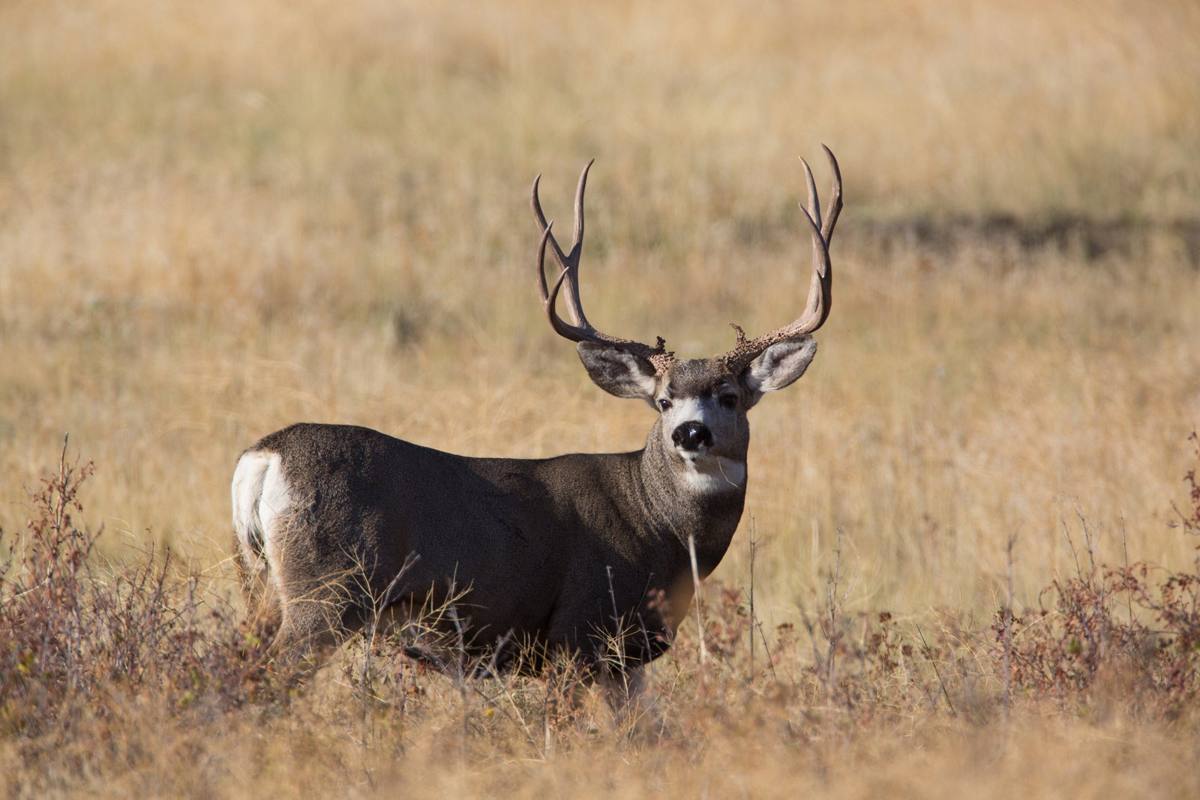
How to score mule deer antlers is easier than most people expect, because the Boone and Crockett system allows only a handful of normal points. You measure the inside spread, both main beams, the normal points (G-1 through G-4) and four circumferences (H-1 through H-4) on each side, add them up, then subtract the side-to-side differences. B&C’s measuring guide says typical mule deer “are actually the easiest of all the deer to measure as there can be no more than five specific normal points per antler, including the brow point (G-1) and the main beam tip.” Here’s how it works, step by step.
Key Takeaways
- Each antler has at most five normal points: G-1 (brow), G-2, G-3, G-4 and the beam tip.
- The scoring lines are inside spread credit, main beams, G-1 to G-4 and H-1 to H-4. Tip-to-tip and greatest spread are recorded but don’t count.
- Spread credit can’t exceed the longer main beam, a limit wide mule deer often hit.
- Typical score: subtotal minus side-to-side differences and abnormal points. Non-typical: abnormal points are added back.
- Measure to the nearest eighth of an inch. Official scores require a 60-day drying period and a B&C Official Measurer.
Before you measure
Boone and Crockett’s score chart says to use a quarter-inch-wide flexible steel tape and record to the nearest eighth, and to “Enter fractional figures in eighths, without reduction” (Boone and Crockett Club, Typical Mule Deer Score Chart). A flexible steel cable can be used for beams and points.
For an official score, wait. “Official measurements cannot be taken until the antlers have air dried at a habitable room temperature for at least 60 days after the animal was killed.” A green score is fine for bragging, but it’s not the record-book number. See why green scores shrink after drying.
Right and left refer to the deer, not you. B&C’s guide notes they “refer to the trophy’s right and left side, not the Measurer’s perspective when looking straight at the rack” (B&C measuring guide via Journal of Mountain Hunting).
Step 1: Count points and sort normal from abnormal
To count as a point, the chart says “the projection must be at least one inch long, with length exceeding width at one inch or more of length.” Mule deer antlers fork in a Y. The guide says “Normal points occur in the “Y” branching pattern (dichotomous), with two such forks (G-2 and G-3; G-4 and beam tip) comprising the normal condition.”
Everything else is abnormal. The guide’s rules include: “Burr tines or “beauty points” (points arising from or near the antler burr) are always abnormal,” and “Except for the G-3 point, point branches (those arising from points rather than the main beam) are always abnormal.”
Typical or non-typical? “If there are no or only a couple of short abnormal points, the rack should first be scored as a typical. If there are several to numerous abnormal points, use the non-typical score chart.” All the measurements are the same either way.
Step 2: How to score mule deer antlers, measurement by measurement
Spreads. There are three. Tip-to-tip and greatest spread are recorded but “are not figured into the final score.” Only the inside spread counts: the chart says it’s measured “at a right angle to the center line of the skull at widest point between main beams.” Here’s the mule deer catch. Spread credit “May Equal But Not Exceed Longer MAIN BEAM.” The guide notes that while this rarely happens on whitetails, “this situation is fairly common in mule deer.”
Main beams (F). The chart measures each beam “from the center of the lowest outside edge of burr over the outer side to the most distant point of the Main Beam.”
Normal points (G-1 to G-4). Per the guide, “the lengths of G-1, G-2, and G-4 points are measured from their base lines on the main beam,” but “The base line for the G-3 point is along the front edge of the G-2 point from which it arises.” Points are measured over the outer curve. A missing normal point gets a zero.
Circumferences (H-1 to H-4). “Four and only four circumferences are always taken on mule deer and blacktail deer regardless of the number of normal points.” The guide places them:
- “The H-1 circumference is taken at the narrowest place between the burr and the brow tine (G-1)”
- “the H-2 circumference is taken at the narrowest place between the G-1 and G-2 points”
- “the H-3 circumference is taken on the G-2 point at the narrowest place between the main beam and the G-3 point”
- “the H-4 circumference is taken at the narrowest place between the G-2 and G-4 points”
Use a ring-end tape for these. “only the 1/4-inch wide ring-end tape can be used for circumference measurements.”
Abnormal points. Measure each one the same way as a normal point and total them.
Step 3: Do the math
The score chart has four columns: spread credit, right antler, left antler and difference. The guide walks through it:
- For each matched measurement, “subtract the smaller measurement from the larger measurement for each line item, regardless of which side is smaller or larger, and enter the difference.”
- For a typical, the abnormal point total “is then moved to Line E, Column 3 where it is added into the difference column.”
- Add the spread credit to the right and left antler totals to get the subtotal.
- Typical: “The total of Column 3 is now subtracted from the subtotal to arrive at the Final Score.”
- Non-typical: subtract the differences, then “Add the total of the lengths of the abnormal points from Line E to the second subtotal to arrive at the Final Score.”
So symmetry pays on a typical. Every inch one side is longer than the other comes off the score. For more on why, see net versus gross antler score and how official scorers round to eighths.
Making it official
B&C’s typical chart lists an Awards minimum score of 180 for mule deer. Note that “A score chart is not authenticated until signed and dated by a certified Boone and Crockett Club Official Measurer,” and “No scores are official Boone and Crockett scores until verified and the trophy is accepted by the Boone and Crockett Club.” If your score looks close, the guide says to contact B&C “to get a list of Measurers in your area.” See finding an official measurer.
FAQ
How do you score mule deer antlers? Add the inside spread credit, both main beams, normal points G-1 to G-4 and circumferences H-1 to H-4, then subtract side-to-side differences (and abnormal points for a typical).
How many points does a typical mule deer have per side? No more than five normal points per antler, including the brow tine and the beam tip, under B&C rules.
Does tip-to-tip spread count? No. Tip-to-tip and greatest spread are recorded but don’t count. Only the inside spread counts, capped at the longer main beam.
Is mule deer scoring the same as whitetail? The idea is the same, but mule deer use the forked Y point pattern, four set circumferences, and hit the spread cap more often.
The other side of it
Plenty of mule deer hunters think the typical system punishes the bucks people actually want, since a wide, heavy deer with a few stickers can lose inches for every abnormal point. That’s what the non-typical chart is for, and B&C lets you score a rack both ways and list it where it ranks highest. A tape measure doesn’t change the deer. The hunter who gross-scores a buck at the truck, rounds every measurement up and quotes it at the café for the next decade is keeping his own record book.
Sources
- Official Scoring System, Typical Mule Deer and Blacktail Deer score chart, Boone and Crockett Club
- "Measuring and Scoring Mule and Blacktail Deer, B&C Club Official Guide" (excerpt from B&C's How to Score North American Big Game), Journal of Mountain Hunting (republishing Boone and Crockett Club material)
Comments