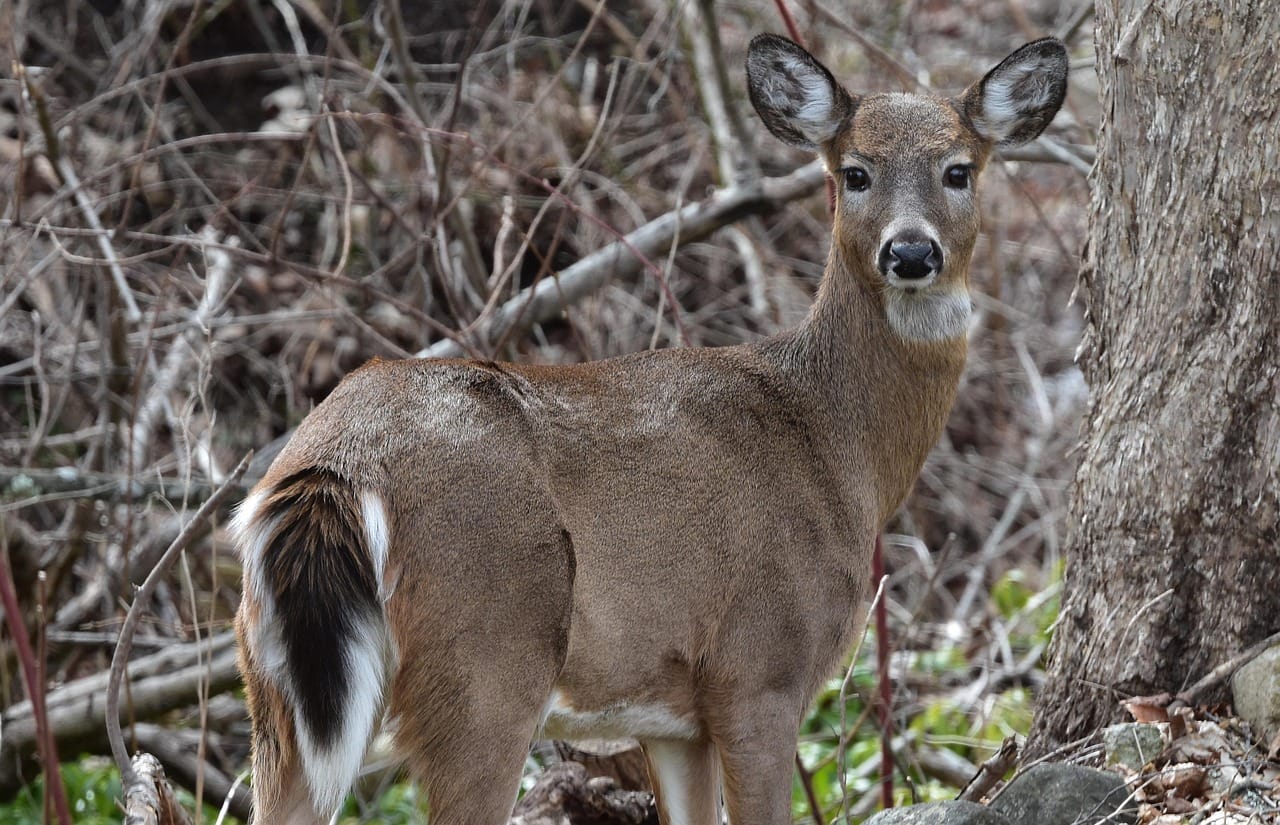
How much does a deer weigh depends mostly on where it lives and whether it’s a buck or a doe. Across the whitetail’s range, state agencies put adult bucks anywhere from about 115 pounds on the hoof in Florida to an average of 203 pounds in New York’s Adirondacks, and adult does roughly 90 to 155 pounds. Pennsylvania’s average adult buck is about 140 pounds. Fawns are born at 3 to 8 pounds. If you’re staring at a deer hanging in the garage and want the live weight, skip to the conversion chart below.
Key Takeaways
- Bucks: Pennsylvania’s average adult buck weighs about 140 pounds (PGC). North Dakota bucks average 170 pounds, range 100 to 330 (ND Game and Fish). Adirondack bucks average 203 pounds, with a 405-pound maximum on record (SUNY ESF). Florida bucks average 115 (FWC).
- Does: 88 pounds live for South Carolina yearling does and 100.6 for does 2.5 and older, from 86,000 weighed deer (SC DNR). Adirondack does average about 155 (SUNY ESF).
- Fawns: 3 to 6 pounds at birth in New York, 4 to 8 in Alabama, about 7 in North Dakota (SUNY ESF; Outdoor Alabama; ND Game and Fish).
How much does a deer weigh in different states?
Here’s the honest problem with every “average deer weight” you’ve read: there isn’t one. The agencies that actually weigh deer get very different numbers, and they don’t all measure the same way. Some report live weight, some field dressed, some a range for “healthy adults.” So we’re giving you their numbers, labeled, and letting you find your state on the map.
| State or region | Bucks | Does | Basis | Source |
|---|---|---|---|---|
| New York (Adirondacks) | avg 203 lb, max 405 | avg ~155 lb, max 218 | adult, live | SUNY ESF |
| North Dakota | avg 170 lb (100 to 330) | avg 130 lb (90 to 210) | live | ND Game and Fish |
| Pennsylvania | avg adult ~140 lb | “smaller than bucks of the same age” | live, early winter | PGC |
| Alabama | 140 to 250+ lb | under 90 to 140+ lb | healthy adults | Outdoor Alabama |
| South Carolina | 107.3 lb at 1.5 yrs; 137.9 lb at 2.5+ | 88.0 lb at 1.5; 100.6 at 2.5+ | live, historic harvest data | SC DNR |
| Florida | avg 115 lb, 190+ in North Florida | avg 90 lb, 120+ for big ones | adult, live | FWC |
| Florida Keys (Key deer) | up to ~80 lb | FWC |
Notice the South Carolina numbers. Those aren’t guesses, they’re the averages of 57,958 yearling bucks and 47,913 older bucks on a scale. A 2.5-year-old-and-up South Carolina buck averages 138 pounds live. In the Adirondacks, that’s a doe (SC DNR; SUNY ESF).
Do does weigh less than bucks?
Yes, everywhere, by roughly a quarter to a third. The Adirondack numbers run 155 versus 203. Florida runs 90 versus 115. South Carolina’s older does average 100.6 to the older bucks’ 137.9. The gap is one reason MU Extension’s aging guide warns that yearling bucks get mistaken for does: they’re thin, long-legged “does with antlers” until they put on frame (MU Extension).
Why are northern deer so much heavier?
Biologists call it Bergmann’s rule: within a species, body size tends to increase as you go north. The Mississippi State University Deer Lab explains the logic in plain terms. A bigger body has less surface area per pound, so it holds heat better in a cold climate, while a smaller body sheds heat better in a hot one. Their extremes: a mature Key deer buck may weigh 60 pounds and “a similar buck in Minnesota may weigh 300 pounds” (Strickland and Demarais, MSU Deer Lab).
But temperature isn’t the whole story, and a new study put numbers on the rest. Researchers from Tennessee, Mississippi State and Florida weighed 2,371 adult does on 35 properties across 21 eastern states from 2021 to 2023. Site averages ranged from 42.9 to 70.3 kg (about 95 to 155 pounds). Does got 1.4 kg heavier for every 1°C colder the average annual temperature, and 1.6 kg heavier for every 10 percent more row crops within 10 km. Does in the northern tier were 9 kg (about 20 pounds) heavier than the middle tier, and southern does were 4.2 kg lighter (Turner et al. 2026, Ecosphere).
Translation for deer camp: latitude sets the ceiling, groceries decide how close a deer gets to it. That’s why an Iowa doe standing in a bean field outweighs a Maine doe standing in spruce, and why the MSU authors point out that South Texas bucks “aren’t born big” but get there through age and habitat.
How much does a fawn weigh at birth?
Small enough to hold in two hands. SUNY ESF puts Adirondack fawns at 3 to 6 pounds at birth (ESF). Alabama says most fawns weigh 4 to 8 pounds and stand about 18 inches at the shoulder (Outdoor Alabama). North Dakota lists about 7 pounds for fawns born late May to late June (ND Game and Fish). They don’t stay small. Indiana DNR says fawns “grow rapidly, doubling their weight in just two weeks” (Indiana DNR). That’s why “big doe or button buck?” is such a common question from the tree by November.
How old is a 200-pound deer?
It depends entirely on your zip code, and whether you mean on the hoof or on the gambrel.
In South Carolina, a 200-pound live buck is a freak. The statewide average for bucks 2.5 and older is 137.9 pounds, and the heaviest county average in the SC DNR table is Lexington at 164.8 (SC DNR). In Florida, 190 pounds is the top end FWC mentions for North Florida (FWC). In Pennsylvania, where the average adult buck is 140, a 200-pounder is a very good deer (PGC). In North Dakota or the Adirondacks, where averages run 170 to 203, a 200-pound buck is a normal mature animal (ND Game and Fish; SUNY ESF).
Age matters, but the agency data we could get only splits bucks into yearlings and 2.5-plus. South Carolina yearlings average 107 pounds, and the 2.5-plus class averages 138, a 30-pound jump in one year. MU Extension’s aging guide describes the rest qualitatively: 2.5-year-olds are still leggy, 3.5s look like a “thoroughbred,” and by 4.5 the body “has reached physiological maturity” (MU Extension). So a 200-pound live buck in the Midwest is most likely 3.5 or older. Below the Fall Line, we’d want to see the jawbone before we believed the scale.
Is a 200-pound buck big?
In the South, enormous. In farm country and the North Woods, respectable. And the date matters as much as the place. The PGC says breeding-age bucks “might weigh 25 to 30 percent more at the onset of the breeding season than they do at its conclusion,” so a 140-pound buck in December may have been about 180 in September (PGC). MU Extension puts post-rut losses at up to a quarter of body weight (MU Extension). Same buck, two very different weights.
So here’s our question for you: was your heaviest buck weighed in October or in January? Because that answer is worth 30 or 40 pounds.
How do you convert field-dressed weight to live weight?
Most hunters never see their deer’s live weight. The Pennsylvania Game Commission, working with Penn State’s Department of Dairy and Animal Science, built a chart that ties chest girth (measured just behind the front legs) to live weight, field-dressed weight and boneless edible meat (PGC Deer Weight Estimating Chart). The full chart starts at a 20-inch chest. Here’s the part that covers most adult deer:
| Chest girth (in.) | Live weight (lb) | Field dressed (lb) | Boneless edible meat (lb) |
|---|---|---|---|
| 30 | 90 | 70 | 39 |
| 32 | 102 | 80 | 45 |
| 34 | 118 | 91 | 54 |
| 36 | 135 | 104 | 61 |
| 38 | 157 | 126 | 71 |
| 40 | 182 | 144 | 80 |
| 42 | 210 | 170 | 94 |
| 44 | 244 | 198 | 110 |
| 46 | 290 | 233 | 130 |
| 48 | 340 | 272 | 153 |
Source: Pennsylvania Game Commission, chart developed with Penn State University. “Field dressed” means entrails removed, body cavity cleaned out.
If you only have the hanging weight, Tennessee published a dressed-to-whole chart in a 2007 state release: 100 pounds dressed is about 127 whole, 150 dressed is about 191, 200 dressed is about 254 (tn.gov). That works out to a multiplier a little above 1.27, which lines up with the 25 to 32 percent range the AP quoted from Minnesota experts in the record-buck story below.
How much meat do you actually get?
Look at the right-hand column of the PGC chart. A 157-pound live deer yields about 71 pounds of boneless meat, a 210-pounder about 94. Roughly 45 percent of live weight, a bit over half the field-dressed weight. Shoot it through both shoulders and you’ll come in under that. (We’ll do the full breakdown of quarters and cuts in a separate guide.)
What’s the heaviest whitetail ever weighed?
The number everybody quotes is 402 pounds field dressed, and it belongs to Carl Lenander Jr., who shot the buck on November 22, 1926, in Minnesota. The Minnesota DNR regards it as the world record by field-dressed weight, according to a 1999 Associated Press story. The same story reports that George Himango’s 1981 Minnesota buck also field dressed 402 pounds and shares the record, and that “experts say a deer’s live weight can be 25 percent to 32 percent greater than its dressed weight” (AP via Brainerd Dispatch).
Here’s the part the forums leave out. The AP noted there is “no mention of how Lenander’s deer was verified,” only that it was “fairly well documented” in a letter to the DNR, and a Duluth bowhunter quoted in the piece “wonders about the accuracy of the scales” (AP via Brainerd Dispatch). The 511-pound live weight you’ll see attached to these bucks is an estimate, not a scale reading. Deer author Leonard Lee Rue told the AP the live weight “is estimated at 511 pounds” and that a couple of top biologists have disputed it (AP via Brainerd Dispatch). You’ll also see a 1977 Ontario buck claimed at 431 pounds dressed. We couldn’t find a wildlife agency that states that figure or how it was weighed, so it’s not in this article as fact.
For a scale-verified ceiling with a university behind it, SUNY ESF lists 405 pounds as the maximum recorded adult male in its Adirondack whitetail profile (ESF). Four hundred pounds of deer is real. It’s also about three Pennsylvania bucks.
Related reading on RAD:
The other side of it
There’s a fair argument that asking how much does a deer weigh is the wrong question. Weight swings 25 to 30 percent with the calendar, girth charts are regional estimates applied to deer from somewhere else, and “field dressed” means something slightly different in every garage, so the number on the scale tells you less about the deer than the jawbone and the habitat do. The biologists who built these charts would be the first to say that. Still, somehow every buck that was never put on a scale “went 250 easy,” and the ones that were weighed all came in at 160.
Keep reading
Latest deer news
Sources
- White-tailed deer | Game Commission | Commonwealth of Pennsylvania
- White-tailed Deer | North Dakota Game and Fish
- SUNY ESF White-tailed Deer | White-tailed Deer
- Land Mammals - Deer | FWC
- SC DNR (dnr.sc.gov)
- White-tailed Deer | Outdoor Alabama
- Techniques for Aging Live Deer | MU Extension
- Strickland and Demarais, MSU Deer Lab (msudeer.msstate.edu)
- Influence of temperature, landscape, and fine‐scale forage availability on ungulate morphometrics
- Deer Weight Chart | Game Commission | Commonwealth of Pennsylvania
- How Much Did Your Deer Weigh?
- Minnesota can claim two world-record whitetails
- White-tailed Deer Biology | Indiana DNR
Comments