The deer diseases in Michigan right now are chronic wasting disease (CWD) in the central Lower Peninsula, bovine tuberculosis (bTB) in the northeast, and an epizootic hemorrhagic disease (EHD) outbreak confirmed in 15 counties this fall (Michigan DNR). On Nov. 23, 2026, state agriculture officials also confirmed CWD in a farmed cervid in Roscommon County, the county’s first farmed case (MDARD). Here’s what the agencies are reporting and what they ask of hunters.
Updated Nov. 23, 2026 with the Roscommon County farmed-cervid detection and the DNR’s CWD and bTB results current as of Nov. 20.
Key Takeaways
- As of Nov. 20, 2026, 46 of 739 deer with final CWD results this season were positive (DNR).
- Two of 2,304 deer tested in the 11 TB-area counties were bTB positive as of Nov. 20, one each in Alcona and Alpena (DNR).
- MDARD found CWD in a farmed cervid in Roscommon County through routine surveillance and is investigating other possible exposures (MDARD).
- EHD can’t infect people, including through venison (DNR).
- Baiting is legal only in the Upper Peninsula, Sept. 15 through Jan. 1, and the DNR ties its baiting advice to limiting disease exposure (Michigan DNR).
Where is CWD in Michigan?
The DNR lists 421 CWD-positive free-ranging deer to date. Montcalm (217), Kent (60), Jackson (40), Gratiot (29) and Ionia (24) account for most of them, with smaller counts in 12 other Lower Peninsula counties, one in Dickinson County in the Upper Peninsula and three from an unknown county (DNR). Roscommon County isn’t on that wild-deer list.
For 2026, the DNR is focusing CWD collection in five counties: Ionia, Kent, Mecosta, Montcalm and Newaygo (DNR). Results with final tests, current as of Nov. 20 (Michigan DNR 2026 CWD results):
| County | Tested | Positive |
|---|---|---|
| Ionia | 73 | 10 |
| Kent | 206 | 10 |
| Mecosta | 43 | 1 |
| Montcalm | 114 | 23 |
| Newaygo | 63 | 0 |
| Rest of state | 240 | 2 |
| Statewide | 739 | 46 |
Deer with pending results aren’t in those totals. Counting pending results and deer left out for things like insufficient samples, the DNR puts the statewide total at 913 (DNR).
Has CWD been found on Michigan deer farms?
Yes. The Michigan Department of Agriculture and Rural Development (MDARD), which regulates farmed cervids, reported on Nov. 23, 2026 that a farmed cervid from Roscommon County tested positive through the state’s CWD surveillance program. MDARD called it “the first detection of CWD in a farmed cervid in the county” and said investigations are ongoing to rule out exposures to other farmed cervids (MDARD).
Before this case, MDARD says farmed-cervid detections had turned up in Calhoun, Hillsdale, Kent, Lake, Mackinac, Mecosta, Montcalm, Newaygo and Osceola counties. The release doesn’t say what species the animal was or how many animals are on the facility, and it announces no change to wild deer hunting or testing.
State Veterinarian Dr. Nora Wineland said the agencies “remain committed to protecting not only the health of Michigan’s farmed cervid herds but also the wild deer population” (MDARD).
How do you get a deer tested for CWD in Michigan?
You must complete your harvest report before you submit a sample (DNR).
- In the five focus counties: testing is free when you bring the whole head to a DNR drop box or staffed submission site. Self-sample kits aren’t offered there this year.
- Elsewhere: hunters outside the CWD and TB focus areas can use a free lymph-node kit with overnight shipping to the Michigan State University Veterinary Diagnostic Laboratory. You extract the lymph nodes yourself, and results come straight to you from the lab.
- In the bTB counties (Alcona, Alpena, Cheboygan, Crawford, Iosco, Montmorency, Ogemaw, Oscoda, Otsego, Presque Isle and Roscommon), don’t extract lymph nodes. Take the head to a DNR wildlife field office and ask for CWD testing along with bTB testing.
That last rule covers Roscommon County hunters who want a deer checked after the farm case. Every head the DNR tests for CWD is also screened for bovine TB (DNR).
Is bovine TB still found in Michigan deer?
Yes. In 2026, focused bTB collection covers 12 northeastern and northern counties, including Charlevoix (DNR preview). As of Nov. 20, the DNR had tested 3,619 deer statewide. Two of the 2,304 tested in the 11 TB-area counties were positive, one in Alcona County out of 283 tested and one in Alpena County out of 668. Roscommon had 59 deer tested with none positive (DNR). Hunters anywhere can ask for a TB test.
What is EHD, and where is it in Michigan this year?
EHD is a viral disease spread by biting midges, not from one deer to another. In Michigan it shows up in late summer and early fall, and outbreaks usually end within about two weeks of the first frost, which kills the midges (DNR).
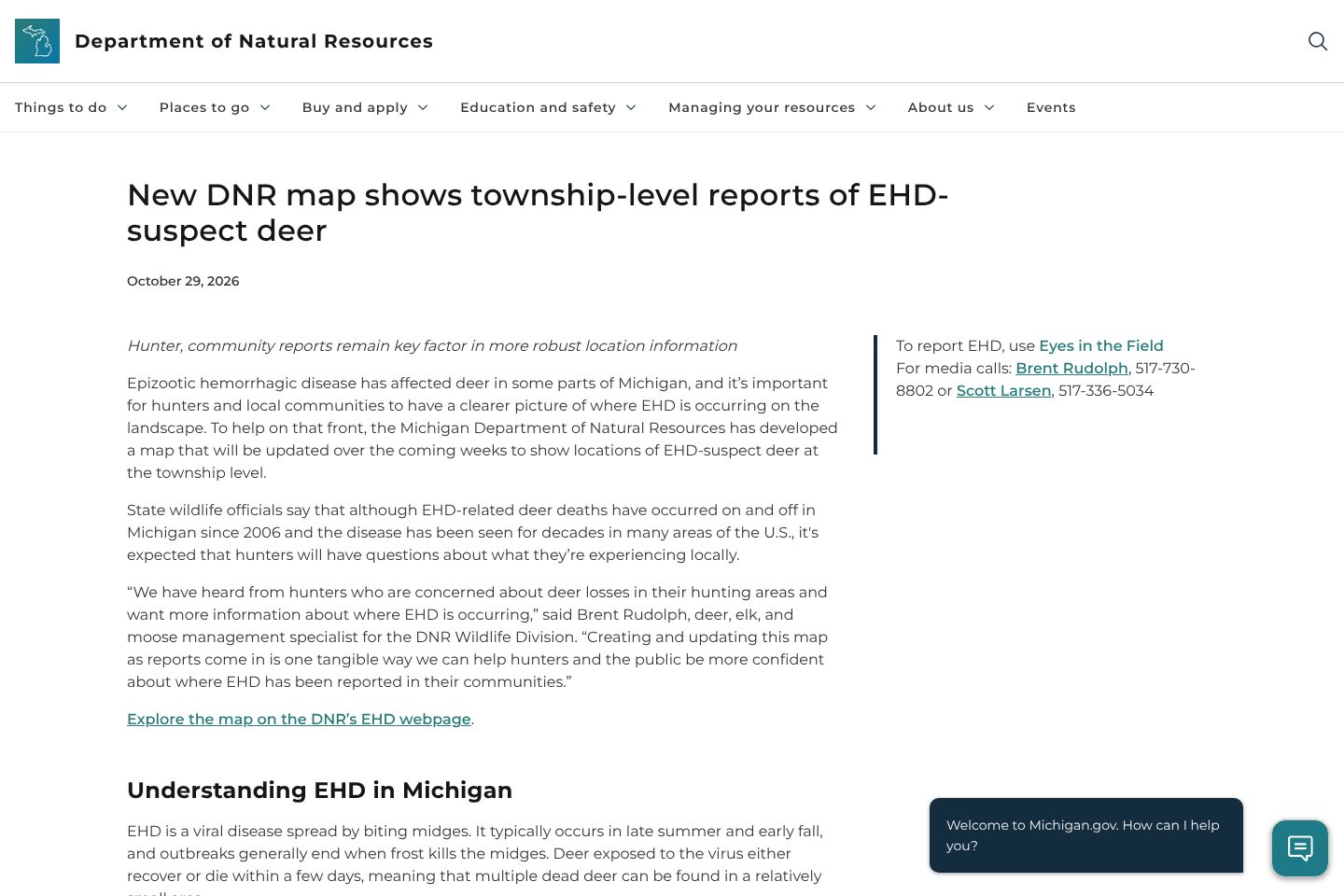
As of the DNR’s Oct. 29 release, laboratory testing had confirmed EHD in deer from Allegan, Branch, Calhoun, Clinton, Hillsdale, Ingham, Jackson, Kalamazoo, Lapeer, Lenawee, Montcalm, Oakland, Oceana, Saginaw and Washtenaw counties. That’s comparable to 16 counties in 2025 and 15 in 2024 (DNR release). The DNR has also launched a township-level map of suspect reports, which it plans to update about weekly while the outbreak lasts.
What are the signs of EHD in deer?
Sick deer lose their appetite and their fear of people, grow weak and run a high fever, which is why dead deer are often found in or near water. Some show bloody discharge from the nose or mouth, swelling of the head or neck, or a blue-tinged tongue. Many die within 36 hours of the first signs (DNR).
Can you eat a deer from an EHD area?
The DNR says humans cannot get EHD by any route, including eating venison, and dogs, cats and horses aren’t affected either (DNR). Dead deer aren’t a significant source of the virus.
Do Michigan deer herds recover from EHD?
The effects aren’t uniform. After Michigan’s major 2012 outbreak, deer numbers rose over five years in one affected area while surveys a few miles away showed no change (DNR release). The DNR also says outbreaks are localized and some immunity develops in outbreak areas through deer that survive exposure (DNR).
Is deer baiting legal in Michigan, and how does it tie to disease?
Only in the Upper Peninsula, Sept. 15 through Jan. 1. Baiting and feeding are banned throughout the Lower Peninsula, except for qualifying hunters with disabilities during the Liberty and Independence hunts (Michigan DNR). Michigan counts “minerals (including salt and salt blocks)” as bait.
In the UP, you can use no more than 2 gallons of bait per hunting site, spread over at least a 10-by-10-foot area and scattered directly on the ground. Spin-cast feeders are fine if they stay under that volume. The DNR recommends not baiting the same spot repeatedly, and baiting only when you’re actively hunting, to limit disease exposure (Michigan DNR). In the Lower Peninsula, scents must be placed so deer can’t eat or touch them, though urine-based products for mock scrapes and drags are still allowed. Food plots and standing crops aren’t bait, but food plots on public land are prohibited. See the 2026 regulations summary for Liberty Hunt bait details.
What should Michigan hunters do this season?
- Report suspected EHD deer through the DNR’s Eyes in the Field portal (DNR).
- Report your harvest within 72 hours, or before you transfer possession, before you submit any disease sample (DNR preview).
- In Roscommon and the other bTB counties, take the whole head to a DNR wildlife field office for CWD testing instead of pulling lymph nodes yourself (DNR).
- Follow the baiting rules above, which differ between the Lower and Upper Peninsulas.
For the bigger picture, see our guides to deer disease, chronic wasting disease and deer disease in Ohio.
The other side of it
Read the CWD table with some care. Testing is concentrated in five focus counties where the DNR already expects to find it, pending results aren’t counted, and 240 deer for the rest of the state (DNR) is a thin look at a lot of ground. A positive behind a deer-farm fence is also a different thing from a positive in the wild herd, and MDARD hasn’t said whether this one touches wild deer at all. And the guy who says it’s only 46 deer never seems to be the one dropping his head in the bin.
Keep reading
Michigan's biggest bucks in the record book →
Latest deer news
Sources
- Chronic Wasting Disease Confirmed in Farmed Cervid in Roscommon County
- New DNR map shows township-level reports of EHD-suspect deer
- 2026 CWD testing results
- 2026 bTB testing goals and results
- Epizootic hemorrhagic disease (EHD) in white-tailed deer
- County-level CWD detection information
- CWD testing
- 2026 deer hunting preview
- Baiting and Feeding
- 2026 Michigan Deer Hunting Regulations (see Michigan.gov/Deer for accessible HTML)
Comments