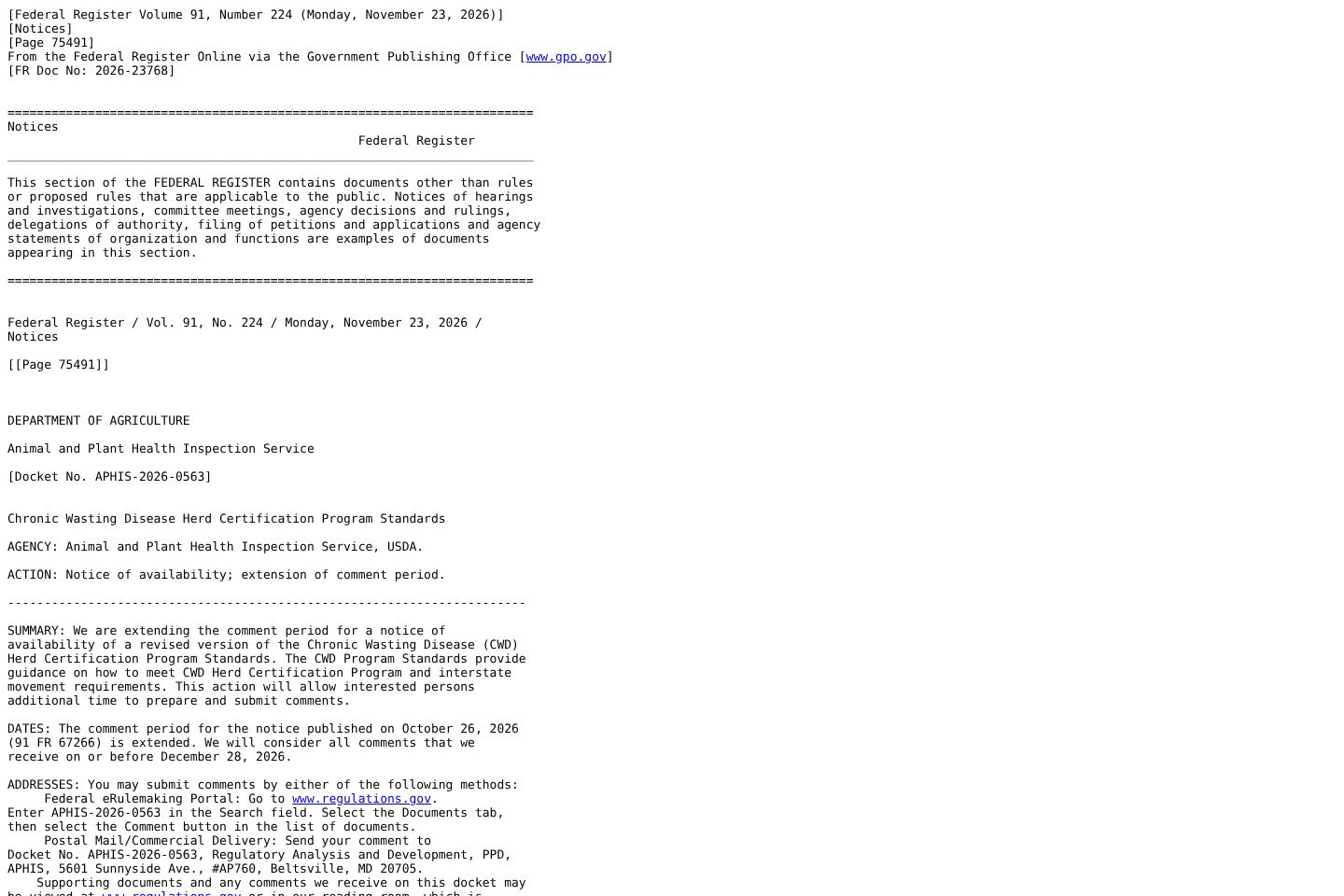
USDA’s revised CWD Herd Certification Program Standards would shorten trace and quarantine periods for farmed white-tailed and mule deer, steer indemnity money toward genetics and move away from killing whole infected herds by default. The Animal and Plant Health Inspection Service (APHIS) put the draft out for comment on Oct. 26, 2026, and on Nov. 23 it pushed the comment deadline from Nov. 25 to Dec. 28, 2026 (Federal Register, Nov. 23 notice). The standards cover deer farms, not wild deer, but they decide how farmed deer that have been around CWD get traced, held and moved across state lines.
Key Takeaways
- Comments on Docket APHIS-2026-0563 are now accepted through Dec. 28, 2026, up from Nov. 25 (Federal Register, Nov. 23 notice).
- The draft shortens the trace and quarantine period for whitetails and mule deer and keeps it the same for elk and other species (Federal Register, Oct. 26 notice).
- APHIS says it is “shifting away from whole‑herd depopulation as the default approach” in favor of genetics-based herd plans and removing positive animals (USDA APHIS).
- One proposed change would let cervids from a CWD-positive herd move to a quarantined hunt facility in a “wildlife endemic area” in another state, if both states’ animal health officials agree (Federal Register, Oct. 26 notice).
- If APHIS decides no substantive changes are needed after comments, the revisions become final without another Federal Register notice (Federal Register, Oct. 26 notice).
What is the CWD Herd Certification Program?
It’s the national program for chronic wasting disease in farmed deer and elk. APHIS started it in 2014 as “a voluntary Federal-State-industry cooperative program administered by APHIS and implemented by participating States.” Herds advance in status each year they comply, and after 5 years with no evidence of CWD, a herd is certified low risk. “Farmed cervids may only move interstate from enrolled herds certified as low risk for CWD” (Federal Register, Oct. 26 notice).
The Program Standards are the detailed how-to behind the federal rules in 9 CFR parts 55 and 81. They were last revised in 2019 (Federal Register, Oct. 26 notice). White-tailed deer are on APHIS’s list of species known to be susceptible to CWD, along with elk, mule deer, moose and several others.
What would the revised standards change?
The Oct. 26 notice lists six proposed changes (Federal Register, Oct. 26 notice):
| Proposed change | What the notice says |
|---|---|
| Trace and quarantine | “Reducing the trace and quarantine period for white-tail and mule deer, and maintaining it for elk and other species.” |
| Indemnity priorities | Adds reducing transmission risk, removing high-risk animals, encouraging participation and genetic strategies |
| Clarifications | “Making science-based updates and clarifications in areas that were open to interpretation.” |
| Predictive genetics | New guidelines for using genetics to reduce herd susceptibility |
| Indemnity appeals | A new appeal section, plus predictive genetics in the indemnity guidelines |
| Positive-herd movement | Moving cervids from a CWD-positive herd to a terminal positive quarantined hunt facility in another state’s wildlife endemic area |
APHIS’s announcement says the shorter timelines for whitetails and mule deer, with elk kept the same, are “based on incubation periods.” It says that as a result, “fewer trace herds will need to be quarantined, and some may be eligible to be released from quarantine earlier” (USDA APHIS).
Neither APHIS page gives the new number of years. The draft standards themselves are posted in the docket on regulations.gov as an image-only scan, and RAD isn’t reporting a figure it can’t quote from the agency’s own text.
Why does this matter to deer hunters?
The program is the main federal check on farmed deer that move between states. Two parts of the draft stand out for hunters.
First, the depopulation shift. APHIS says “Genetics‑based herd plans and targeted removal of positive animals now provide a more sustainable path for long‑term CWD management.” Indemnity, the federal payment for animals that are removed, “will continue for CWD‑positive and -exposed animals, especially those required for genetic evaluations or other research” (USDA APHIS).
Second, the positive-herd movement change. The notice would allow “moving cervids from a CWD positive herd to a terminal positive quarantined hunt facility in a wildlife endemic area in another State with concurrence of the State Animal Health Authorities in the origin and receiving States” (Federal Register, Oct. 26 notice). The notice doesn’t define those terms further. Hunters in states with established wild-herd CWD may want to read the draft’s details on that one.
What does “predictive genetics” mean here?
It means breeding farmed deer for lower CWD susceptibility using a genomic score called a GEBV. USDA’s guide for producers calls a score of -0.056 “the starting point for herd improvement, not the end goal.” It also says “breeding for specific codon 96 genetics (GS or SS) alone is insufficient to significantly reduce herd susceptibility,” and that “Even good scoring deer may not be able to withstand infection in highly contaminated environments or in herds with a high CWD prevalence” (USDA APHIS GEBV guide).
Why was the comment period extended?
APHIS’s extension notice gives one reason: “This action will allow interested persons additional time to prepare and submit comments” (Federal Register, Nov. 23 notice).
State wildlife agencies had asked for more time. The Minnesota DNR wrote that the original “30 day comment period falls exactly during cervid hunting seasons and chronic wasting disease surveillance when staff do not have the time to review the revised program standards,” and asked for 90 days (Minnesota DNR comment). The Wisconsin DNR asked for “a minimum of 60 days (but 90 days would be desired)” (Wisconsin DNR comment). With the extension, the comment period runs about 63 days from the Oct. 26 start (Federal Register, Nov. 23 notice).
Some deer farmers back the plan. Silverhorn Ranch wrote, “These are science based changes that will help support my industry” (Silverhorn Ranch comment). Wide and High Whitetails agreed “with the relaxing of the standards” but objected: “I disagree with using only genomic values, ie GEBV values, for any basis for decisions” (Wide and High Whitetails comment).
How do you comment, and what happens next?
Go to regulations.gov, enter APHIS-2026-0563, open the Documents tab and click Comment. Mail goes to Docket No. APHIS-2026-0563, Regulatory Analysis and Development, PPD, APHIS, 5601 Sunnyside Ave., #AP760, Beltsville, MD 20705. APHIS will consider comments received on or before Dec. 28, 2026 (Federal Register, Nov. 23 notice).
After that, if the APHIS Administrator decides no substantive changes are needed, “the proposed revisions to the CWD Program Standards will be adopted as final without subsequent publication of another document in the Federal Register.” If substantive changes are made, APHIS will publish another notice with a final version (Federal Register, Oct. 26 notice).
The other side of it
APHIS says the changes came from “extensive stakeholder input” required under the 2021 CWD Research and Management Act, and that state and industry partners flagged problems with traceback and quarantine duration and inconsistent implementation among states (USDA APHIS). The agency says it will put indemnity savings into research on diagnostics and genetics. The specifics that matter most, like the new quarantine length, are in a draft that’s still open to change before Dec. 28.
Sources
- Chronic Wasting Disease Herd Certification Program Standards (notice of availability; extension of comment period), 91 FR 75491, FR Doc. 2026-23768, Docket No. APHIS-2026-0563 (official GPO text on GovInfo; PDF copy: https://www.govinfo.gov/content/pkg/FR-2026-11-23/pdf/2026-23768.pdf), Federal Register (GPO GovInfo) / USDA APHIS
- Chronic Wasting Disease Herd Certification Program Standards (notice of availability), 91 FR 67266, FR Doc. 2026-21745, Docket No. APHIS-2026-0563 (official GPO text on GovInfo; PDF copy: https://www.govinfo.gov/content/pkg/FR-2026-10-26/pdf/2026-21745.pdf), Federal Register (GPO GovInfo) / USDA APHIS
- APHIS Announces Plans To Modernize Chronic Wasting Disease Control in Farmed Cervids, Seeks Comment on Revised Herd Certification Program Standards (USDA's direct.aphis.usda.gov copy of the www.aphis.usda.gov announcement, same text; www.aphis.usda.gov returned 403 to the desk), USDA APHIS
- APHIS Announces Plans To Modernize Chronic Wasting Disease Control in Farmed Cervids (APHIS's own print-to-PDF copy of the same announcement, node 8336; backup copy for source 3), USDA APHIS
- Genomically Estimated Breeding Value: Predictive Genetics and Chronic Wasting Disease, USDA APHIS
- Comment from Minnesota Department of Natural Resources, APHIS-2026-0563-0011 (Regulations.gov), Regulations.gov
- Comment from Wisconsin Dept. of Natural Resources, APHIS-2026-0563-0015 (Regulations.gov), Regulations.gov
- Comment from Silverhorn Ranch, APHIS-2026-0563-0013 (Regulations.gov), Regulations.gov
- Comment from Wide and High Whitetails, APHIS-2026-0563-0024 (Regulations.gov), Regulations.gov
Comments