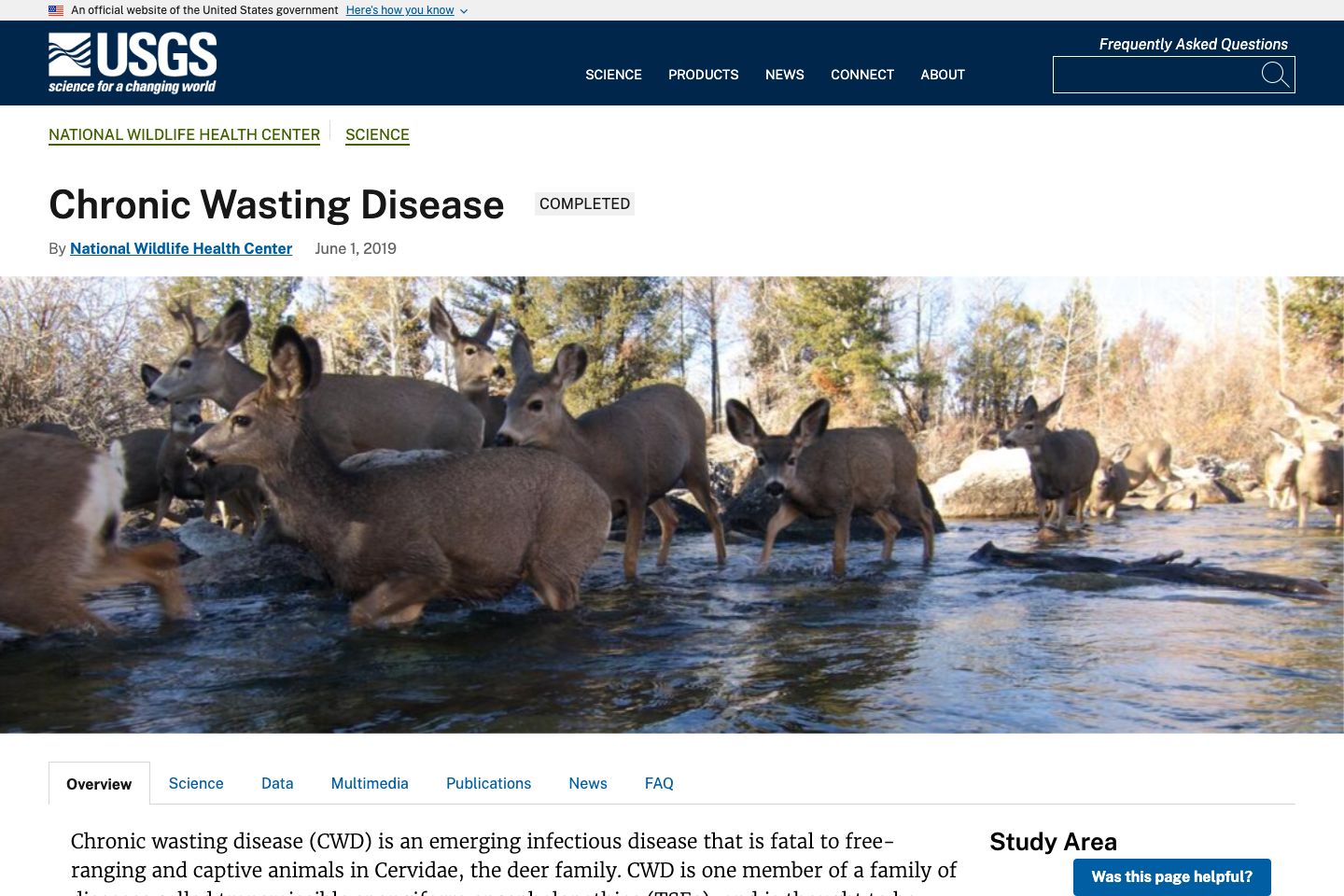
Chronic wasting disease spreads both by deer-to-deer contact and by prions that linger in the environment for years (U.S. Geological Survey; U.S. Geological Survey). USGS summarizes CWD as a fatal prion disease of cervids and highlights research on environmental persistence, soil and plant factors, and tools for early detection (U.S. Geological Survey). Modeling work published through USGS shows that longer environmental infectious periods push epidemics toward higher prevalence and deeper population declines, because the infectious window can outlast an individual host (U.S. Geological Survey). Scavengers and predators enter that picture when they feed on infected carcasses and then move across the landscape (U.S. Geological Survey; U.S. Geological Survey). Recent USGS-linked surveillance work detected PrP CWD in feces from free-ranging carnivores using RT-QuIC, after experimental studies had already shown prions in feces of crows, coyotes, and cougars (U.S. Geological Survey).
Key Takeaways
- CWD transmits directly and through contaminated environments (U.S. Geological Survey; U.S. Geological Survey).
- Environmental prion persistence can last years and reshape epidemic trajectories (U.S. Geological Survey).
- Carcasses and gut piles draw many mammal and bird scavengers (U.S. Geological Survey).
- Experimental feeding studies found prions in feces of crows, coyotes, and cougars (U.S. Geological Survey).
- RT-QuIC can detect PrP CWD in free-ranging carnivore feces (U.S. Geological Survey).
- Scavenger role in starting new foci is still being quantified (U.S. Geological Survey; U.S. Geological Survey).
Environmental persistence sets the stakes
USGS modeling of CWD routes shows indirect transmission and the duration of environmental prion persistence can swing long-term outcomes from modest prevalence to host-population collapse (U.S. Geological Survey). High persistence builds an environmental pool of prions during early epidemic decades, so management tools that ignore the landscape reservoir lose leverage as years pass (U.S. Geological Survey). USGS NWHC research priorities explicitly include assessing and predicting spread and persistence of CWD in wildlife and the environment (U.S. Geological Survey). Soil and plants are among the environmental factors USGS scientists study for transmission risk on the landscape (U.S. Geological Survey).
What shows up at a deer carcass
A Journal of Wildlife Management study archived by USGS placed disease-free white-tailed deer carcasses and gut piles in Wisconsin’s CWD area and photographed scavenger visits (U.S. Geological Survey). Observers recorded 14 scavenging mammal species and 14 scavenging bird species; prominent visitors included American crows, raccoons, and Virginia opossums (U.S. Geological Survey). Carcasses persisted from 18 to 101 days depending on season and year, while gut piles lasted about 3 days (U.S. Geological Survey). Mammalian and avian scavenger activity and higher temperatures were associated with faster removal (U.S. Geological Survey). Domestic dogs, cats, and cows also visited some sites, which the authors flagged as a potential human-exposure pathway worth management attention (U.S. Geological Survey).
Prions in scavenger feces
USGS summarizes that experimental feeding studies demonstrated prions in feces of American crows, coyotes, and cougars, yet the epidemiologic role of scavengers remained poorly understood (U.S. Geological Survey). A Scientific Reports study highlighted by USGS adapted RT-QuIC to recover spiked PrP CWD from feces of nine carnivore species and then detected naturally acquired PrP CWD in free-ranging predator and scavenger feces (U.S. Geological Survey). Detection rates in carnivore feces tracked relative CWD prevalence in the matching cervid populations, turning scavenger scat into a community-level surveillance signal (U.S. Geological Survey). Gut residency of prions appears short in experimental work cited there, on the order of days in coyotes and cougars and hours in crows, which still allows translocation before excretion (U.S. Geological Survey).
Dilution versus dispersal
The same USGS carnivore-feces synopsis notes that infectious PrP CWD shed in coyote feces was reduced relative to ingested material, and that predator work on cougars suggests much ingested prion may be eliminated or sequestered (U.S. Geological Survey). That tension matters for hunters and managers: scavengers may both move prions away from a carcass and reduce the dose left on site (U.S. Geological Survey; U.S. Geological Survey). USGS still treats infected carcasses and gut piles as potential exposure sources for many scavenger species and recommends considering scavenger testing where surveillance is practical (U.S. Geological Survey).
Practical takeaways for deer country
Carcass disposal rules and transport bans exist because environmental contamination is not theoretical (U.S. Geological Survey; U.S. Geological Survey). Leaving gut piles or whole carcasses in place concentrates scavenger traffic on infectious material for days to months (U.S. Geological Survey). Follow state CWD carcass rules, and treat scavenger activity around known positives as a reason to keep dogs and livestock away from those sites when agencies advise it (U.S. Geological Survey; U.S. Geological Survey).
Bottom line
Scavengers can carry detectable CWD prions in feces after feeding on infected material, while long environmental persistence keeps landscape risk alive for years (U.S. Geological Survey; U.S. Geological Survey; U.S. Geological Survey).
The other side of it
The evidence cuts both ways, and the article admits it. Coyote feces carried less infectious prion than the coyotes ate, cougar work suggests much of it gets eliminated or sequestered, and scavengers may lower the dose left at a carcass even as they move some elsewhere. Their role in starting new foci is still being quantified, and the population-collapse scenarios come from models. None of which helps the guy who tosses his gut pile over the fence and calls it nature’s cleanup crew.
Keep reading
Latest deer news
Sources
- Chronic Wasting Disease | U.S. Geological Survey
- Modeling routes of chronic wasting disease transmission: Environmental prion persistence promotes deer population decline and extinction | U.S. Geological Survey
- Deer carcass decomposition and potential scavenger exposure to chronic wasting disease
- Detection of prions from spiked and free-ranging carnivore feces | U.S. Geological Survey
Comments