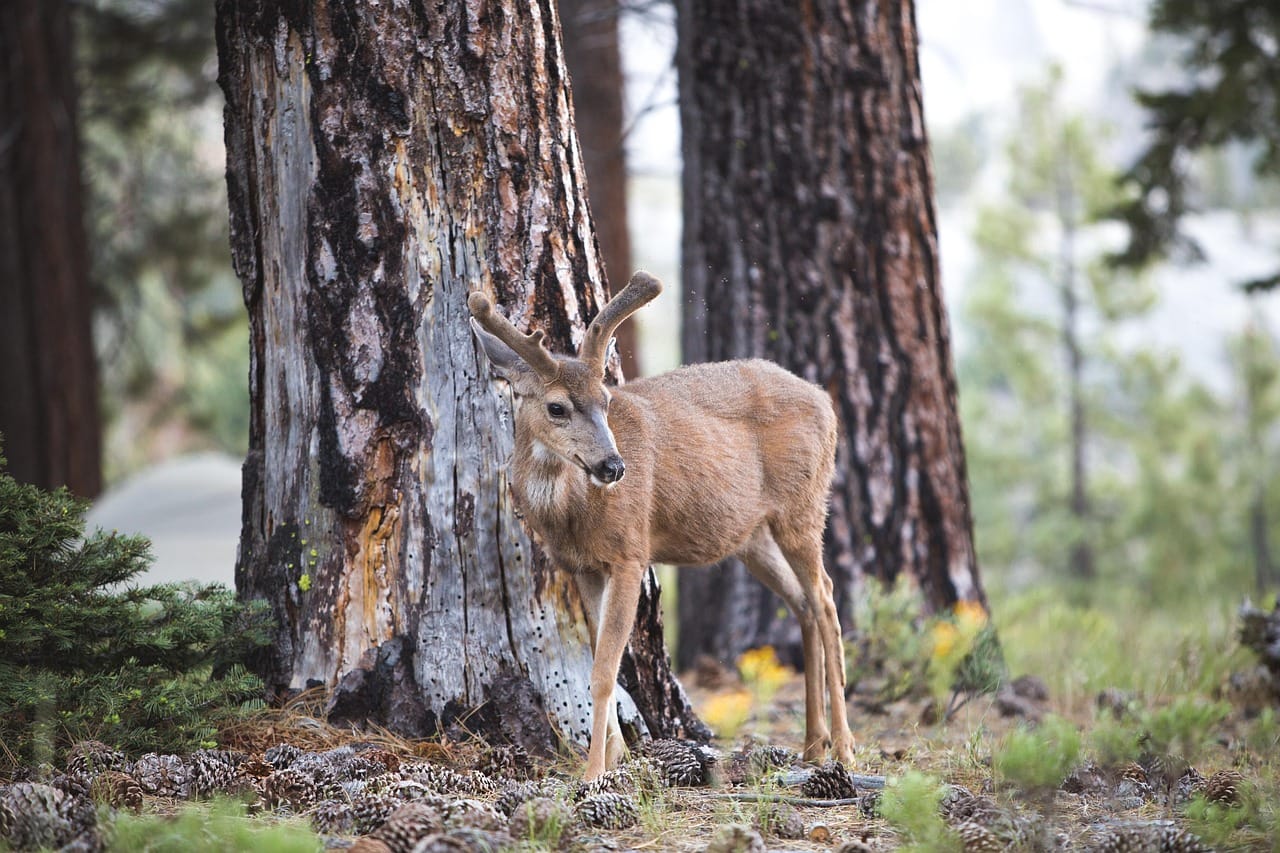
Why do deer rub their antlers on trees? Bucks rub partly to strip the velvet off new antlers, but most rubbing is communication. The Maine Department of Inland Fisheries and Wildlife puts it simply: “Rubs are made when deer rub their antlers and foreheads on trees, removing bark and depositing their scent in the process. These rubs communicate a buck’s presence in an area” (Maine IFW). Velvet is the short answer. Signposts are the long one.
Key Takeaways
- Rubbing starts when antlers harden and velvet comes off, which the Pennsylvania Game Commission puts in September.
- Velvet stripping is quick. Deer biologist John Ozoga writes that it is “generally accomplished within 24 hours.”
- Most rubs are signposts that carry scent from forehead glands and show up as bright, peeled bark.
- Mature bucks make more rubs, start earlier and rub bigger trees than yearlings.
- Even researchers say they don’t fully understand every message a rub sends.
Why do deer rub their antlers on trees after velvet?
Antlers grow inside living skin. The Missouri Department of Conservation says “During the antler-growth period, the soft skin and short hair covering the antlers have a plush quality, giving this stage the name of” velvet, and “In Missouri, antler growth typically starts in April and is completed in August” (MDC field guide).
When that skin dies, bucks get rid of it. The Pennsylvania Game Commission says “velvet is shed by September. This is when rubbing activity begins,” and that “Rubbing during and shortly after velvet loss is violent.” After that, it says, “rubbing evolves into its more typical, highly visual signpost” (Pennsylvania Game Commission). For what the shedding looks like, see deer antler velvet shedding day by day.
Ozoga, a retired deer research biologist writing for Deer & Deer Hunting, makes the key point: “Bucks naturally scar trees and shrubs while rubbing them to remove antler velvet, but velvet stripping is generally accomplished within 24 hours. Bucks also make rubs while sham fighting. Bucks rub as long as they carry hardened antlers, so most rubs are made for other reasons” (Deer & Deer Hunting).
Rubs as scent posts
The forehead is the main scent tool. Ozoga writes that “Investigations conducted by Thomas Atkeson and Larry Marchinton revealed whitetails possess specialized forehead skin glands that become especially active during autumn. Bucks and does have these glands, but mature, socially high-ranking bucks tend to excrete more from them.” He adds that “rubbing is done primarily with the antler base and forehead,” so each rub carries the scent of the buck that made it.
The Missouri Department of Conservation agrees. Its Conservationist magazine says scrapes and rubs, “Although visual in nature,” also “serve a chemical communication role,” and that bucks “deposit scent from this gland on trees and overhanging branches while rubbing and making scrapes” (MDC Conservationist). For more on the glands, see forehead and preorbital gland rubbing.
Ozoga is candid about the limits. He admits that even researchers don’t fully understand the messages bucks send with rubs. “Logically, some antler rubs are made to clean the antlers of velvet, but most are made for communicative purposes” (Deer & Deer Hunting).
Rubs as visual signposts
A rub is also meant to be seen. Ozoga writes that “Buck rubs are visual and olfactory (chemical) signals. They are showy and are anointed with various glandular secretions.” He notes that “Bucks might even grunt while making rubs, thereby attracting the attention of other deer.”
Location matters. In his Michigan work, he says “The most attractive buck rubs in Michigan were located along forest opening edges, where deer can detect them from a distance.” Researchers disagree on whether looks or smell matter more. Ozoga sums it up: “Study findings are contradictory.”
Who reads the rubs?
Other deer pay attention. Ozoga writes that “Mature bucks made most of the rubs, but adult does and young bucks were the primary visitors to authentic and mock rubs.” In Georgia studies with tame deer, “adult does frequently paused and sniffed fresh buck rubs.” Researcher Karl Miller has proposed that pheromones left by dominant bucks at rubs and scrapes “help synchronize reproductive cycles, bring adult does into estrus early, and suppress the aggressiveness and sex drive of young bucks.” That remains a hypothesis, which Ozoga says his own studies support.
Age and tree size
Older bucks rub more and rub bigger. The Pennsylvania Game Commission says “Yearlings make about half as many rubs as mature bucks,” “Yearlings typically rub saplings no more than 2 to 3 inches in diameter,” and a mature buck “may rub pole trees 6 inches or larger.” Maine IFW adds that “a rub on a large tree of 4 or more inches in diameter means a big buck is in the area.”
Some trees get hit every year. The Game Commission says rubs “only require a tree” and that “some rubs are historic being used annually.” Ozoga notes, though, that “most rubs are not re-rubbed.”
How to tell a fresh rub
Maine IFW gives the clues: “A fresh rub will typically expose brighter layers of inner bark, which will contrast with the dull outer bark of the tree. There will often be strands of shredded bark or deer hair or velvet still hanging from the rub, and the rub will have a rough appearance.” Older rubs “will be all dull in appearance and relatively smoothed over.” Rubs often go hand in hand with scrapes; see licking branches and scrape overhangs and the deer rut.
FAQ
Do deer rub trees only to remove velvet? No. Velvet comes off quickly, and Ozoga writes that bucks “rub as long as they carry hardened antlers.”
Do does rub trees? Does have forehead glands too. In the Georgia studies, the dominant doe “sometimes even rubbed her forehead directly on the rub.”
When do bucks start rubbing? In Pennsylvania, when antlers harden and velvet is shed, by September.
Does a big rub mean a big buck? Maine IFW says a rub on a tree 4 inches or more in diameter “means a big buck is in the area.”
The other side of it
Some hunters say rubs are overrated as stand sites, since many rubs are never revisited and the buck that made one may be bedded a long way off. The research backs part of that: rub reuse varies, and even the biologists admit they can’t read every message. But rubs still tell you a buck lives there, roughly how mature he is and when he got busy. The hunter who hangs a stand on the first rub he finds and calls it a plan is reading one word and claiming the whole book.
Keep reading
Latest deer news
Sources
- Rut Watch: Maine Deer Spy, Maine Department of Inland Fisheries and Wildlife
- Ask a Deer Question, Pennsylvania Game Commission
- White-Tailed Deer Field Guide, Missouri Department of Conservation
- Deer Dialogue, Missouri Department of Conservation, Conservationist magazine (2014)
- "Signpost Science: What Research Tells Us About Buck Rubs", Deer & Deer Hunting (John Ozoga, retired deer research biologist)
- The Science of Buck Rubs, Deer & Deer Hunting (John Ozoga)
Comments