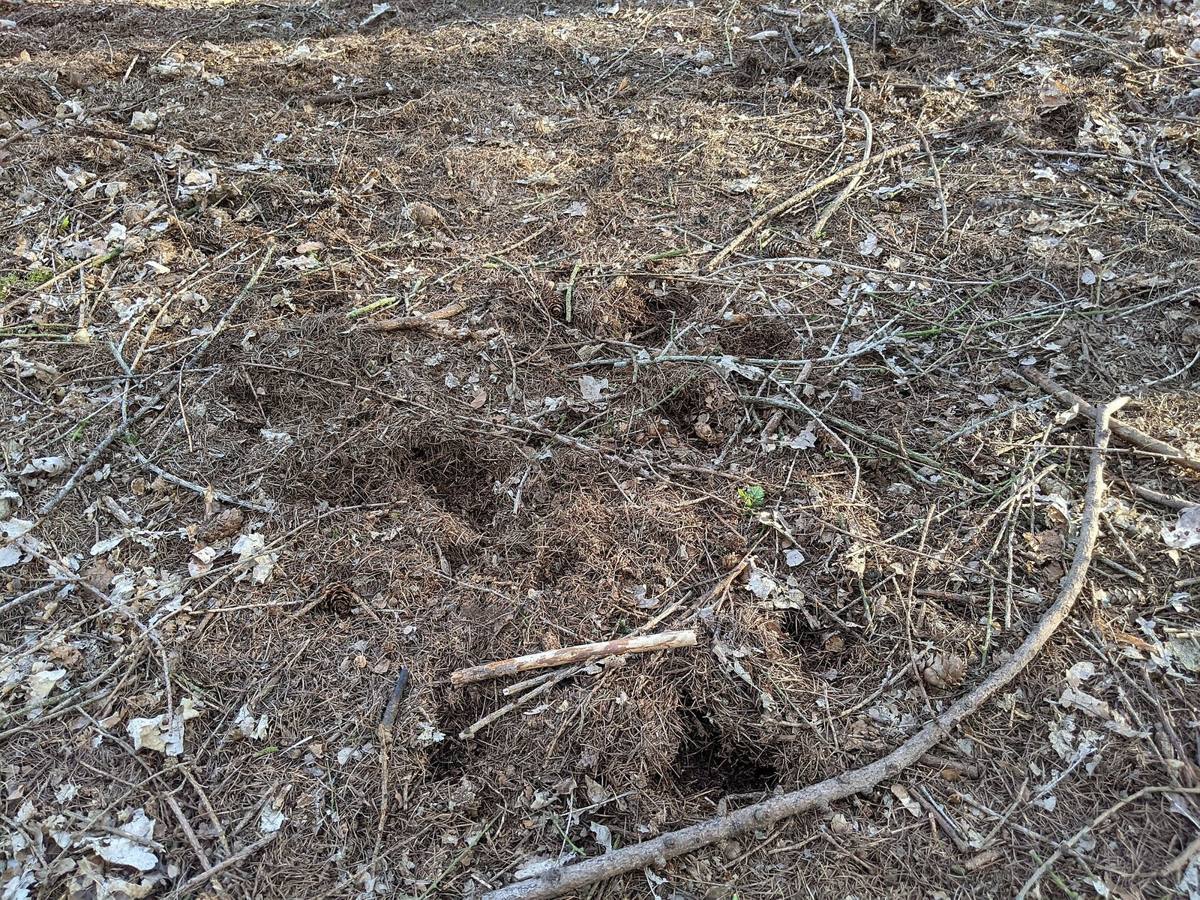
What is a deer scrape? It’s a scent post: a patch of pawed-up bare dirt under an overhanging branch, where deer, mostly bucks, leave and read scent. A 2024 study published by USDA researchers describes scraping as a “unique breeding season behavior” in which white-tailed deer “deposit urine and saliva at shared sites” (Huang et al. 2024, via UNL Digital Commons). The dirt is the part you notice. The branch above it is the part deer care about most.
Key Takeaways
- A scrape is a cleared spot of soil under a “licking branch.” Bucks mark the branch with face glands and saliva, paw the ground, and often urinate in it.
- Bucks do most of the scraping. NDA says “Mature bucks rub-urinate much more often” than young bucks.
- Does visit scrapes too, and deer use them year-round, with a peak during the breeding season.
- Most scrape visits happen in the dark. NDA puts it at “nearly 85 percent.”
- Scrapes can reappear in the same spot for years if the branch and travel patterns stay put.
What does a deer scrape look like?
Look for two things together: bare soil on the ground and a low branch hanging over it. The National Deer Association (NDA) says the buck will “paw away the leaf litter or vegetation immediately below the overhanging branch and create a shallow depression in the exposed soil” (NDA).
The branch overhead is the licking branch. NDA says bucks “often bite or chew it to leave their desired scent signal for other deer.”
Where you find them: NDA says a scrape “may reappear every year for several years in the same location as long as the tree remains and deer travel patterns stay the same.” It adds that “Scrapes can be readily found on field edges, along trails, or in the interior of woods,” and they “are concentrated where two or more vegetation types or age classes meet.”
Why do deer scrape?
To communicate. NDA’s Kip Adams, a certified wildlife biologist, calls rubs and scrapes “primary communication locations for deer.” A full scrape visit runs in a sequence, according to NDA:
- Mark the branch. “Bucks may rub their preorbital and/or forehead gland on the branch,” and often bite or chew it.
- Paw the ground. The buck clears litter down to soil. “The scent of the exposed soil alone can attract other deer.”
- Urinate. “Bucks often urinate in the pawed area.” Some rub-urinate, where “the buck urinates while rubbing his tarsal glands together.”
Rub-urination is an age clue. NDA says “younger bucks urinate in scrapes without rubbing their tarsals together, especially yearling bucks,” while “Mature bucks rub-urinate much more often, which is why dark-stained tarsal glands are one indicator of buck age.” Our guide to tarsal gland chemistry and rub-urination goes deeper.
Not every visit includes every step. NDA: “They may check the overhanging branch or scrape for scent without pawing the ground or urinating.”
Is the licking branch the most important part of a scrape?
For deer, it looks that way. NDA’s mock-scrape guide says “the licking branch is by far the most important part of the scrape” (NDA). See licking branches and scrape overhangs for how scent gets shared there.
A single scrape draws a crowd. In the 2024 study, which watched scrapes in a CWD study area, researchers “identified 218 unique bucks visiting 105 scrapes, with a mean of 12.2” bucks per scrape (Huang et al. 2024).
Do does use scrapes?
Yes. NDA says “does routinely visit scrapes, and it’s not uncommon for them to urinate and leave their own personal information” (NDA). So a scrape isn’t a buck-only message board. Bucks and does both leave scent there.
When do deer scrape?
All year, with a peak during the breeding season. NDA says scraping “occurs throughout the year” and “Bucks and does use scrapes during any month, but their use peaks during the breeding season.” Our deer rut guide covers the timing.
Pawing tends to start later than branch work. NDA’s mock-scrape guide says “Deer will work the licking branch practically all year long, but rarely do you see pawing in the ground before October 1” (NDA).
Do bucks visit scrapes in daylight?
Not often. NDA says “wildlife researchers have shown that most scraping activity (nearly 85 percent) occurs at night” (NDA).
Do scrapes spread CWD?
Researchers are studying it. The 2024 study tested scrape soil and licking branches and “detected prion seeding activity in 20% of the soil and 41% of the licking branches of the scrape sites within the CWD study area.” The authors wrote, “Our data show there is environmental prion contamination at scrape sites,” and suggested scrapes “could serve as early warning sentinel sites for CWD surveillance” (Huang et al. 2024). Our page on mock scrape evidence vs folklore covers whether homemade scrapes work.
FAQ
What is a deer scrape? A patch of pawed bare soil under an overhanging licking branch, where deer leave scent with urine, saliva and glands.
Do does make scrapes? NDA says does “routinely visit scrapes” and may urinate in them. Bucks do most of the pawing.
When are scrapes most active? NDA says use “peaks during the breeding season,” and most visits happen at night.
Should I hunt over a scrape? NDA suggests setting up “between scrapes and good bedding cover” instead of right on top of one.
The other side of it
A fresh scrape feels like a promise, but the research says it’s mostly a night-shift bulletin board. NDA’s scrape guide suggests setting up “between scrapes and good bedding cover” instead. Some hunters will say their best buck came off a scrape, and some did. Still, the hunter who hangs a stand over the first scrape he finds and calls it scouting has mostly scouted where deer walk in the dark.
Keep reading
Latest deer news
Sources
- A Guide to Rubs and Scrapes, the Social Media of the Deer World, National Deer Association (Kip Adams, certified wildlife biologist)
- The Why and How of Mock Scrapes, National Deer Association
- When Do Bucks Visit Scrapes?, National Deer Association
- Expanding CWD Disease Surveillance Options Using Environmental Contamination at Deer Signposts (Huang et al. 2024, Ecological Solutions and Evidence; abstract), University of Nebraska-Lincoln Digital Commons (USDA NWRC staff publications)
Comments