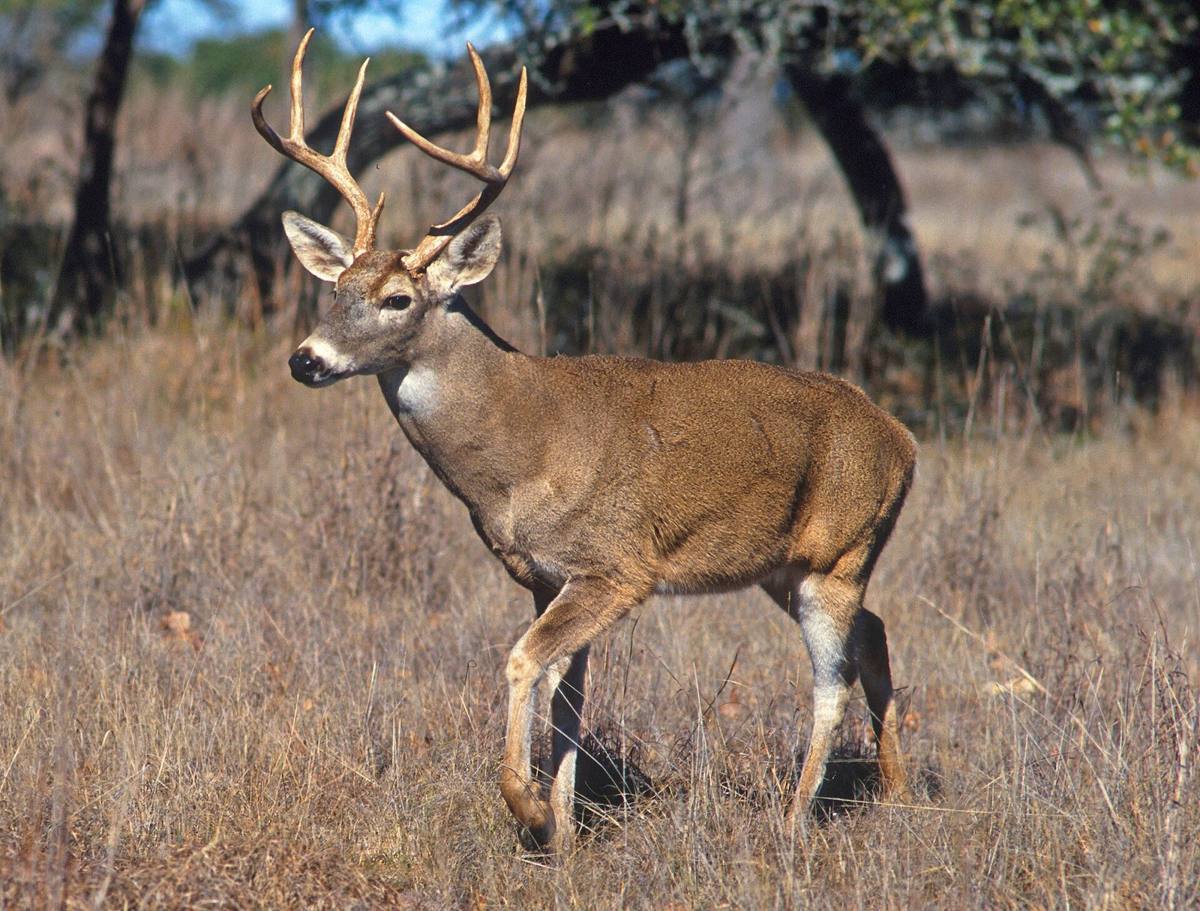
Mature bucks enter the breeding season heavy and leave it thin. MU Extension’s live-aging guide states that bucks lose weight as the rut progresses because they spend more time on breeding activity than foraging, and that research shows mature bucks can lose up to a quarter of their body weight by the post-rut, when they are normally in the worst condition of the year (MU Extension G9485). Mississippi State Extension similarly describes bucks increasing daily travel during peak rut and losing more than 30% of body weight in some accounts, leaving them vulnerable to starvation, disease, and predators if winter forage fails (MSU Extension bucks bounce back).
Key Takeaways
- Rutting bucks trade feeding time for searching, tending, and fighting (MU Extension G9485).
- Weight loss around 25% (MU) to 30% or more (MSU messaging) is reported for hard-run mature bucks (MU Extension G9485; MSU Extension bucks bounce back).
- Post-rut is the annual low point for buck body condition (MU Extension G9485).
- Unbalanced sex ratios can lengthen the rut and worsen condition loss (MU Extension G9485; MSU Extension bucks bounce back).
- Habitat and winter food decide whether thin bucks recover or die (MU Extension G9485; MU Extension G9479).
Seasonal body timeline hunters can see
Pre-rut: Bucks are typically in their best condition after spring and summer foraging in bachelor groups. Necks may not yet be swollen even on mature animals (MU Extension G9485). Rut: Necks swell on mature bucks; antler breakage and body wear increase; foraging time drops as breeding activity rises (MU Extension G9485). Post-rut: Bucks look thin compared with early fall, with fatigued bodies and depleted reserves. MU warns bucks can die in this window when winters are severe and food is scarce (MU Extension G9485).
MU’s ecology guide adds that bucks typically lose weight during the breeding season and regain it in spring and summer, while does prioritize fetal growth and lactation on a different calendar (MU Extension G9479). That split explains why a February buck and a February doe can tell opposite nutrition stories on the same property.
Movement explains the calorie hole
Mississippi State describes adult buck daily travel rising from roughly 2.7 miles pre-rut to more than 4 miles in peak rut on their study area, matching the biological story that bucks cover ground to find estrus does instead of feeding efficiently (MSU Extension bucks bounce back). More yards walked plus less time eating equals rapid condition loss even before cold stress arrives. Hunters who only sit evenings in early season and then wonder why December bucks look like different animals are seeing that energy budget play out.
Sex ratio and recycle timing
MU notes that when adult sex ratios skew heavily toward females, the rut tends to last longer and hits buck condition harder (MU Extension G9485). MSU likewise ties too many does to extended chasing as bucks work later estrus cycles (MSU Extension bucks bounce back). Agency biology pages commonly describe a short estrus window with recycle intervals near four weeks if a doe is not bred - which is how a drawn-out doe-heavy herd keeps bucks running (NJ Fish and Wildlife deer biology; TPWD the rut; Maryland deer biology). Antlerless harvest aimed at balanced adult sex ratios is therefore not only a density tool - it can shorten the gauntlet bucks run (MU Extension G9491; MU Extension G9485).
Hunting and management implications
- Late-season judgment: A hollow-flanked December buck may be a healthy mature deer that spent everything on breeding, not a permanently poor animal (MU Extension G9485).
- Aging on the hoof: Use body cues carefully after the rut; thin edges and changed silhouettes can confuse age-class calls (MU Extension G9485).
- Habitat: Post-rut food - standing crops, late brassicas, woody browse where mast failed - supports recovery when bucks bed more and feed heavily again (MSU Extension bucks bounce back; MU Extension G9479).
- Northern winters: Thin bucks plus deep snow is the mortality stack MU explicitly warns about (MU Extension G9485).
What landowners can do
Keep quality forage available into late winter, avoid unnecessary late harassment after peak breeding, and use antlerless harvest to prevent endlessly prolonged ruts from extreme doe skews (MU Extension G9485; MU Extension G9491; MSU Extension bucks bounce back). QDM age-structure goals mean little if post-rut starvation deletes the mature bucks you protected in November (MU Extension G9480; MU Extension G9485). Camera catalogs that score antlers in October should be paired with late-winter observation of which bucks still walk your ground in March.
Regional recovery differences
MSU notes that short, intense northern ruts can allow quicker recovery if forage remains available, while deep snow can erase that advantage; southern herds may face longer or more staggered breeding calendars that stretch recovery windows even in milder winters (MSU Extension bucks bounce back). Match late-season food-plot and browse plans to your latitude rather than copying a single national calendar (MSU Extension bucks bounce back; MU Extension G9479).
Bottom line
Rut weight loss is expected physiology, not a mystery disease. MU and MSU extension sources put the scale in the mid-twenties to roughly thirty percent for hard-run mature bucks, with post-rut the danger season. Manage forage, sex ratios, and late-season pressure accordingly (MU Extension G9485; MSU Extension bucks bounce back; MU Extension G9479; NJ Fish and Wildlife deer biology).
Related: aging a buck on the hoof and doe estrus cycle.
The other side of it
The fair objection is that most body-condition numbers come from penned or managed deer, and the buck on your camera never read the study. Fine. He’ll still look like a coat hanger by mid-December.
Keep reading
Latest deer news
Sources
- Techniques for Aging Live Deer | MU Extension
- Help bucks bounce back from rut | Mississippi State University Extension Service
- Ecology and Management of White-Tailed Deer in Missouri | MU Extension
- NJ Fish and Wildlife deer biology (dep.nj.gov)
- TPWD: The Rut in White-tailed Deer
- White-tailed Deer Biology
- Managing for White-tailed Deer in Missouri: Setting and Accomplishing Management Goals | MU Extension
- Implementing Quality Deer Management on Your Property | MU Extension
Comments