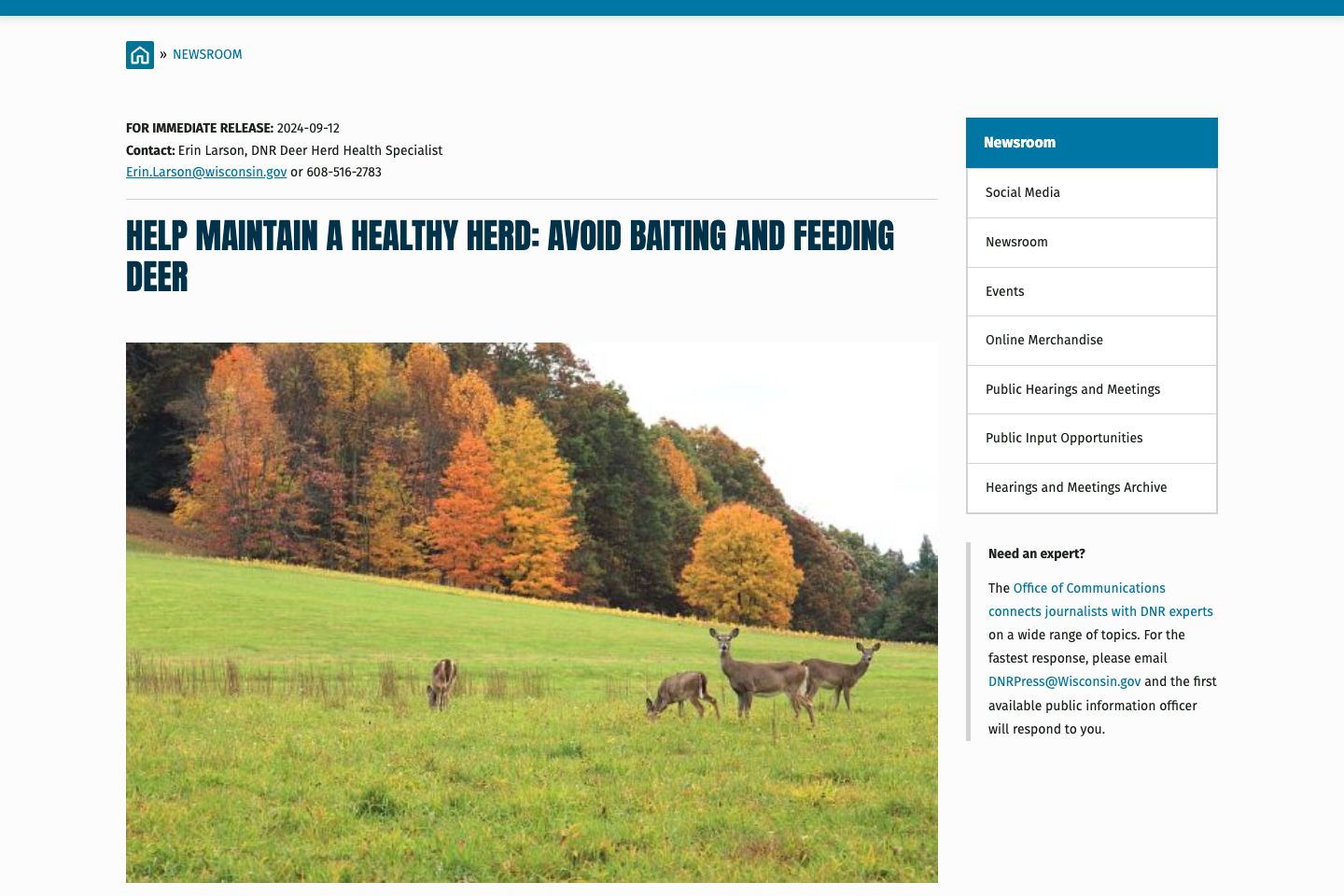
Supplemental feeding and baiting pull deer into unnaturally tight spacing where saliva, urine, feces, and contaminated soil or feed share pathogens. Wisconsin DNR’s September 2024 herd-health release urges hunters and the public to follow baiting and feeding bans and to refrain even where bans are not in effect because CWD is always fatal and spreads faster when deer congregate (Wisconsin DNR). Indiana DNR likewise warns that feeding concentrates deer that would otherwise forage apart, helping CWD - already detected in Indiana - move through saliva, urine, feces, and soil that can stay infectious for years (Indiana DNR). Northern extension partners add that winter feeding can raise starvation, predation, disease, and collision risk even before CWD enters the conversation (UNH Extension).
Key Takeaways
- WI DNR: follow baiting/feeding bans; avoid feeding even where legal to slow CWD (Wisconsin DNR).
- IN DNR: feeding congregates deer and aids CWD and other disease spread (Indiana DNR).
- CWD prions persist in soil; feed sites become risk nodes (Indiana DNR).
- UNH/NHFG: feeding raises starvation, predation, disease, and collision risk (UNH Extension).
- Sudden grain bait can cause grain toxicity before rumen microbes adapt (Wyoming Game and Fish).
Concentration is the mechanism
Indiana explains that under normal foraging deer spread out, but supplemental food makes them congregate closer than they would in the wild, easing disease transmission (Indiana DNR). Wisconsin frames baiting and feeding as creating environments where infected deer can quickly spread CWD (Wisconsin DNR). CWD affects the nervous system of deer, elk, moose, and related cervids and is invariably fatal (Wisconsin DNR).
Why feed piles outlast the corn
Indiana notes CWD stays active and infectious in soil for years, so a discontinued feeder can remain a risk site (Indiana DNR). That environmental persistence is why agencies treat artificial congregation - bait, feed, mineral sites - as management problems, not just ethics debates (Indiana DNR; Wisconsin DNR). Wisconsin DNR herd-health contacts emphasize preventing spread between deer by not creating those contact hubs (Wisconsin DNR).
Nutrition myths collide with winter physiology
UNH Extension with New Hampshire Fish and Game states feeding often makes deer more vulnerable to starvation, predation, disease, and vehicle collisions (UNH Extension). Adult northern deer may lose up to 20 percent of body weight in winter regardless of offered food and can draw about 40 percent of daily winter energy from fat; cover, not forage piles, becomes the survival key (UNH Extension). Indiana calls many commercial deer feeds unhealthy “junk food” relative to natural diets and notes medical complications from corn-based feeding (Indiana DNR). Wyoming Game and Fish separately warns that sudden grain bait can kill deer via grain toxicity before rumen microbes adapt (Wyoming Game and Fish).
Policy posture
Wisconsin asks the public to follow all baiting and feeding bans and to refrain even where no ban exists (Wisconsin DNR). Utah DWR maintains separate supplemental winter feeding guidance for agency-managed emergencies, underscoring that private ad-hoc feeding is not the same tool (Utah DWR). Always read current state CWD-zone rules before putting out any attractant (Wisconsin DNR; Indiana DNR).
Hunter bottom line
Skip recreational feeders and bait where disease is a concern; hunt natural travel and food sources instead (Wisconsin DNR; Indiana DNR). If neighbors feed, treat those sites as high-contact nodes for surveillance and carcass discipline (Indiana DNR). Winter “rescue” piles fight both disease policy and rumen biology (UNH Extension; Wyoming Game and Fish).
Bottom line
Feeding concentrates deer onto prion- and pathogen-friendly ground - follow bans, prefer natural forage, and do not invent winter rescue piles that raise CWD risk (Wisconsin DNR; Indiana DNR; UNH Extension).
The other side of it
A feeder guy will point out that deer already bunch up under good oaks and on green fields, and nothing here measures how much a feeder adds beyond that. Utah also runs its own emergency winter feeding, which shows even an agency thinks feeding has a place when it’s done on agency terms. Still, “it’s only a little corn” has never once been the opening line of a good CWD story.
Keep reading
Latest deer news
Comments