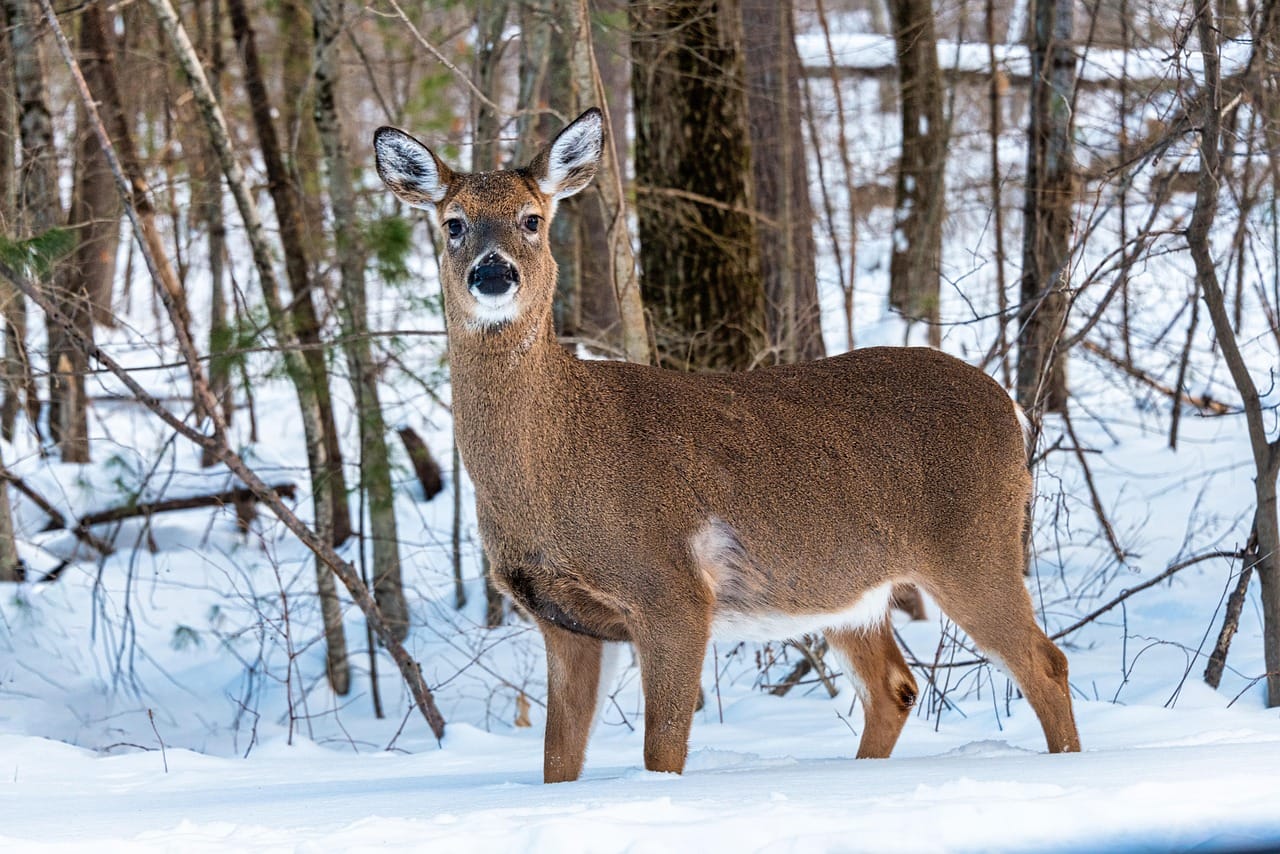
What do whitetail deer eat in the winter? Mostly woody browse: the twigs, buds and needles of trees and shrubs. They also eat any acorns still on the ground and burn fat they stored in the fall. Michigan’s DNR says that in fall, winter and early spring, “deer browse on the leaves, needles, buds, and twig ends of trees and shrubs” (Michigan DNR). What’s on the menu depends on where the deer lives, and in the South the mix looks different from the North Woods.
Key Takeaways
- Winter deer food is mostly woody browse: twigs, buds and evergreen foliage.
- Northern white cedar is a top winter food in the North.
- Acorns are eaten until they run out or are buried by snow.
- Southern deer turn to greenbrier, honeysuckle and young-forest browse.
- Deer also rely on fat stored in fall.
- Dumping corn for deer in winter can kill them, state agencies warn.
What do whitetail deer eat in the winter up north?
SUNY ESF’s Adirondack species account says “After snowfall, the winter diet consists of woody browse - the twigs and stems of seedlings, saplings and shrubs” (SUNY ESF). It lists preferred species: “white cedar, birches, aspens, American yew, hemlock, maples, ash, white pine, mountain ash, scarlet elder, sumac, witchhobble, and high bush cranberry.”
Wisconsin’s forestry outreach site agrees: “In winter, deer mainly browse woody plants, like northern white cedar, red maple, mountain ash, dogwoods, and aspen” (My Wisconsin Woods). Michigan’s DNR lists white cedar first among preferred deer foods and notes that “In many areas browsing deer have eaten practically all cedar within reach.”
That heavy use leaves a mark. ESF describes “a noticeable browse line in white cedar swamps and where white cedar fringes lakes and rivers; almost all foliage and twigs are removed to a height of 6 ft.” Michigan DNR tells you to “look for browsed vegetation from ground level to about five feet in height.”
Acorns and other mast
Before snow covers them, nuts are a big part of the menu. ESF says “Acorns and beechnuts (until buried by snow) and woody browse are important autumn and early winter foods, as well as dried leaves and grasses.” Michigan’s DNR says oak buds are “only moderate in food value, but acorns provide excellent deer food.”
Mississippi State University Extension adds that “Body fat stores are increased during the fall and early winter months with a variety of mast crops, such as persimmons and acorns, which are good sources of carbohydrates” (MSU Extension). For why deer pick some acorns over others, see our guide on acorn tannins.
What southern deer eat in winter
In Virginia, the DWR’s deer, bear and turkey biologist Katie Martin says deer “are now entering the hardest time of the year for them.” The DWR article notes that by winter in most years, acorn crops are mostly gone, and Martin says December “foods often include lower quality items such as greenbrier, honeysuckle, privet, and the variety of browse that can be found in young forests” (Virginia DWR).
MSU Extension’s guide to native deer forages in Mississippi and the Southeast says that “Basal rosettes are eaten by deer in winter and early spring.” It rates Japanese honeysuckle, a semi-evergreen vine, as a high-preference food.
Fat reserves do part of the work
Deer don’t eat their way through winter alone. ESF says “Both browsing and fat reserves provide winter energy needs.” It adds that deer “may lose 25-30% of their body weight and survive.” It also notes that “Fawns from the pervious year are the most vulnerable to starvation because they have the least time to accumulate fat before winter.”
In deep-snow country, deer move to conifer cover. ESF says they leave summer range “when the snow depth reaches 15 inches” for “traditional winter ranges (deer yards) that offer continuous coniferous cover overhead.” Our guides on nutrient hotspots under winter deer yards and winterkill indicators go deeper.
Why you shouldn’t dump corn for winter deer
A winter deer’s gut is tuned to browse. Wisconsin’s DNR explains that “The rapid change from a natural diet of high-fiber woody browse to a low-fiber/high carbohydrate diet as is found in grain, such as corn,” can cause acidosis or enterotoxemia. It adds that these diseases “are usually seen in late winter and are often associated with where well-meaning people have put out corn or other artificial foods for deer” (Wisconsin DNR).
The Pennsylvania Game Commission says “A sudden change in diet to high carbohydrate and low fiber disrupts the normal microflora (bacteria, protozoa, and fungi) in the rumen that is necessary for digestion” (PGC). Minnesota’s DNR warns that “It’s not uncommon for wintering deer to eat themselves to death despite having reserves of fat” (Minnesota DNR). Feeding and baiting are also regulated in many states; see our deer baiting laws by state and rumen science guides.
FAQ
What is the main food for deer in winter? Woody browse: twigs, buds and evergreen foliage. In the North, white cedar is a favorite.
Do deer eat acorns in winter? Yes, while they last. ESF says acorns are important until buried by snow.
Should I feed deer corn in winter? State wildlife agencies in Wisconsin, Pennsylvania and Minnesota warn that sudden grain feeding can kill deer.
How do deer survive winter without much food? They combine browse with fat stored in fall, and in snow country they gather in conifer cover.
The other side of it
Some landowners argue that feeding helps deer through a hard winter, and the urge is understandable when the snow is deep. But the agencies quoted here say a sudden switch to grain can kill the very deer it was meant to save, and that browse and fat are what deer are built to run on. Better winter habitat does more good than a corn pile. The guy who dumps fifty pounds of shelled corn in January and calls it conservation is mostly feeding his own conscience.
Keep reading
Latest deer news
Sources
- Forest foods deer eat, Michigan Department of Natural Resources
- White-tailed Deer (Adirondack Ecological Center), SUNY College of Environmental Science and Forestry
- Deer (My Wisconsin Woods), My Wisconsin Woods
- How Virginia's Deer Change in December and January, Virginia Department of Wildlife Resources
- A Guide to Common Native Deer Forages in Mississippi and the Southeast, Mississippi State University Extension Service
- Corn toxicity in ruminants, Wisconsin Department of Natural Resources
- Rumen Acidosis, Pennsylvania Game Commission
- "Don't feed deer", Minnesota Department of Natural Resources
Comments