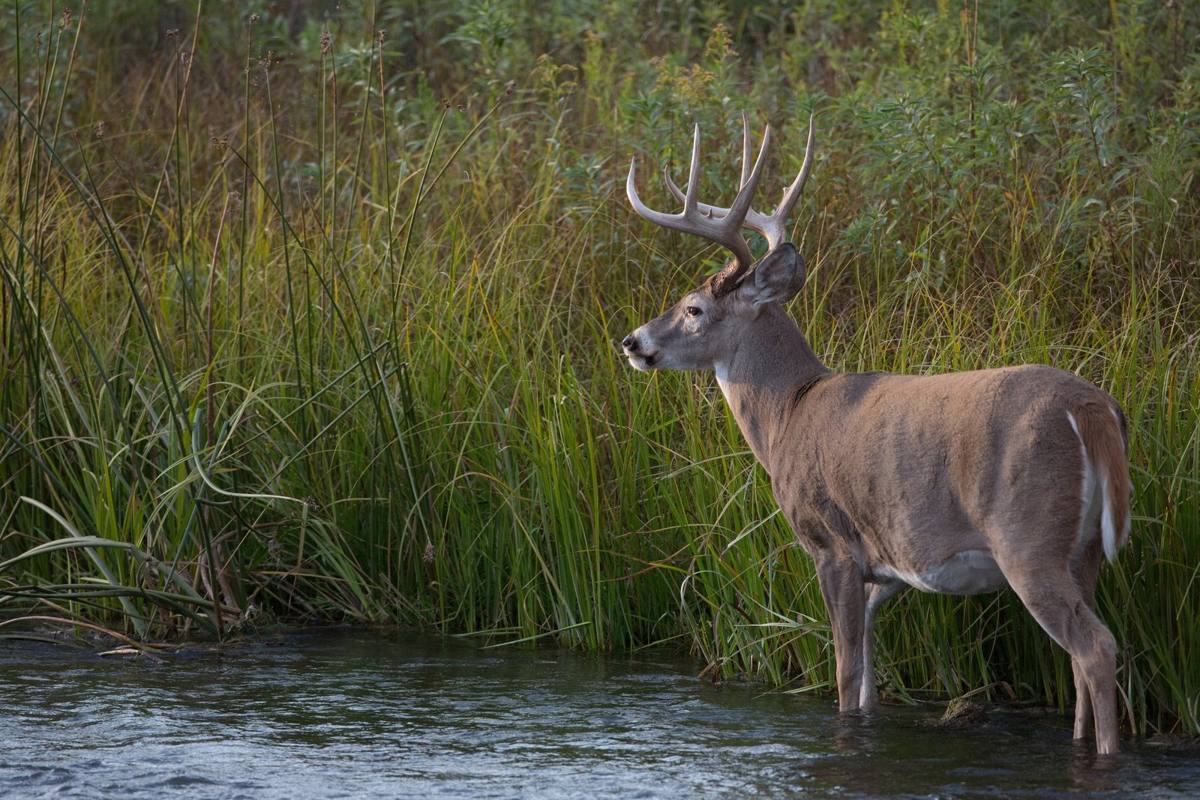
Antler calendars are testosterone calendars for mature bucks. Pennsylvania Game Commission explains that antler mineralization and velvet drying take about a month from mid-July through mid-August, after which velvet is rubbed off (Pennsylvania Game Commission). After the breeding season, testosterone levels drop and antlers shed in late winter or early spring before growth restarts (Pennsylvania Game Commission). That rise-harden-rut-fall-cast sequence is the field expression of the seasonal androgen curve (Pennsylvania Game Commission). Summer velvet growth occupies the lower-androgen window; the late-summer rise hardens bone; the post-rut fall opens casting (Pennsylvania Game Commission). Maryland’s two-coat year rides the same seasonal light clock that schedules these hormone shifts (Maryland DNR; Pennsylvania Game Commission).
Key Takeaways
- Hardening/velvet-dry ~mid-July to mid-August (Pennsylvania Game Commission).
- Velvet rub follows that month (Pennsylvania Game Commission).
- Post-rut testosterone drop precedes cast (Pennsylvania Game Commission).
- Casting late winter or early spring (Pennsylvania Game Commission).
- Low-androgen window allows new velvet (Pennsylvania Game Commission).
- Photoperiod links coats and antlers (Maryland DNR; Pennsylvania Game Commission).
Late-summer hardening pulse
Pennsylvania Game Commission places antler mineralization and velvet drying on about a one-month schedule that starts in mid-July and ends in mid-August, after which the velvet dries and is rubbed off (Pennsylvania Game Commission). That window is the practical field marker for the late-summer androgen rise that turns soft velvet antler into hard bone ahead of breeding (Pennsylvania Game Commission). Bucks photographed in heavy velvet after that calendar are either injured, abnormal, or living under disrupted seasonal cues (Pennsylvania Game Commission). Hard antlers then carry bucks through the breeding season as dead mineral weapons no longer nourished by velvet arteries (Pennsylvania Game Commission). Hunters timing early hunts against velvet rub are therefore timing against that hormone-driven hardening month (Pennsylvania Game Commission).
Post-rut casting valley
Pennsylvania states that after the breeding season testosterone levels drop off and antlers are shed in late winter or early spring before the whole process starts again (Pennsylvania Game Commission). Casting is therefore a hormone-valley event, not a random winter accident (Pennsylvania Game Commission). Once antlers drop, the pedicle surface prepares for a new velvet growth phase while androgen titers remain comparatively low (Pennsylvania Game Commission). Spread in cast dates among neighbors still sits inside that post-rut decline rather than inventing a separate calendar (Pennsylvania Game Commission). Clubs that log cast weeks are logging the androgen fall as much as weather (Pennsylvania Game Commission).
Photoperiod upstream of androgens
The same Pennsylvania FAQ set that tracks antlers also explains fawn coat molt with daylight as the bigger trigger than weaning alone, and Maryland DNR describes the two-coat winter-versus-summer system that rides the annual light cycle (Pennsylvania Game Commission; Maryland DNR). Antler androgen timing is another downstream product of that photoperiod machinery (Pennsylvania Game Commission). Fixed indoor lighting in captive bucks can desynchronize velvet and cast dates from free-ranging neighbors on natural day length (Pennsylvania Game Commission). Wild bucks keep the mid-summer harden / late-winter cast pattern Pennsylvania outlines (Pennsylvania Game Commission; Maryland DNR).
How to read photos and cast logs
Velvet-on versus hard-antler photos are better used to date the androgen rise than to guess exact nanogram blood values (Pennsylvania Game Commission). Cast dates similarly mark the fall without diagnosing disease by themselves (Pennsylvania Game Commission). Pair antler phenology with coat stage - Maryland’s underfur winter coat versus Pennsylvania’s underfur-free summer coat - for a fuller seasonal read on trail cameras (Maryland DNR; Pennsylvania Game Commission). Nutrition still decides how large a frame can grow, but testosterone timing decides when that frame hardens and when it drops (Pennsylvania Game Commission). You cannot feed a buck into keeping velvet through a normal late-summer hardening month (Pennsylvania Game Commission).
What feeding cannot rewrite
Diet and body condition set antler potential size, but they do not rewrite the Pennsylvania hardening month once androgen titers rise (Pennsylvania Game Commission). Likewise, a fat buck still casts when testosterone falls after the rut (Pennsylvania Game Commission). Treat feeders as growth tools inside the hormone calendar, not as overrides of it (Pennsylvania Game Commission; Maryland DNR).
Bottom line
Mature bucks follow a seasonal testosterone curve: low during velvet growth, rising through the mid-July to mid-August hardening window before the rut, then falling so antlers cast in late winter or early spring (Pennsylvania Game Commission).
The other side of it
Strip away the framing and there isn’t a single testosterone measurement in this piece. The curve is read backward from velvet and casting dates in a Pennsylvania FAQ, and nothing in the sources separates mature bucks from younger ones. Calendar timing is useful for reading trail-cam photos, but calling it a hormone curve is an inference, not a reading. Still beats the guy who swears his feeder will keep a buck in velvet for the early opener.
Keep reading
Latest deer news
Comments