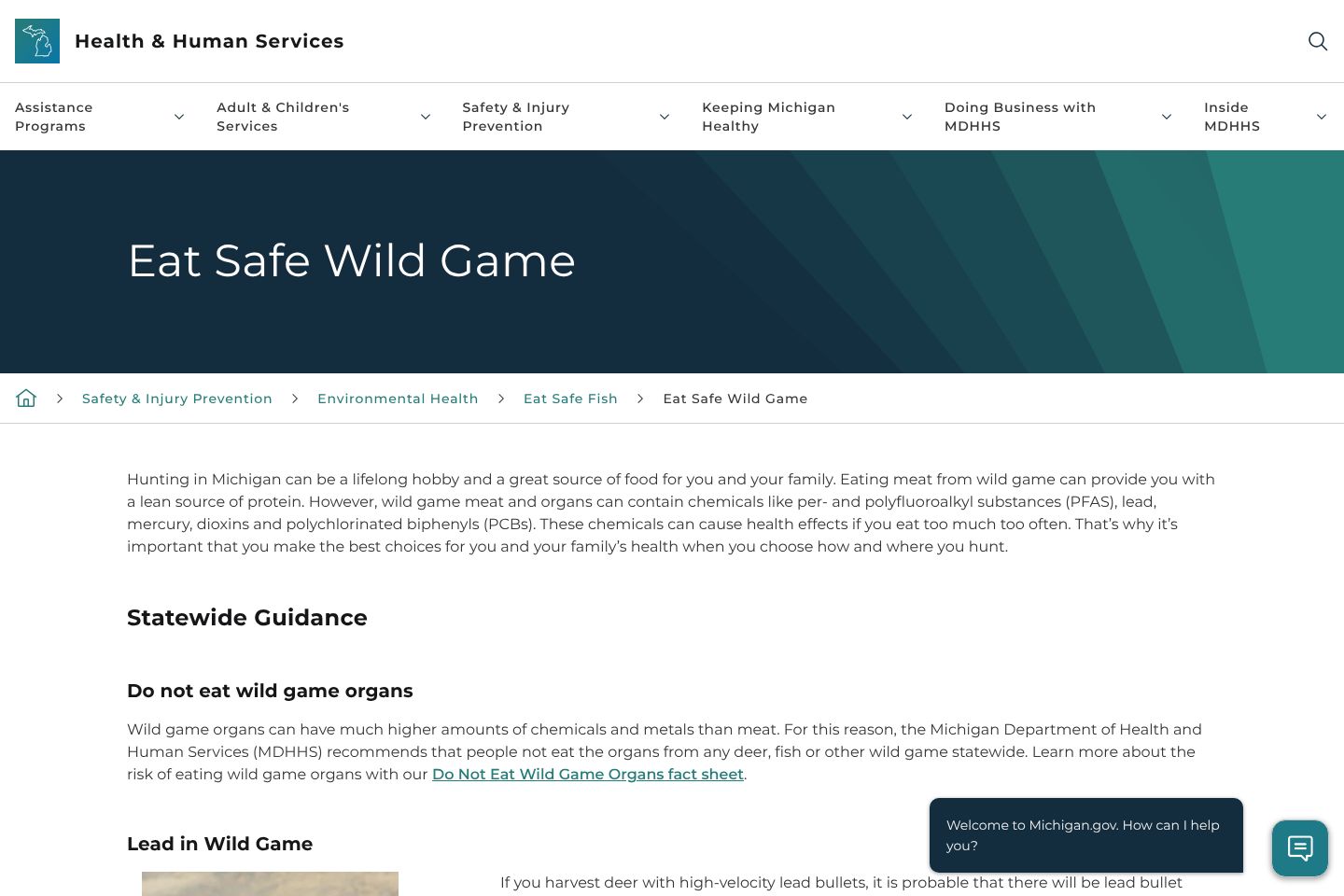
PFAS (per- and polyfluoroalkyl substances) advisories for wild deer are site-specific, not a nationwide “venison is unsafe” message. Michigan and Wisconsin health and wildlife agencies publish do-not-eat or meal-limit rules around known contamination plumes while statewide sampling often finds little or no PFOS in muscle away from those sites (MDHHS Eat Safe Wild Game; Wisconsin DNR PFAS Advisories). Hunters also face separate lead-fragment and organ-avoidance guidance that applies more broadly than PFAS maps (MDHHS Eat Safe Wild Game; Wisconsin Safely Eating Venison).
Key Takeaways
- Michigan: Do Not Eat deer taken within three miles of Clark’s Marsh (Oscoda Township, Iosco County) because muscle and liver showed elevated PFAS including PFOS; statewide, do not eat wild-game organs (MDHHS Clark’s Marsh notice; MDHHS Eat Safe Wild Game).
- Wisconsin: Marinette-area Do Not Eat for deer liver; within five miles of Stella town hall (Oneida County), one meal per month of muscle and Do Not Eat liver (Wisconsin DNR PFAS Advisories; Wisconsin Safely Eating Venison).
- Statewide Wisconsin deer-liver sampling in 2020 (32 counties) found almost no PFAS and no PFOS detections, so no statewide liver advisory (Wisconsin DNR PFAS Advisories).
- Michigan sampling near Alpena, Rockford, Grayling, and Proud Lake found no or very low muscle PFAS outside Clark’s Marsh (MDHHS Eat Safe Wild Game).
- Lead fragments from high-velocity bullets and dioxin/PCB floodplain rules are separate maps hunters must stack on top of PFAS polygons (MDHHS Eat Safe Wild Game; Wisconsin Safely Eating Venison).
What PFAS are doing in deer tissue
PFAS are persistent industrial chemicals. Agencies focus consumption advice on PFOS because that compound drives many Great Lakes fish and wildlife meal limits (Wisconsin DNR PFAS Advisories). Livers concentrate chemicals filtered from blood, which is why Michigan recommends never eating organs from deer or other wild game statewide and why Wisconsin’s Marinette and Stella rules hit liver hardest (MDHHS Eat Safe Wild Game; Wisconsin DNR PFAS Advisories). Muscle advisories appear only where sampling shows elevated tissue near known sources such as fire-training foams or industrial sites (MDHHS Clark’s Marsh notice; Wisconsin Safely Eating Venison).
Michigan: Clark’s Marsh and statewide organ rule
MDHHS and DNR remind hunters each season that the Clark’s Marsh Do Not Eat deer advisory remains in force inside a three-mile radius after earlier five-mile wording was tightened with 2021 sampling (MDHHS Clark’s Marsh notice). Separate Do Not Eat rules cover fish and resident aquatic or semi-aquatic wildlife from the marsh itself (MDHHS Clark’s Marsh notice). Outside that polygon, 2018 MPART sampling of twenty deer from Alpena, Rockford, and Grayling found no or very low muscle PFAS, and 2019 Proud Lake (Oakland County) sampling found no PFAS in muscle or heart (MDHHS Eat Safe Wild Game). The statewide organ ban still stands because organs accumulate multiple chemicals, not only PFAS (MDHHS Eat Safe Wild Game).
Wisconsin: Marinette liver and Stella meal limits
Wisconsin DNR and DHS issued a Do Not Eat advisory for white-tailed deer liver in the Marinette area after sampling near the JCI/Tyco Fire Technology Center; muscle and heart there did not warrant a PFAS meal limit (Wisconsin DNR PFAS Advisories; Wisconsin Safely Eating Venison). In September 2025 they added a five-mile Stella (Oneida County) advisory: at most one meal per month of muscle and Do Not Eat liver after elevated muscle and liver results from hunter-donated samples (Wisconsin DNR PFAS Advisories; Wisconsin Safely Eating Venison). The 2020 statewide liver survey across 32 counties detected PFAS in only one sample and PFOS in none, so background deer liver is not under a statewide PFAS ban (Wisconsin DNR PFAS Advisories).
Other contaminant layers hunters forget
MDHHS still warns that high-velocity lead bullets leave invisible fragments that concentrate further when meat is ground (MDHHS Eat Safe Wild Game). Wisconsin likewise flags wound-channel trimming and ground-meat risk from lead (Wisconsin Safely Eating Venison). Bay, Midland, and Saginaw County floodplain dioxin/PCB guidance for wild game is a third map layer in Michigan (MDHHS Eat Safe Wild Game). CWD testing advice is yet another decision tree that does not cancel chemical advisories (Wisconsin deer health advisories).
Practical checklist before you fill the freezer
Plot harvest GPS against published advisory radii before packaging meat for family or donation. Skip organs everywhere Michigan says so, and skip listed livers in Wisconsin advisory zones (MDHHS Eat Safe Wild Game; Wisconsin DNR PFAS Advisories). Prefer non-lead ammo if children or pregnant people will eat the meat (MDHHS Eat Safe Wild Game). Re-check agency pages each season; Stella’s 2025 muscle limit shows polygons change when new samples land (Wisconsin Safely Eating Venison).
Bottom line
PFAS venison risk is mapped, not mystical: respect Clark’s Marsh, Marinette liver, and Stella meal limits, keep organs out of the skillet under Michigan’s statewide rule, and stack lead and floodplain guidance on the same cutting board (MDHHS Clark’s Marsh notice; Wisconsin DNR PFAS Advisories).
Related: CWD carcass disposal and Michigan deer disease overview.
Why agencies shrink or grow circles
Clark’s Marsh shows how advice tracks data: Michigan narrowed a five-mile deer advisory to three miles after 2021 sampling refined where muscle PFAS clustered (MDHHS Clark’s Marsh notice). Stella moved the other direction when community interest drove 2024 hunter sample collection and 2025 meal limits for muscle inside five miles of the town hall (Wisconsin Safely Eating Venison). Marinette’s liver-only rule reflects tissue differences at the same industrial neighborhood: muscle and heart cleared while liver did not (Wisconsin Safely Eating Venison). Treat every PDF map as provisional until you refresh it the week you hunt.
The other side of it
A clean result outside the mapped circles is reassuring, but the samples behind it are thin. Michigan’s 2018 work outside Clark’s Marsh drew on twenty deer from three areas, and Stella only got its meal limit after community interest drove hunter sample collection. A place without an advisory may simply be a place nobody has sampled, which is an argument for watching the agency pages, not for treating every unmapped county as tested.
Keep reading
Latest deer news
Comments