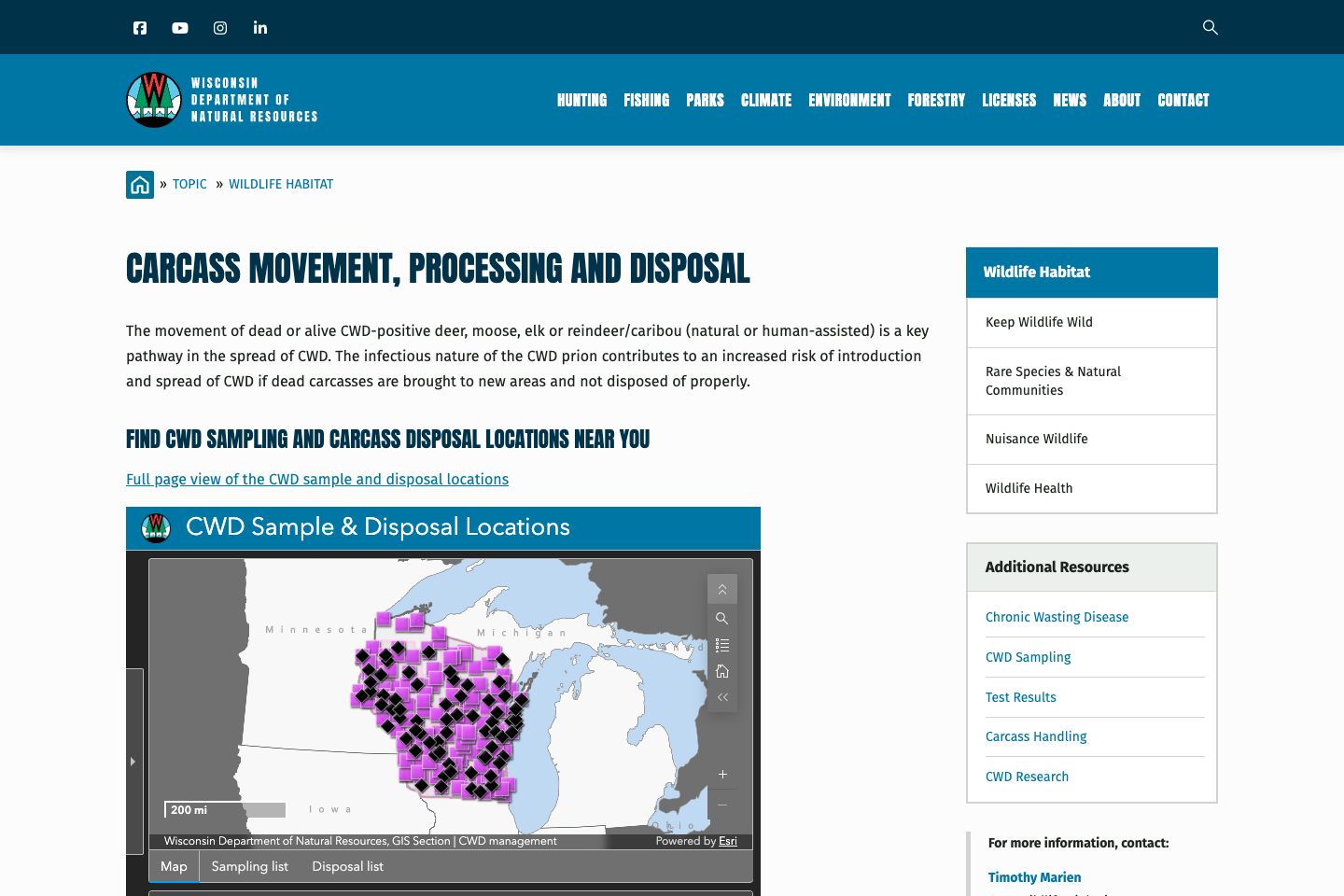
For CWD carcass disposal, trash that ends up in a landfill is the first choice. Wisconsin DNR says carcass waste should go to a landfill when possible, because landfills create an engineered barrier between infectious material and free-ranging deer (WI DNR carcass). Iowa’s hunter guide and the Missouri Department of Conservation give the same order: landfill or trash service first, then burial or leaving the remains where the deer was killed (Iowa CWD hunter guide; MDC carcass disposal).
Key Takeaways
- Use a landfill, transfer station or approved curbside trash first (WI DNR; MDC).
- If you can’t, bury deep with landowner permission or leave the remains at the harvest site (WI DNR; Iowa).
- Don’t dump carcass waste on public land, roads, or private land without permission (WI DNR).
- In a CWD zone, NDA says to dispose of the carcass inside the zone and travel out with only boned-out meat, clean skull plates, clean hides, or clean jawbones and teeth (NDA CWD).
Why does it matter where a CWD carcass goes?
Because prions linger in carcass parts and don’t behave like ordinary bacteria. Texas A&M AgriLife Extension says the main goal is to stop prions from moving to new places and to put a lasting barrier between infectious tissue and susceptible deer (Texas A&M AgriLife disposal). Wisconsin DNR treats movement of dead CWD-positive deer as a key pathway (WI DNR carcass).
Scavengers may not get infected the way deer do, but they can drag parts across the landscape and expose new ground (Iowa CWD hunter guide). That’s why a bag in an approved dumpster headed for a sanitary landfill beats tossing a ribcage over a fence in the next county.
Can you put a deer carcass in the trash?
Often, yes, but check first. Wisconsin lists its preferred options in this order: landfill, transfer station, municipal curbside pickup if the local hauler allows deer waste, or dedicated deer carcass dumpsters during the season (WI DNR carcass). Not every landfill takes carcasses, so check the agency map or call before you haul a truckload of bones across town. Where your town allows deer waste in household cans, double-bag it to cut down on leaks.
Missouri requires hunters to put unused parts in trash that ends up in a sanitary landfill, or to leave them on the harvest property. Processors and taxidermists there have to use landfill or transfer-station disposal and keep proof on file (MDC carcass disposal).
How deep should you bury a deer carcass?
Deep enough that scavengers can’t dig it up, and only on land you own or have permission to use (WI DNR; Texas A&M AgriLife). AgriLife notes many recommend about six feet of cover, or shallower pits finished with fill that still blocks scavengers (Texas A&M AgriLife).
Can you leave the carcass where you killed the deer?
In Iowa and Missouri, yes. Both allow leaving remains at the harvest site when a landfill isn’t practical. That matters most if you hunted a CWD county and would otherwise haul the waste into a clean one (Iowa; MDC).
Wisconsin still allows the usual field-dressing gut pile left on public or private land. It separately makes it illegal to dump processing waste on public land, roadways, or private property without permission (WI DNR).
Which carcass parts should never leave the area?
NDA flags brain, eyes, backbone and spleen as high-risk parts and likely spread pathways, along with live-deer movement (NDA CWD). Bag those scraps for the landfill rather than composting them in a garden where deer browse.
Wisconsin recommends against hauling whole carcasses outside the harvest county or an adjacent county. It restricts whole-carcass imports from listed CWD jurisdictions unless they go to a licensed processor or permitted taxidermist within 72 hours (WI DNR). So plan the processing near the hunt: bone out the meat, clean the skull plate, and dispose of the rest under local rules before you cross state lines. Telecheck or report before interstate travel when your state requires it (MDC).
What if your deer tests positive for CWD?
Disposal and testing go together. CDC advises hunters in CWD areas to strongly consider testing and not to eat meat from a CWD-positive animal, and NDA backs that guidance (CDC; NDA). Taking a positive deer out of the herd still helps, and NDA encourages hunters to collect replacement tags and keep testing (NDA). Trash rules don’t replace your state agency’s sampling drop-off instructions.
Related: CWD test methods for hunters and EHD vs CWD in deer.
The other side of it
The hierarchy quietly makes peace with the thing it warns about. Wisconsin still allows gut piles left in the field, and Iowa and Missouri let hunters leave remains at the kill site, so for a lot of deer the riskiest leftovers never see a landfill at all. Burial isn’t much easier when AgriLife’s guidance talks about six feet of cover. Then again, the hunter who promises to “bury it deep” usually means a shallow scrape and a hope that the coyotes are busy elsewhere.
Keep reading
Latest deer news
Comments