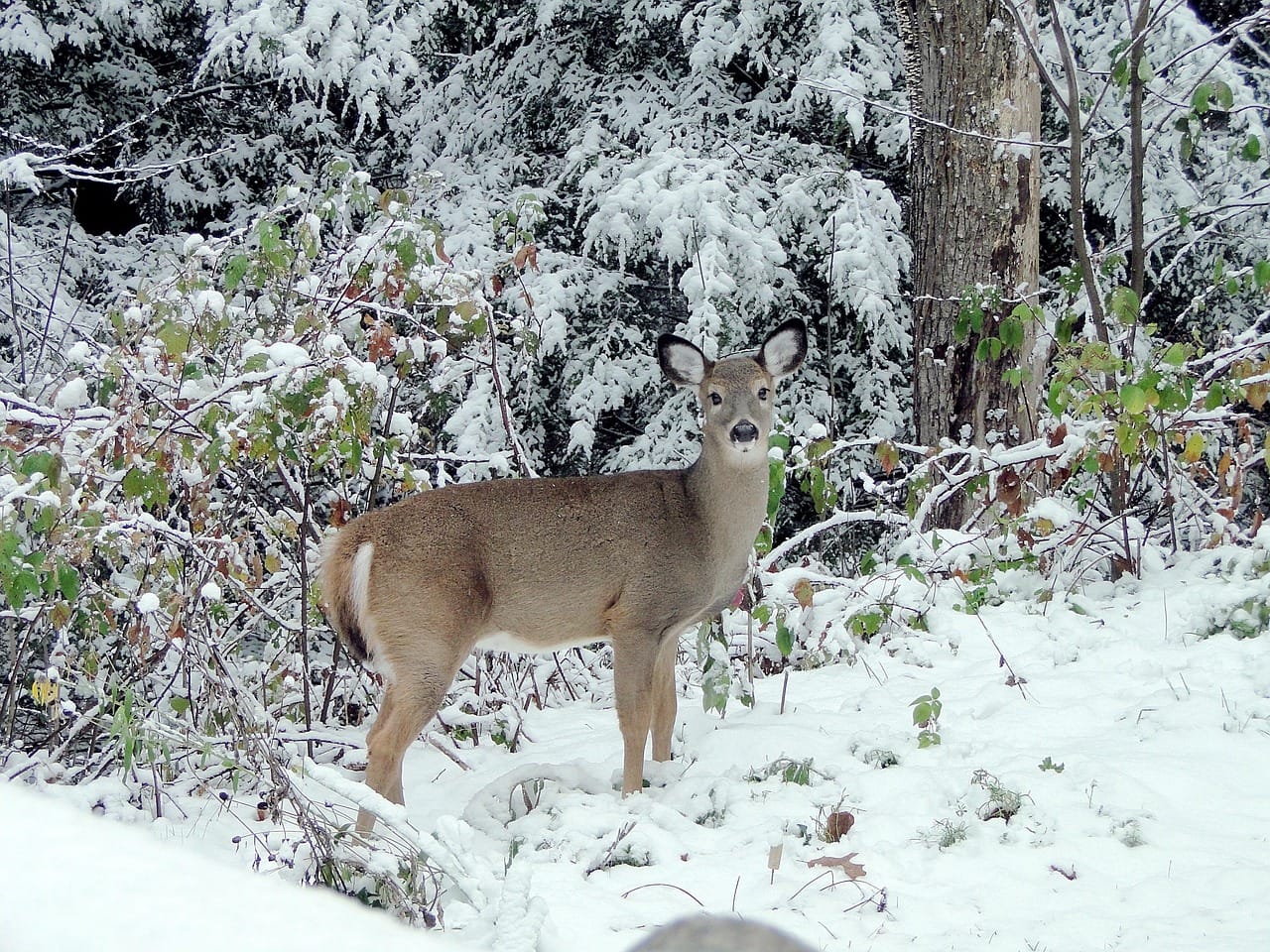
When it snows deep enough, deer go to dense conifer cover, where the trees catch snow and walking costs less. In New Hampshire, deer move into wintering areas once snow passes 10 to 12 inches and crowd into the core softwood shelter once it passes 16 to 20 inches, according to UNH Cooperative Extension. Minnesota’s DNR calls this “yarding up” (Minnesota DNR).
Key Takeaways
- Deep snow costs deer more than cold does, because moving through it burns energy reserves (Minnesota DNR).
- Deer look for dense conifers. Minnesota’s DNR considers canopy closure of 70% or more, close to food, optimum (Minnesota DNR).
- Fawns are the most vulnerable deer in a hard winter, followed by breeding bucks and then adult does (Minnesota DNR).
- In mild winters, deer may not use a wintering area at all (UNH Extension).
What is a deer yard?
A deer wintering area, or deer yard, is the whole area deer occupy in winter. UNH Extension describes two parts:
- Core shelter: dense, mature softwood that holds less snow and makes moving easier.
- Food nearby: hardwood or mixed stands, fields or wetlands within or next to the core.
In New Hampshire, most wintering areas are below 2,000 feet in lowland softwoods: spruce-fir and northern white cedar in the north and eastern hemlock in the south. They often follow streams and riparian areas, because those forest types grow there. Only about 3% of the state’s land meets the habitat requirements (UNH Extension).
Why do deer move to conifers when it snows?
Conifers catch snow in their crowns, so less reaches the ground and deer can keep moving. The Minnesota DNR says deep snow affects deer survival far more than cold, since deer spend more of their energy reserves pushing through it. Yarding up saves energy, but packing deer into small areas also raises competition for scarce food.
Deer are also built for winter. Their hollow winter hair holds body heat, and they move less and slow their metabolism, so they need less food (Minnesota DNR).
How deep does snow have to be before deer yard up?
| Snow depth | What deer do | Source |
|---|---|---|
| Over 10-12 in. | Move into wintering areas | UNH Extension |
| Over 15 in. | Conditions get progressively harder; Minnesota adds a severity point each day | Minnesota DNR |
| Over 16-20 in. | Deer mainly use the core softwood shelter | UNH Extension |
How much deer use a wintering area changes from winter to winter, mainly with snow depth. Some wintering areas aren’t used every year but are still critical in severe winters (UNH Extension).
How does Minnesota measure a hard winter for deer?
The DNR’s winter severity index runs from Nov. 1 to May 31. A day at or below 0 degrees F scores one point, and a day with 15 inches or more of snow on the ground scores another. A total of 50 or less is a mild winter, 51 to 119 is moderate and 120 or more is severe (Minnesota DNR). The DNR warns that the index doesn’t predict deer losses on its own, because 3 feet of snow scores the same as 15 inches.
Which deer die in hard winters?
According to the Minnesota DNR, fawns are most vulnerable, then breeding bucks, then adult does. Fawns have less fat, and bucks spent the fall breeding instead of feeding. Wolves also take more deer in winter, especially when a crust holds wolves up but lets deer break through.
Herds rebound, though. Pregnancy rates average 90% for yearlings and are near 100% for does from 2.5 to at least 15 years old, more than half of them carrying twins. Deer can recover quickly if normal conditions return for 3 to 4 years (Minnesota DNR).
Where should you hunt deer after a big snow?
The research describes deer behavior, not hunting tactics, but the pattern carries over. After a big snow in the north woods, look for deer in the thickest softwood near food, often along creek bottoms, rather than on open ridges. In a mild winter, deer may stay spread out (UNH Extension). For a winter food source, see do deer eat winter rye.
The other side of it
The snow-depth triggers come from New Hampshire and Minnesota, and UNH itself says deer may skip a wintering area entirely in a mild winter, so a hunter south of the north woods may never see a true yard. Minnesota’s own index scores 15 inches the same as 3 feet, which tells you how rough any single number is. The guy who won’t leave the truck in January already found his deer yard, and it’s wherever the heater vents point.
Keep reading
Latest deer news
Comments